
XpertVision GeForce 7600GT Sonic (GeForce 7600 GT)
Targeted at enthusiasts, XpertVision's latest GeForce 7600 GT is geared for the overclocking experience, from its faster memory chips to extra heatsinks. Its red PCB is also different from that on the vanilla GeForce 7600 GT cards in the market now. Read on to find out how much of a boost the Sonic is capable of.

Introduction
Having seen a couple of NVIDIA's latest mid-range GeForce 7600 GT cards perform in our labs, we have had mostly nice things to say about these new cards, especially its attractive pricing and decent frame rates, factors that more than made up for the perceived deficiencies of the architecture. The ones we have reviewed are reference cards so they should serve as an accurate gauge of the card's performance. But in these cases, only the price and the bundle truly separate them from each other. Hence we had been talking about the same boring GeForce 7600 GT appearing from many vendors and in general, lamenting about the lack of unique offerings.
Well, it seems that our wishes have been granted, as a customized, overclocked version of the GeForce 7600 GT has arrived courtesy of XpertVision. Featuring a completely different PCB design, a changed cooler and extra memory heatsinks, the XpertVision GeForce 7600GT Sonic looks ready for some serious overclocking. That's besides its mild overclock out of the box. Before we see what it's capable of, here's a glimpse of the card and its technical specifications:
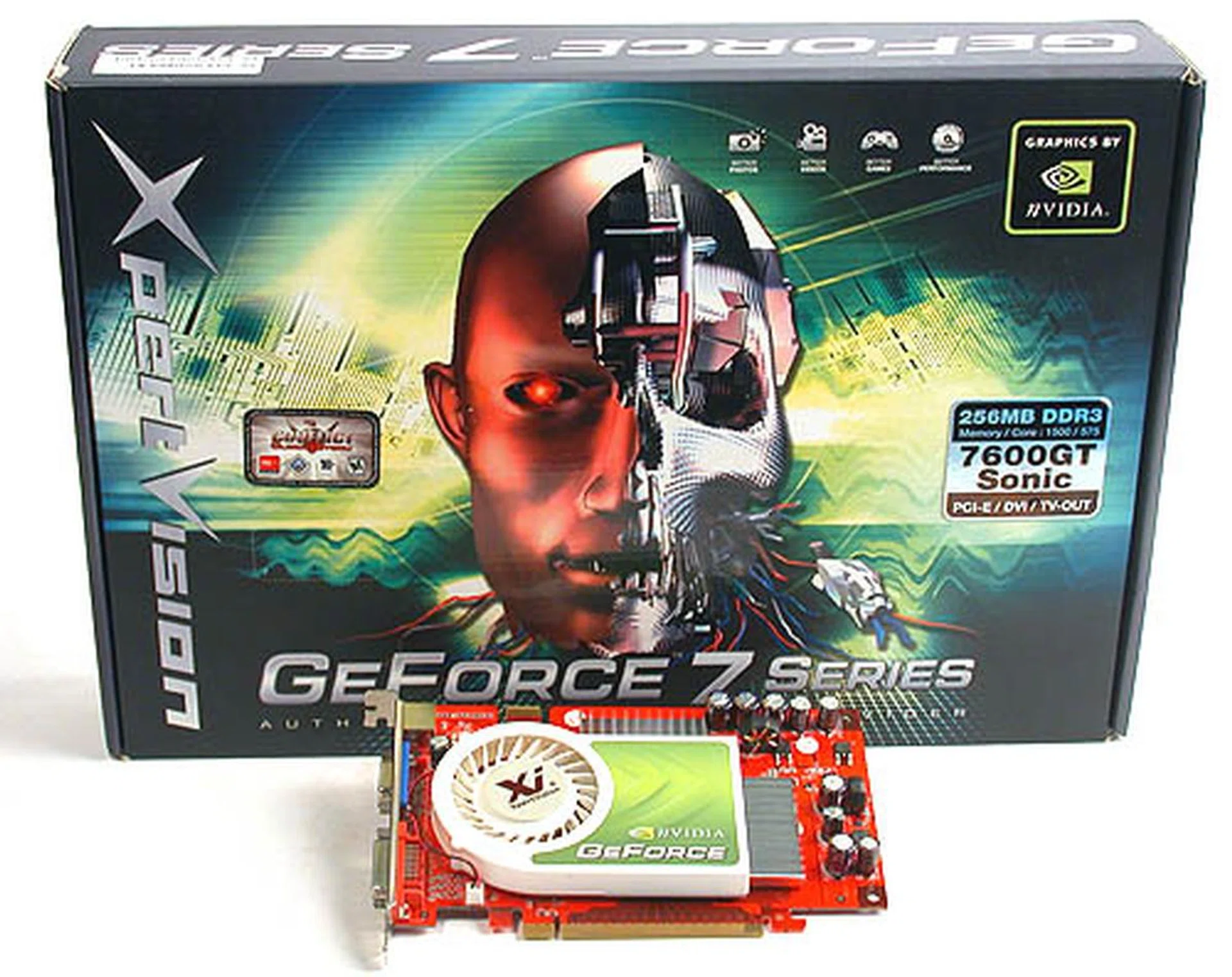
XpertVision's 'vision' of an overclocked GeForce 7600 GT is realized with the GeForce 7600GT Sonic.
Sonic the XpertVision
Instead of the rather boring reference design that we have been seeing from the vendors when it came to their GeForce 7600 GT, XpertVision unsurprisingly chose to take a different approach. We have all seen how the company has time and again opted for its own design, reworking the PCB layout to having faster clock speeds. After all, this is the same company that also made the overclocked Palit graphics cards (GeForce 6800 GS and GeForce 7800 GT) that we had raved about not too long ago.
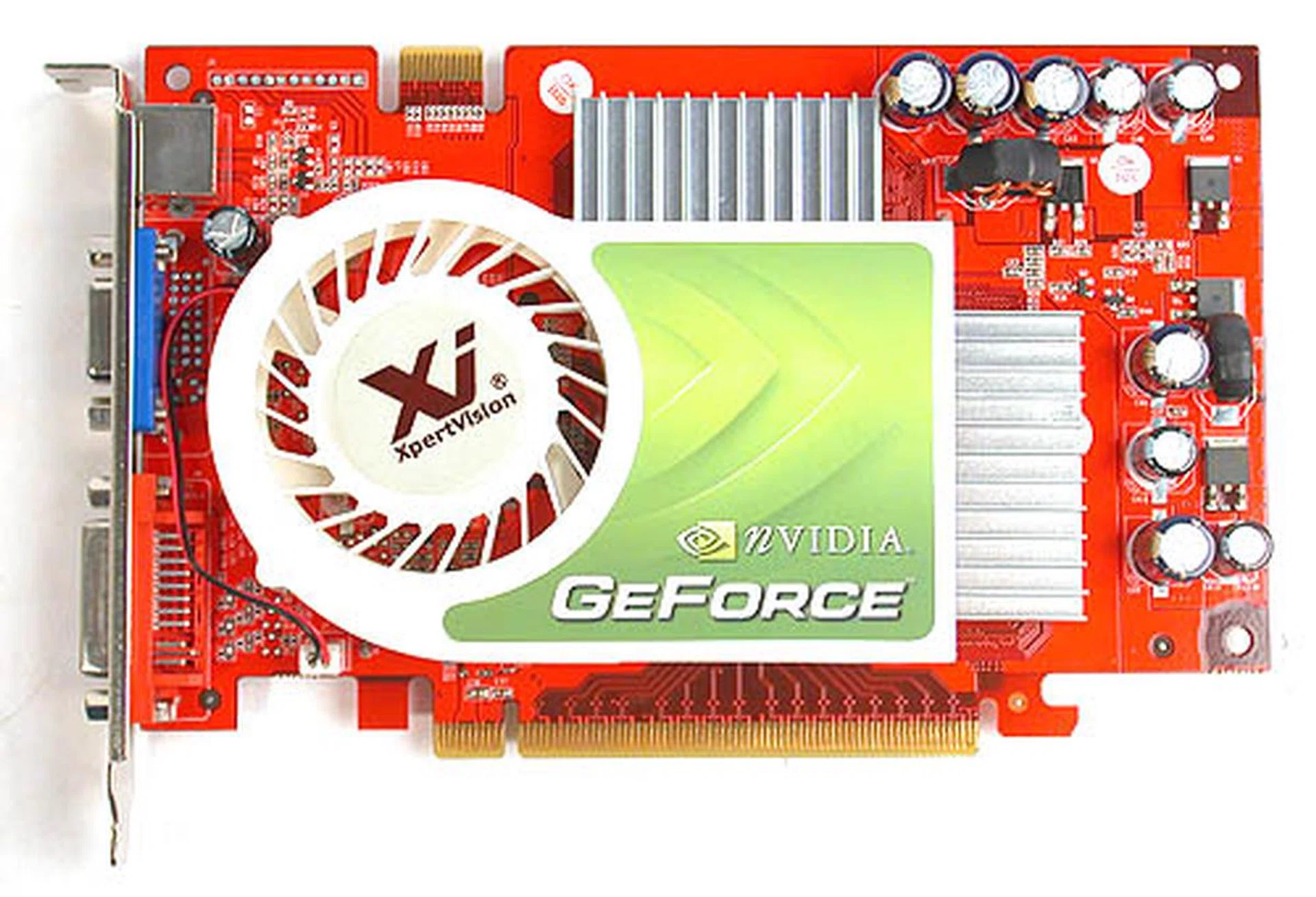
A different PCB board along with a rather plastic looking cooler.
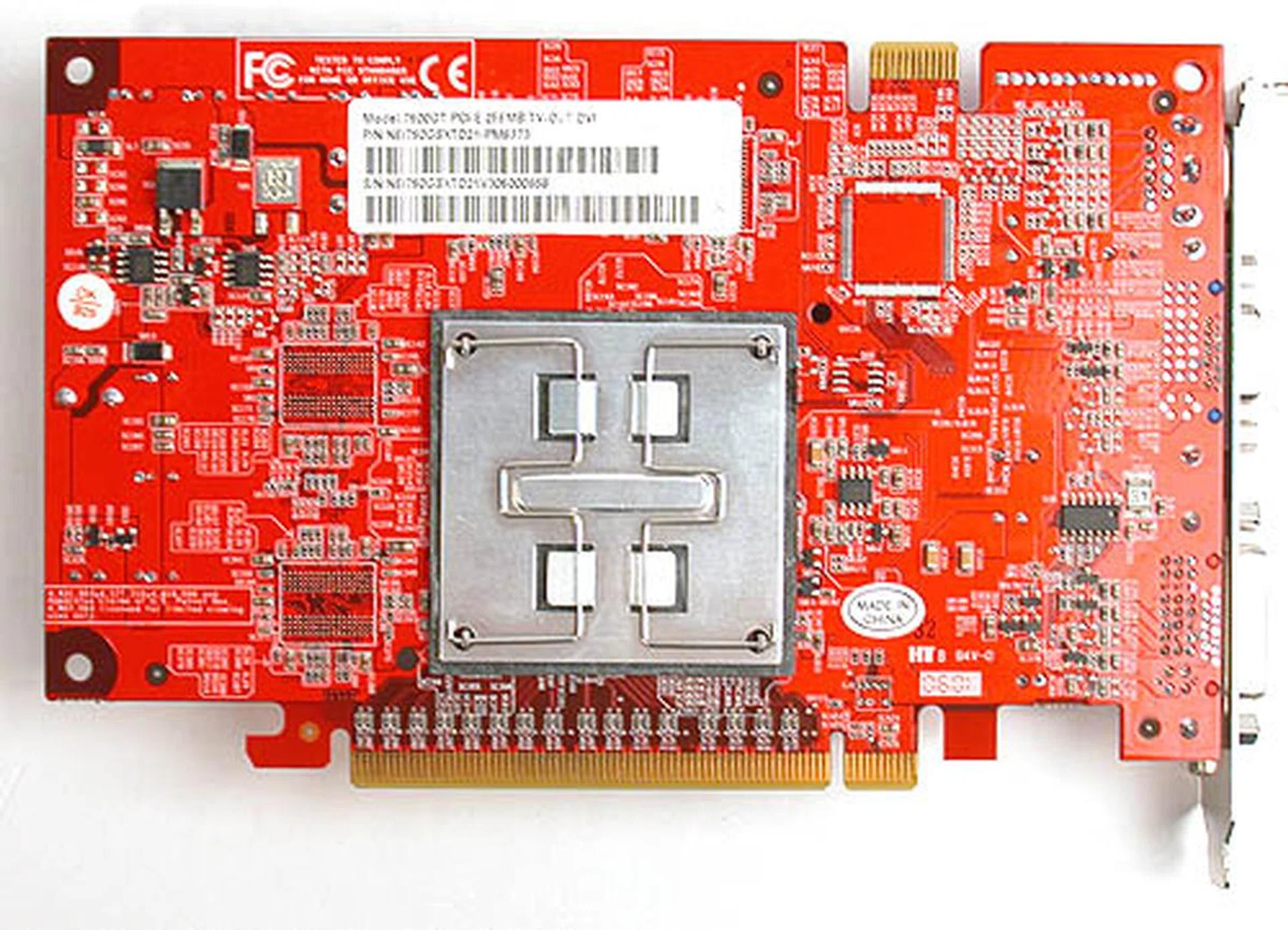
The retention mechanism for the cooler is the only distinct highlight at the back of the card.
For its GeForce 7600GT Sonic, XpertVision has gone for a redesigned red PCB with quite a different layout compared to the reference version. If you are particular about this, you would be glad to know that just like the Palit cards, the GeForce 7600GT Sonic uses Rubycon capacitors from Japan, which has acquired a reputation for its quality among enthusiasts. The cooler is also different from the default one. It may not look that impressive due to its rather unflattering white plastic shroud but in our opinion, there is a discernible improvement over the reference version in the form of a slightly lesser noise output. Also, the overclocked memory chips on the XpertVision has their own heatsink to ensure optimal cooling.
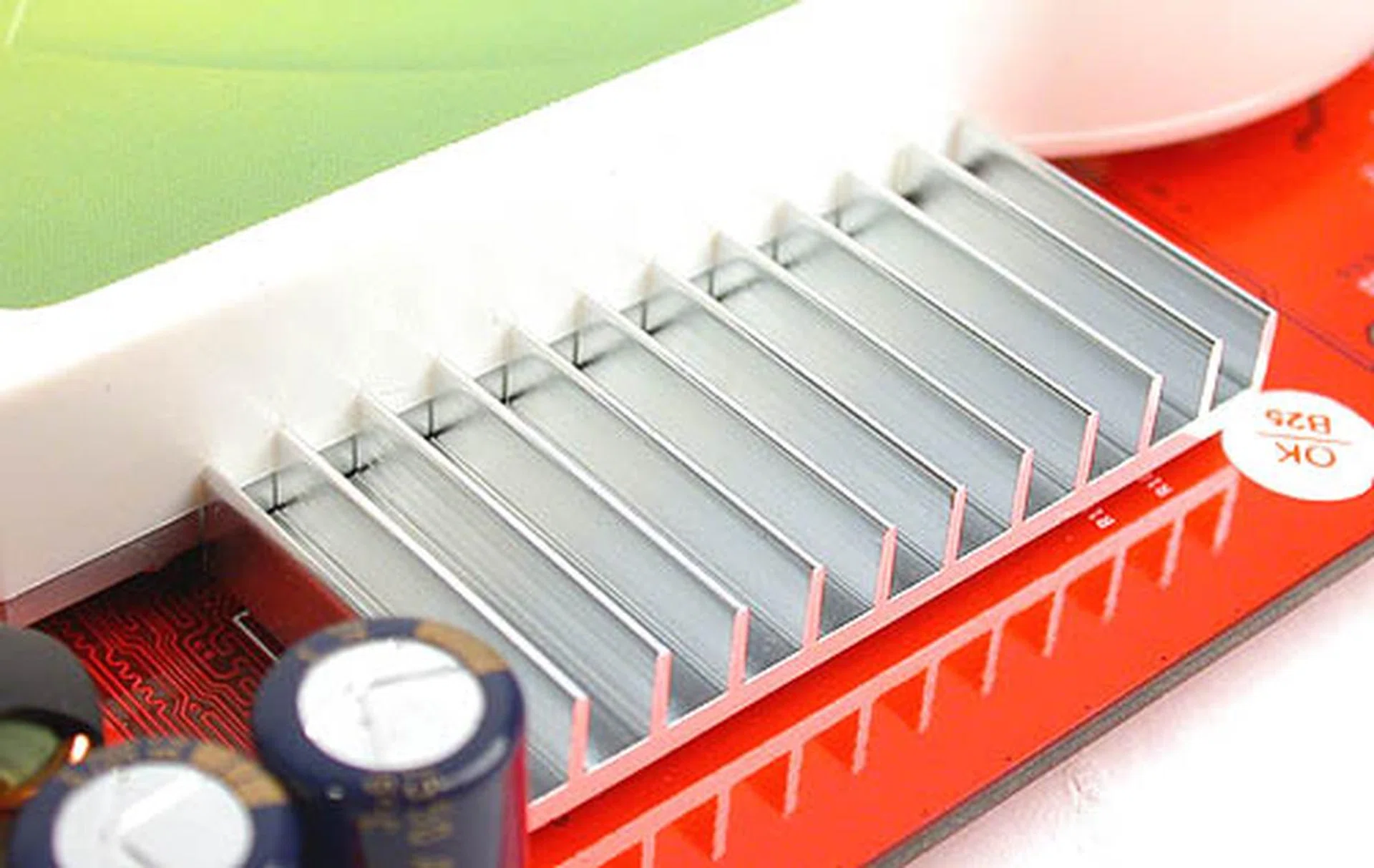
The heatsinks for the 1.2ns rated memory chips are the reason why the XpertVision is capable of its default clock speeds of 1500MHz DDR.
The XpertVision is overclocked to 575MHz for the core, a measly gain of 15MHz over the reference design. The memory chips though undergo a more significant boost to 1500MHz DDR compared to the standard 1400MHz. Physically, XpertVision has also changed the default 1.4ns rated chips to 1.2ns for the GeForce 7600GT Sonic. That should leave a decent margin for those who are inclined to overclock it further.
The other notable difference is that the XpertVision only has one DVI-I output instead of the usual two. One of its single-link DVI output has been replaced with the older VGA analog instead, probably to reduce the cost of the card. While one dual-link DVI output should be enough for most average users that this card is targeted at, it is always disappointing to find less rather than more.
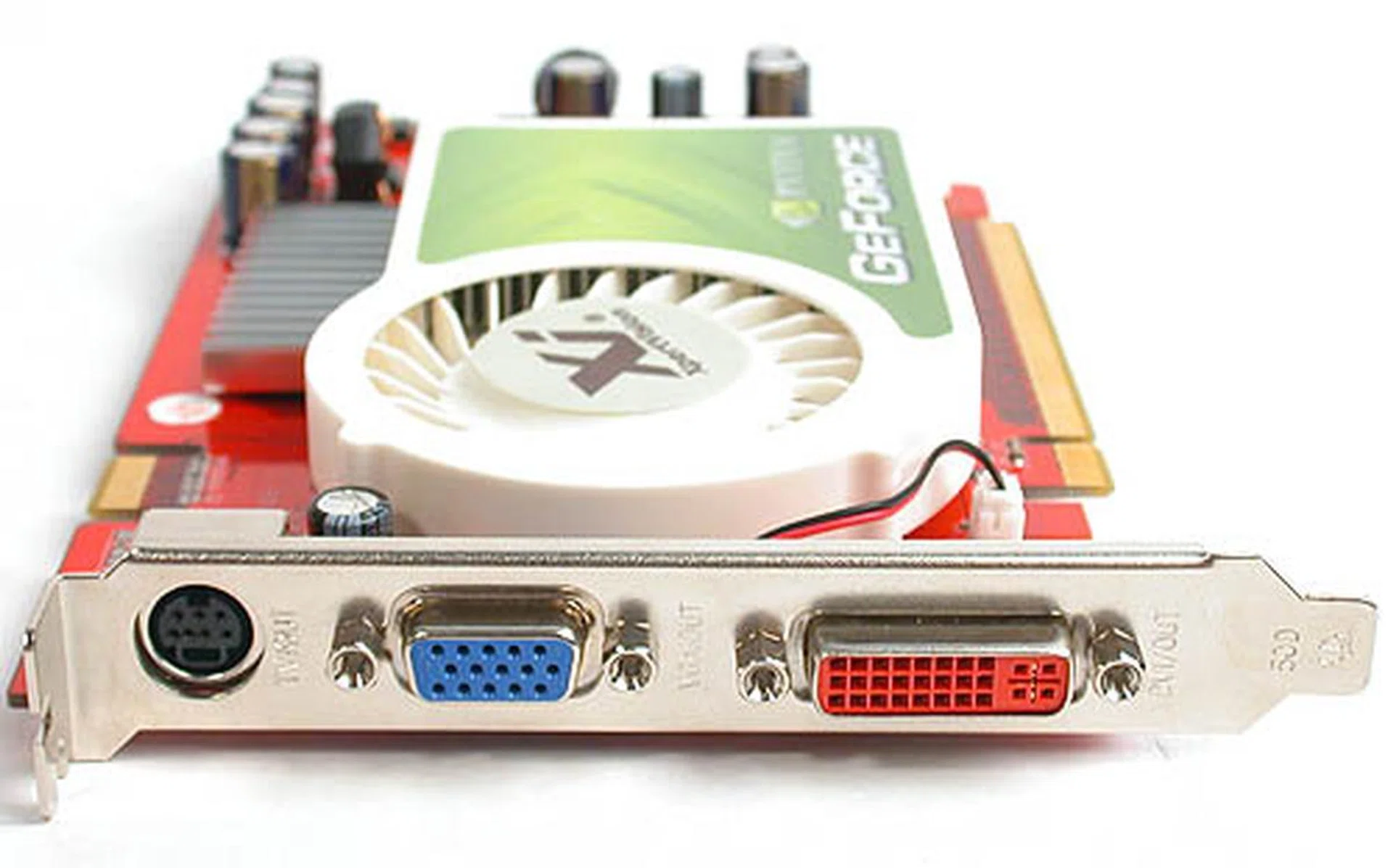
There's just one DVI-I ouput instead of the two found on the reference model. Obviously this helped to reduce cost.
For a mid-range graphics card, the bundle included with the XpertVision GeForce 7600GT Sonic was quite typical. Besides the accessories, which were just adequate rather than generous, we also found a DVD playback application and a game. Sadly, the CyberLink Power DVD application was not the latest version but the relative freshness of the game balanced it somewhat. Too bad that it garnered mostly mediocre reviews from gaming sites. Still, if you don't mind indulging in a game that's out of the norm, the bundled game should occupy you a little while. Surprisingly we didn't find any user manual or guide in our package though adding a video card is a trivial affair. Still, the bundle was adequate and none too shabby. The items that were found are listed below:
- 1 x DVI-to-VGA adaptor
- 9-pin mini-DIN to Component/S-Video dongle
- Driver CD
- CyberLink Power DVD 5.0
- Conflict: Global Storm (full game)
Test Setup
Having tweaked our test system recently, it was time to put it to the test with the XpertVision GeForce 7600GT Sonic. The processor is now an Athlon 64 FX-55 while the motherboard is MSI's K8N Diamond Plus. A total of 1GB of DDR400 low latency RAM from Kingston was added, running in dual channel mode and finally the hard drive used was a Seagage 7200.7 SATA installed with Windows XP Professional with Service Pack 2. This system was also updated to the latest DirectX 9.0c distributable available.
We have done a couple of GeForce 7600 GT reviews in the past so if you are still uncertain of its performance, you can check them out � most specifically where we compared it with many other different cards. Now, we are interested in how much better the XpertVision is compared to the normal clocked GeForce 7600 GT. Hence, we have added the MSI NX7600GT-T2D256E, a reference card to this comparison. The following benchmarks were tested:
- Futuremark 3DMark05 Pro (version 120)
- Futuremark 3DMark06 Pro (version 102)
- Tom Clancy's Splinter Cell 3: Chaos Theory (version 1.3)
- Chronicles of Riddick: Escape from Butcher Bay (version 1.1)
- F.E.A.R
- Quake 4
Results - 3DMark05 Pro (ver .120)
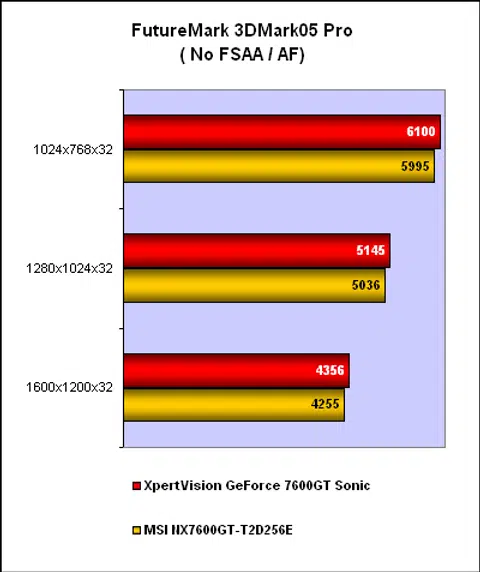
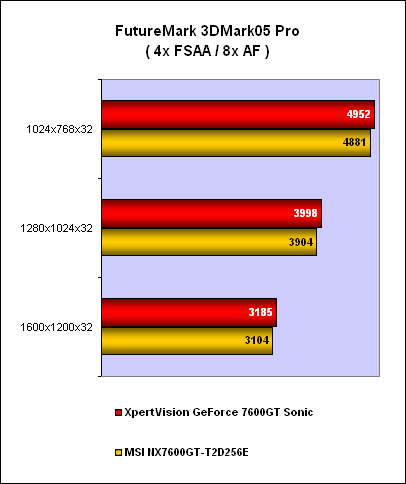
So we come to the first of our benchmarks where we have the popular 3DMark05 application, a synthetic simulator that has become a favored tool used by enthusiasts to compare who has the longer (oops), faster asset. Being overclocked by default, the XpertVision obviously took the lead but according to the results, the margin was about 2%. Of course the default overclocking margin was not a lot so this should have been expected but if you are hoping for spectacular results, we would recommend that you increase the clock speeds yourself.
Results - 3DMark06 Pro (ver .102)
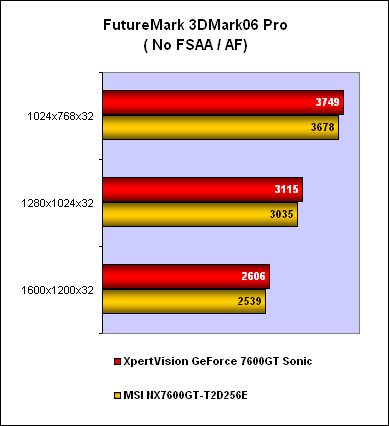
The default minor overclock of the XpertVision GeForce 7600 GT had limited impact in the more demanding 3DMark06, showing a similarly small lead over the MSI and just like any other NVIDIA card, it is not able to enable the anti-aliasing with High Dynamic Range Rendering needed to complete the second half of 3DMark06's battery of tests. Let's move on to actual games that should be a more accurate barometer.
Results - Splinter Cell: Chaos Theory & F.E.A.R (DirectX 9 Benchmarks)
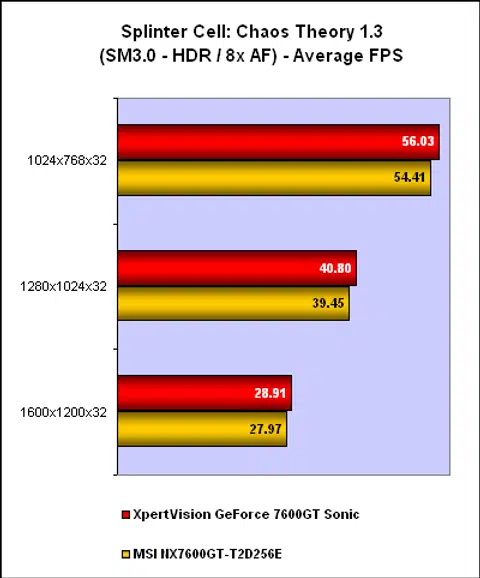
The first game that we had lined up is Splinter Cell: Chaos Theory. With HDR enabled, the difference was honestly quite minor, at most one frame to be generous. This margin was probably the widest at the lower resolutions. Similarly for the next game in our benchmark, the latest shooter from Monolith, F.E.A.R, we saw the XpertVision taking the slightest of leads over the reference MSI card. This minor lead was almost non-existent at higher resolutions

Results - Chronicles of Riddick: Escape from Butcher Bay (OpenGL SM2.0+ Benchmark)
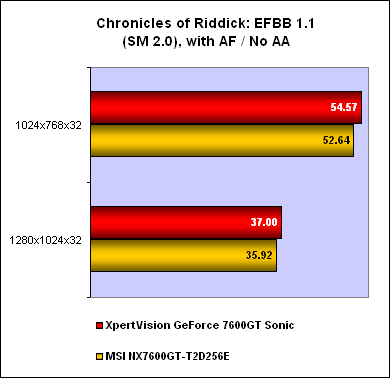
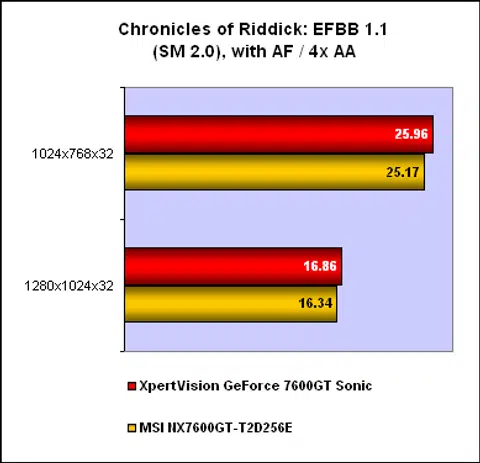
Without anti-aliasing, the gap between the two cards was much wider than it was with anti-aliasing enabled in Chronicles of Riddick. This showed that the effect of higher clock speeds becomes limited once the more intensive settings are enabled. More than anything, this is the limitation of the architecture of the GeForce 7600 GT. As for the XpertVision, it just barely had its nose in front so like the previous benchmarks, the difference may not be easily felt by a gamer.
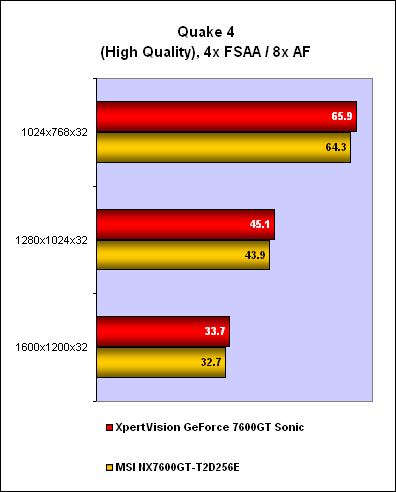
Results - Quake 4 (OpenGL SM2.0+ Benchmark)
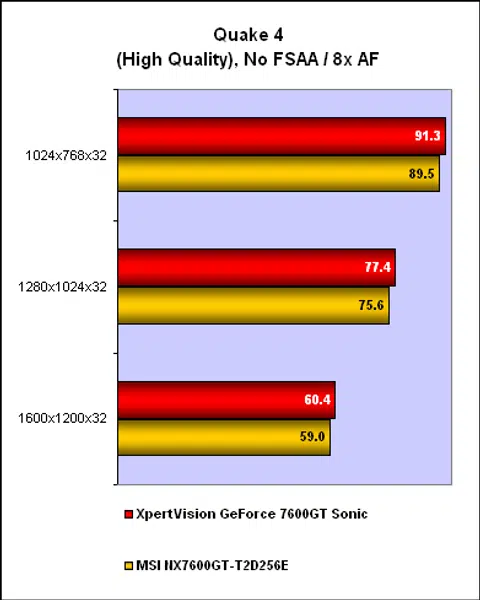
Finally, our last benchmark pretty much confirmed our other results. The XpertVision definitely takes the performance lead thanks to its overclocked core and memory but the margin may not be as much as some would have hoped. A couple of frames or less is as much as can be expected from Quake 4 and this is quite consistent for different resolutions and settings.
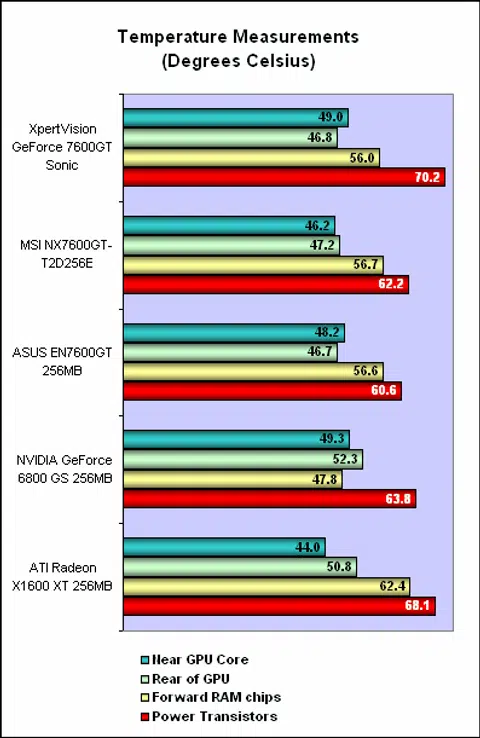
Temperature Testing
Besides the fact that the XpertVision had higher temperatures for its power transistors, it was comparable to the other GeForce 7600 GT cards despite its overclocked frequencies. The cooler is certainly doing a decent job, especially when one considers its lower noise output. Despite its modest overclocked margin, the additional heatsink on the memory chips actually made the XpertVision the coolest among all three cards by a whisker.
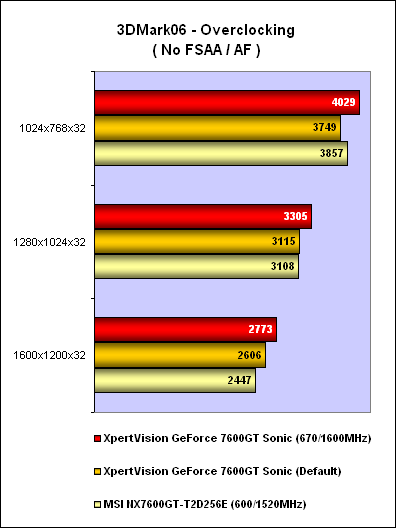
Overclocking
Remarkably, the XpertVision had more reserves when we started to overclock it. While our previous cards like the MSI and ASUS ran out of steam at 600MHz for the core, the XpertVision kept on going, before it finally peaked at 670MHz. That was on paper a rather impressive margin over its competitors but the 3DMark06 results only showed a margin of being 2% to 4% faster than the overclocked MSI. Therefore, try benchmarking some games before you let the big overclock numbers get to your head.
Conclusion
Going its own way as usual seems to have done XpertVision no harm as the company has certainly customized a unique GeForce 7600 GT worthy of NVIDIA's efforts. Not many vendors would have taken the risk of almost revamping the entire card just to satisfy their intended cost and specifications. It would have been easier just to slap on their own, more powerful or less noisy fan, ramp up the clock speed and declare it a premium edition, not forgetting the fancy packaging too. We have seen that happen too often from the manufacturers but the extent of customization on the GeForce 7600GT Sonic is definitely much more radical than these.
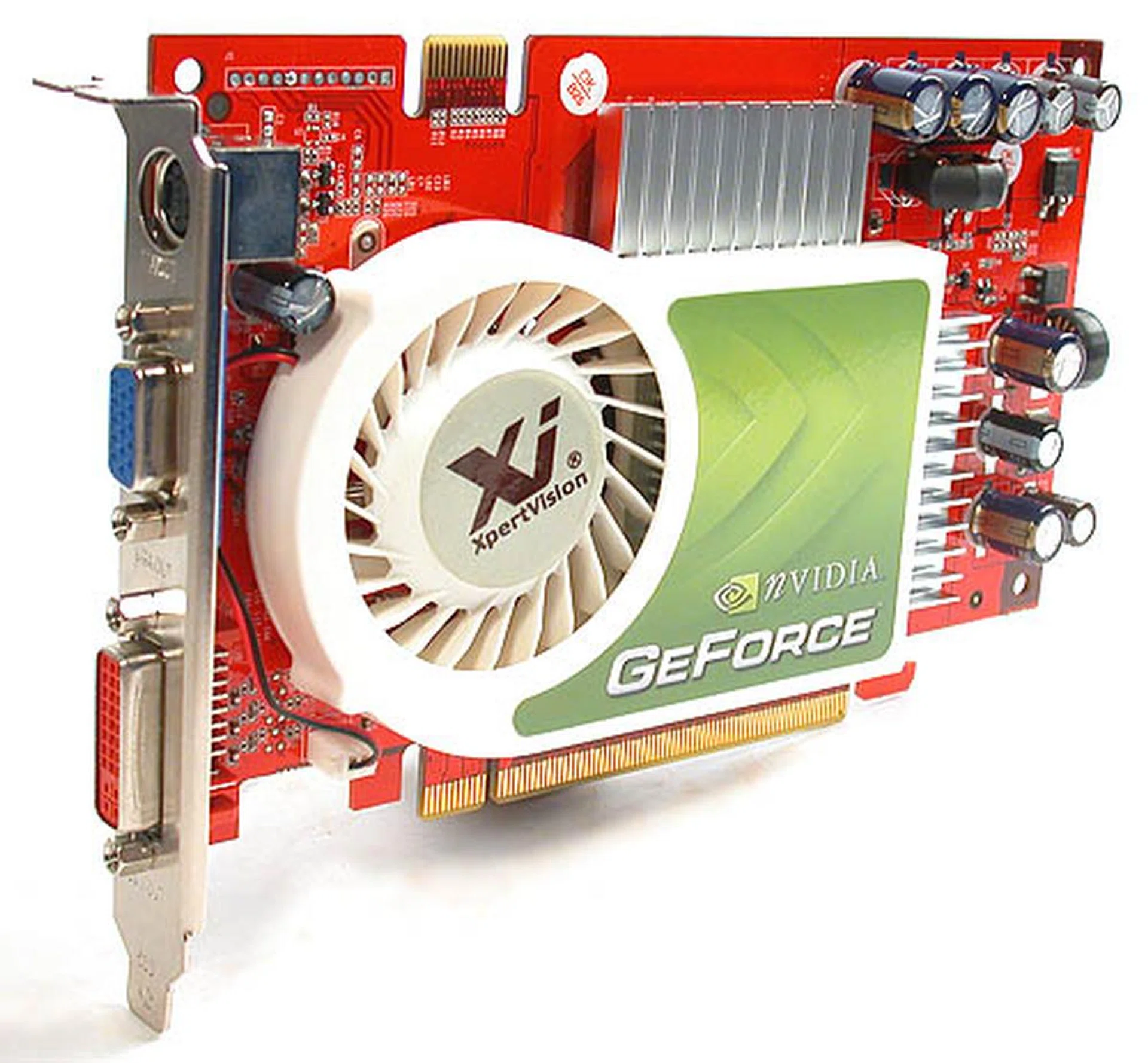
A custom design that NVIDIA would have been proud of. The XpertVision GeForce 7600GT Sonic has the performance edge over the average GeForce 7600 GT.
If the Palit overclocked cards are any indication, XpertVision probably has enough experience with these proprietary designs and the polished GeForce 7600GT Sonic certainly gives us the confidence to recommend it as an excellent product. The noise output has been significantly lowered while the idea of placing heatsinks for the memory chips is simple but effective. The faster and probably more expensive 1.2ns memory chips used also provide for a greater overclocking margin, making it truly a product for the enthusiasts. Most however would not be satisfied with the slight overclock that XpertVision has achieved and would be pushing this card even further. A possible dampener is that despite our 670/1600MHz overclock, we did not notice too much improvement in 3DMark06 benchmark results. You may have better luck for other games and applications.
The only downside to that is the cost cutting that XpertVision had to implement to balance the product and offer it at a competitive price. This means that the GeForce 7600GT Sonic only has one DVI-I output and not two. This is a minor complaint to most who have only one monitor, but the only remaining DVI connector does support dual-link output which is capable of powering very large displays. The bundled accessories and games were rather bland and inferior to some others that we have seen. No doubt enthusiasts would place this at a much lower priority compared to the all-important performance numbers, which were predictably faster than the default but only by a slight margin.
The final clincher is the retail price of the XpertVision GeForce 7600GT Sonic. We were quoted S$369 by its local distributor, but some retail outlets are actually selling as low as S$339, making it one of the cheapest GeForce 7600 GT cards in the market. Throw in the bonus of the slight overclocking, better memory, a solid two-year warranty and we can easily ignore the few flaws of the product. For those who have been waiting impatiently for the special editions catering to enthusiasts, the first contender has shown up and looks just great.
Our articles may contain affiliate links. If you buy through these links, we may earn a small commission.