
MSI RX1800GTO-VT2D256E (Radeon X1800 GTO 256MB)
The Radeon X1800 GTO may find itself undercut by the cheaper GeForce 7600 GT now but with rumors circulating of a possible price adjustment, it could well get back into the game. So for those anticipating such a scenario, we have MSI's take on ATI's latest mid-range card.

Introduction
It's been a pretty rough spring for ATI in the graphics arena. Its Radeon X1800 GTO response to NVIDIA's winning streak of GeForce 7600 and 7900 series have not been entirely convincing. For sure, they still have a strong flagship performer in the Radeon X1900 series but in the mid-range, the prices of the paper-launched and delayed Radeon X1800 GTO have not exactly endeared themselves to the popular masses, a requisite for the more budget conscious mid-range segment.
Just compare the number of vendors that offer Radeon X1800 GTO cards versus that for the GeForce 7600 GT and you'll find it tilting heavily in favor of the GeForce. Already, silent and overclocked editions of its NVIDIA rival are widely available while we could only find the standard Radeon X1800 GTO reference designs on the shelves; that seems somewhat like a sign of disinterest from the vendors themselves, while in contrast, the under-performing but relatively cheaper Radeon X1600 series has had more love.
It could be that there isn't that many 'rejected' R520 cores available for the Radeon X1800 GTO to go around but whatever the reason, price is definitely a major factor. And if some of the rumors circulating around are true, we are likely to see a price cut for the Radeon X1800 GTO soon. The current recommended retail price of US$249 is rumored to fall to US$199, putting it on par with the GeForce 7600 GT and by that measure, finally make it a worthy competitor. It certainly makes sense for ATI in order to try to win back the important mid-range market, though we doubt that it can afford to go much lower due to the complexity and cost of its chip. Meanwhile, the prices of GeForce 7600 GT continue to head south so it could turn out to be a fruitless chase for ATI.
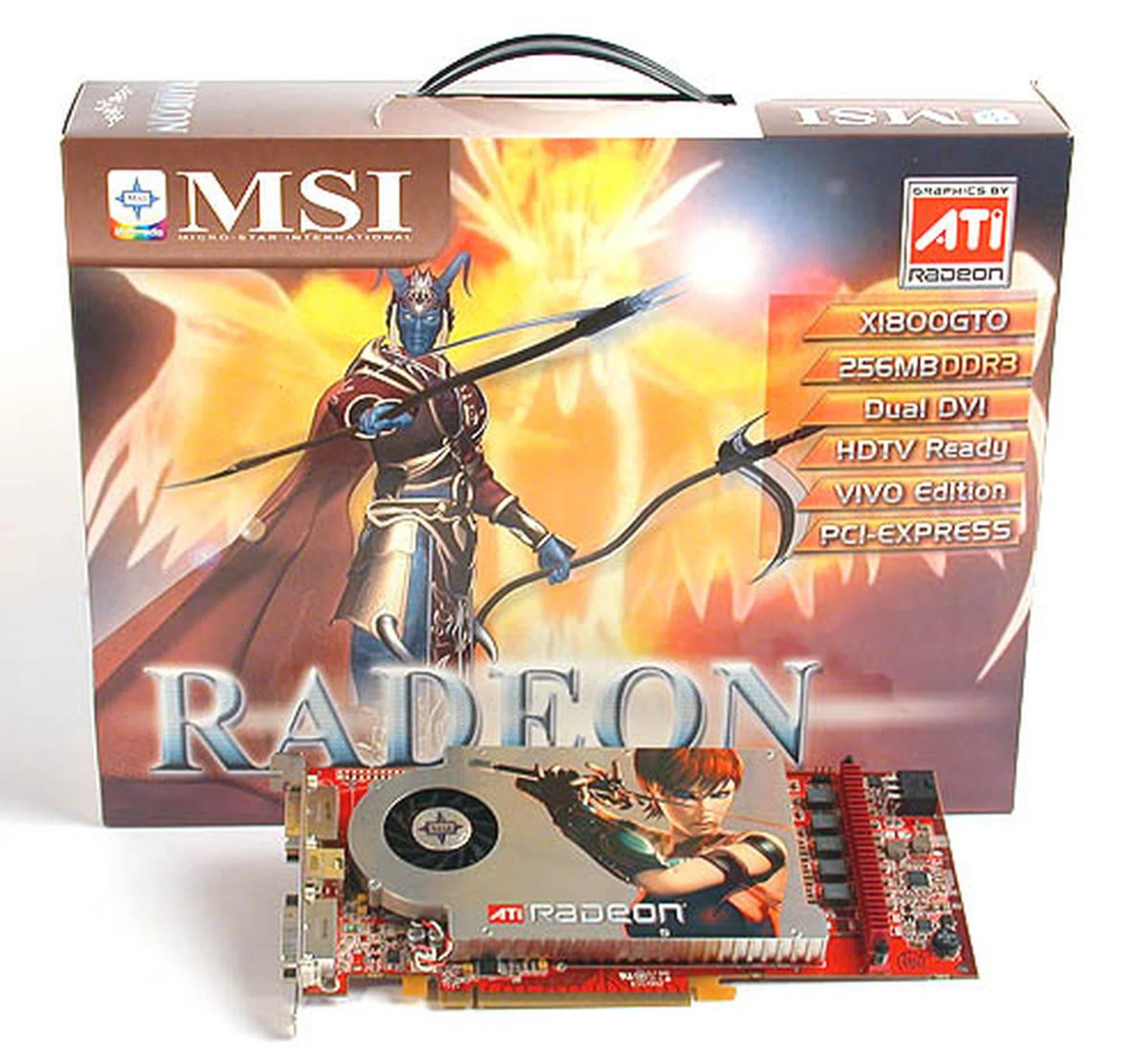
What's the relation between graphics cards and fantastical creatures? The package of MSI's Radeon X1800 GTO features just such an apparition.
Whatever the strategy ATI plans for the mid-range, consumers will of course welcome any price cuts. So if you have been eyeing the Radeon X1800 GTO for a while, especially its performance with high dynamic range rendering and anti-aliasing, where it arguably can outpace the GeForce 7600 GT and the elusive 'image quality superiority' of ATI graphics cards, here's a good time to do some comparison shopping. To aid you in this, we have today the MSI RX1800GTO-VT2D256E, the Radeon X1800 GTO from the giant Taiwanese manufacturer. Here then are its specifications:
MSI's Radeon X1800 GTO 256MB
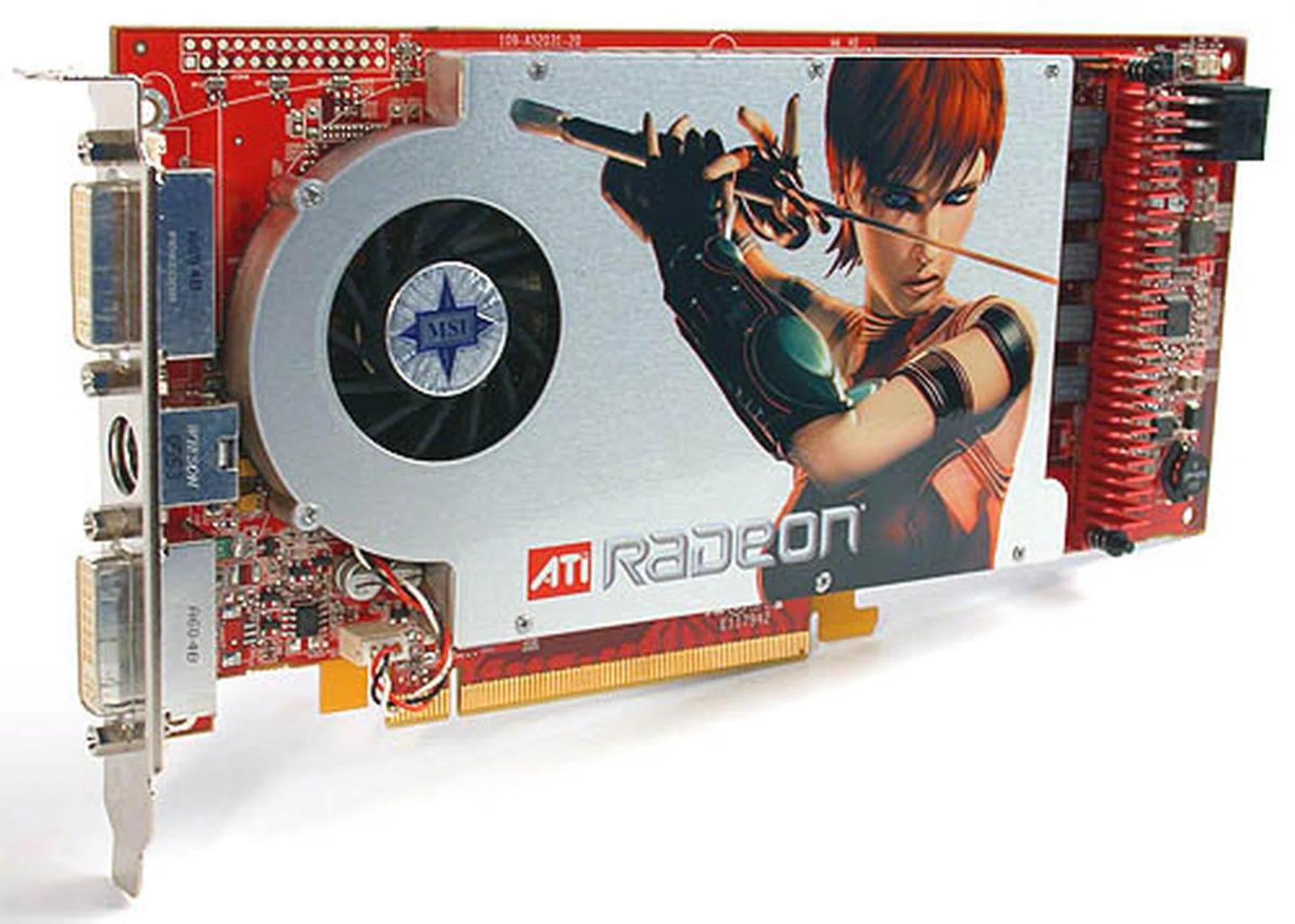
The Radeon X1800 GTO from MSI may come in its own unique box packaging but it is essentially the same as any other Radeon X1800 GTO in the market now. It is a reference design card that bears more than a passing resemblance to the Radeon X1800 XL that it was originally derived from. There is the same large cooler covering most of its already considerably long PCB. The MSI RX1800GTO-VT2D256E is different in the sense that it has a small MSI decal on its fan. Yet, it ends there as the clock speeds, memory chips, down to its transistors and PCB are all done according to ATI's prescription.
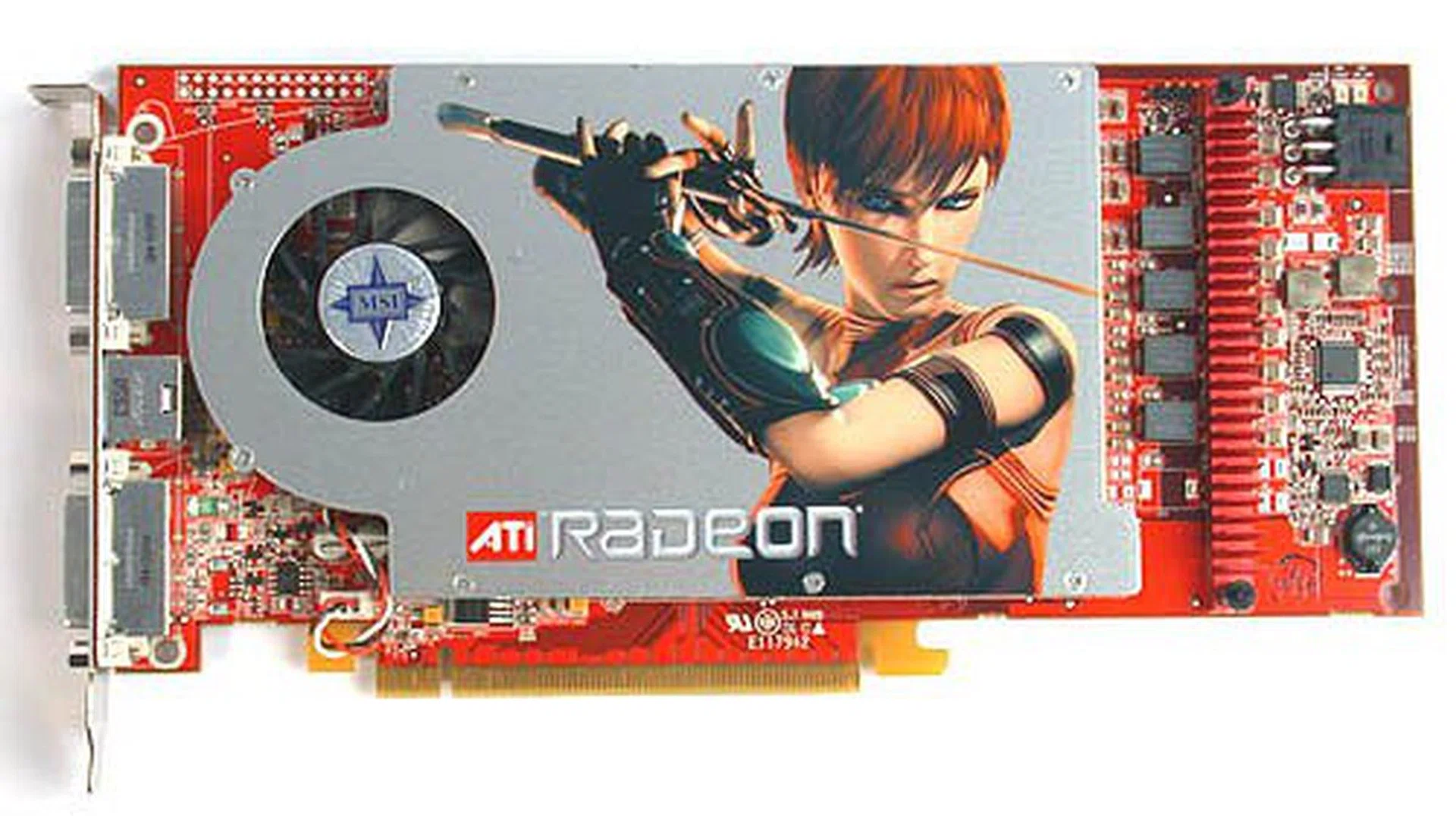
A small, "blink and you'll miss" MSI sticker is the only indication of its origins.
This means a core clock of 500MHz and a memory clock of 1000MHz DDR, along with a 256-bit memory bus that seems to be its best advantage over the 128-bit version found on the GeForce 7600 GT, especially for memory bandwidth intensive applications. If you are interested to find out how the performance of the Radeon X1800 GTO compares against other cards, you can refer to our . Of course, unlike its Radeon X1800 XL relative, the R520 core on the Radeon X1800 GTO has been reduced to 12 pipes from the original 16. Tests done by various hardware sites so far have shown that most Radeon X1800 GTOs cannot be unlocked; the few that have been tested successful have come from Hightech Information Systems (HIS) and that only from the early batches. This further confirms our original suspicions that the Radeon X1800 GTO GPU SKU is derived from 'rejected' R520 cores that may have one faulty functional unit, but the rest of it functions as desired as long as the undesirable section has been isolated.
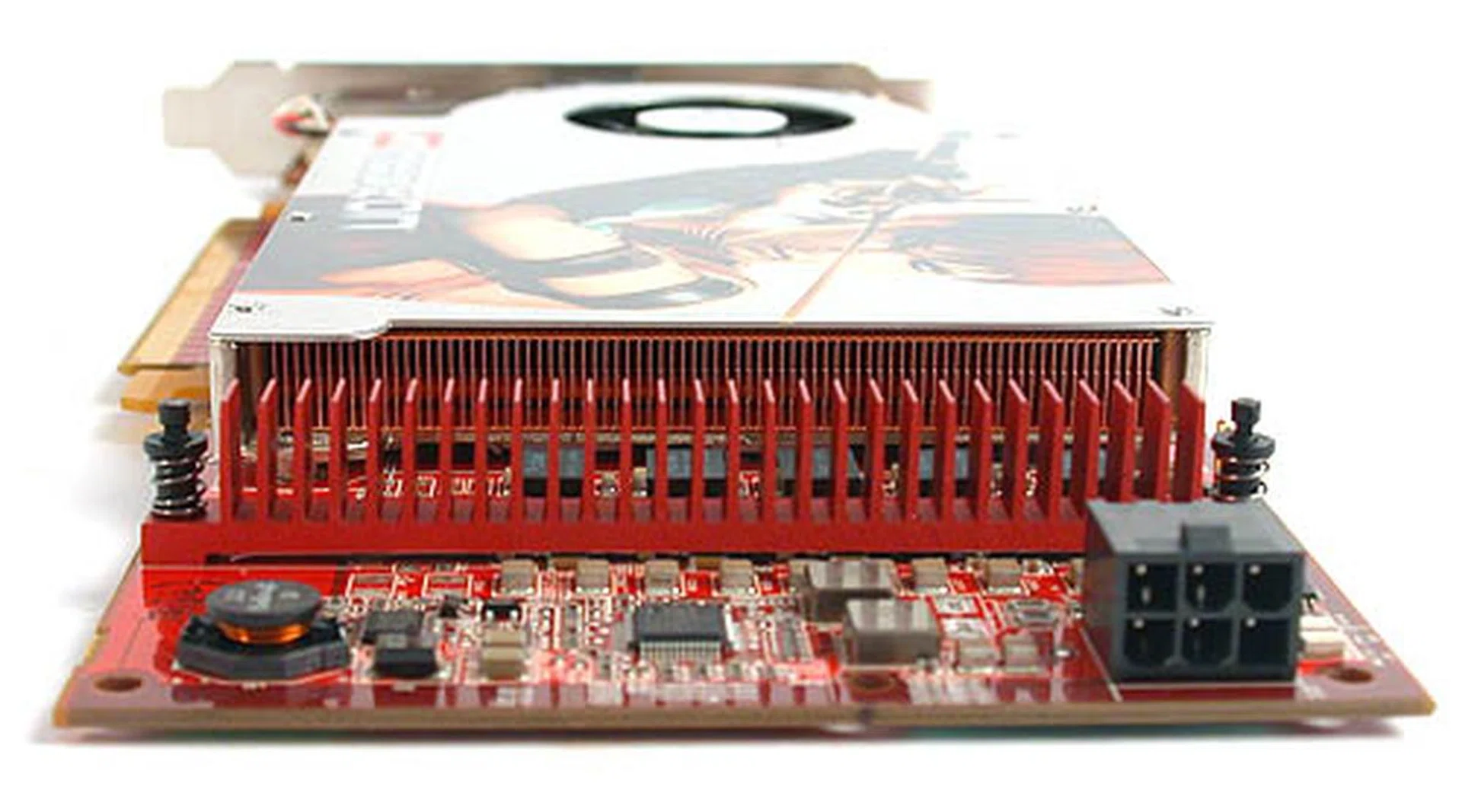
Besides the above average length of its PCB, the Radeon X1800 GTO also requires a dedicated power connector, which is provided in the package.
Noise output from the cooler on the MSI Radeon X1800 GTO is quite low, with the fan spinning most furiously during startup so you might get a louder whine then but it's all good by the time the operating system takes over (even during gaming). Temperatures on the card were also rather typical of its class. Finally, there's a Rage Theatre ASIC onboard to provide the VIVO functionality that is another extra feature over the GeForce 7600 GT.
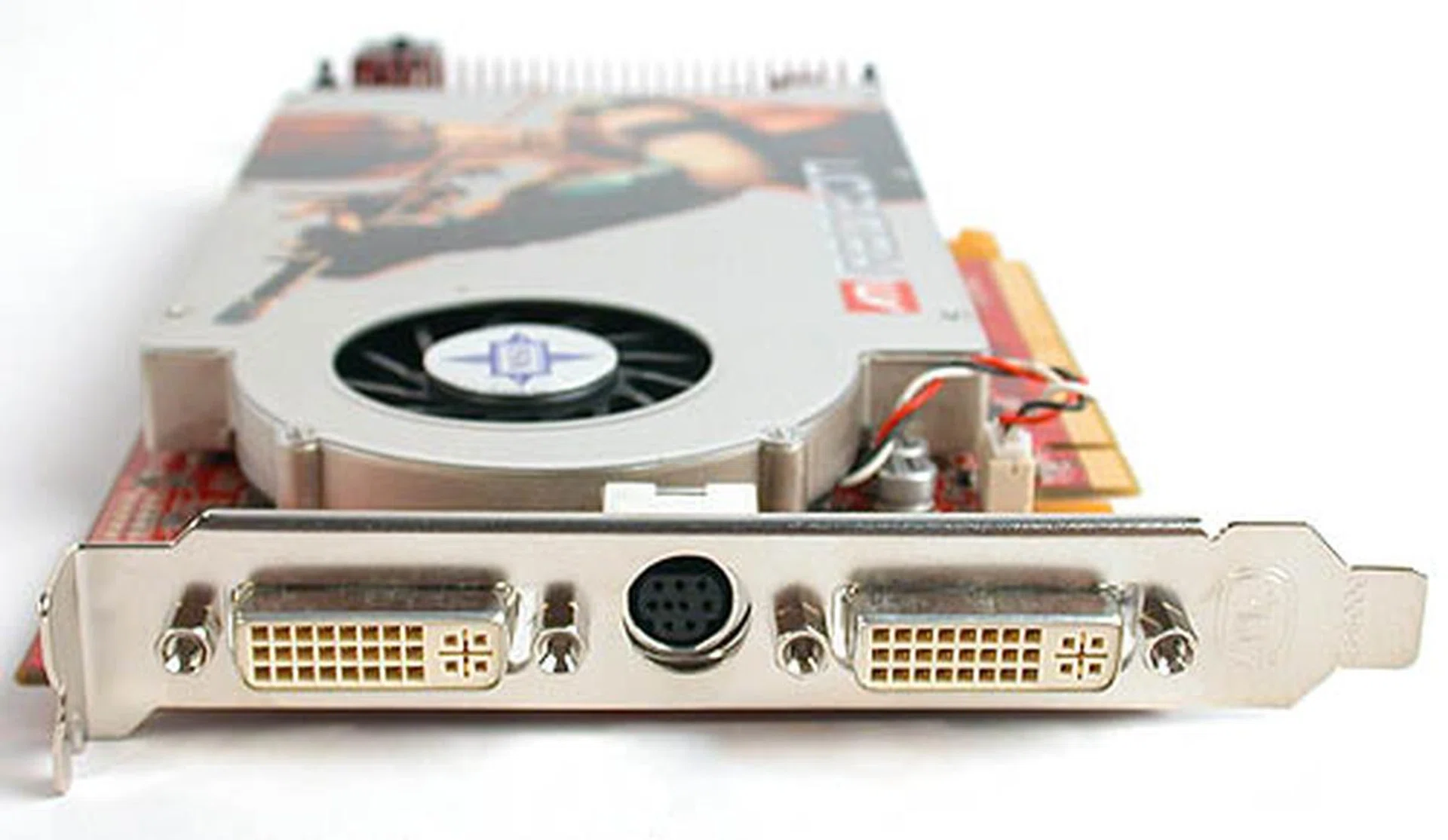
Nothing here that you haven't seen before in other cards; it's the rather common dual DVI-I output and one mini-DIN connector.
Rarely have we found MSI's package less than satisfactory but for its Radeon X1800 GTO, the software was definitely quite disappointing. There was only a single disc - MSI Multimedia - containing a number of the company's own proprietary applications, like MSI Video and WMInfo (you can find the whole list of applications on MSI's website), which despite its intentions, will probably be underused by most users unfamiliar with them. Only the included Norton Internet Security will ring any bells for end-users. At least the assortment of cables and dongles included in the package were up to the mark, though we suspect that they are more likely standard issue for a Radeon X1800 GTO. The package that we received contained the following:
- 2 x DVI-to-VGA adaptors
- S-Video extension cable
- Composite extension cable
- 9-pin mini-DIN to Component dongle
- 9-pin mini-DIN to Composite/S-Video dongle
- 6-pin PCIe to 4-pin Molex power plug converter
- User Manual
- MSI Multimedia (Drivers & Utilities)
Test Setup
To test the MSI RX1800GTO-VT2D256E, we used an AMD Athlon 64 3500+ CPU together with an ASUS A8N-SLI Deluxe motherboard. This was paired with 1GB of Corsair DDR400 RAM in dual channel model and a Seagate 7200.7 SATA hard drive. The operating system used was Windows XP Professional with Service Pack 1 and updated to DirectX 9.0c.
We had featured a chipset comparison of the Radeon X1800 GTO against its potential rivals like the GeForce 7600 GT before so in this review, we will only be comparing the MSI card against the GeCube. However, with both cards using the reference design and having the same clock speeds, this could turn out to be a bit of an anti-climax. Nevertheless, the following benchmarks were tested, with all the cards using Catalyst 6.4:
- Futuremark 3DMark05 Pro (version 120)
- Futuremark 3DMark06 Pro (version 102)
- Chronicles of Riddick: Escape from Butcher Bay (version 1.1)
- Tom Clancy's Splinter Cell 3: Chaos Theory (version 1.3)
- Quake 4
Results - 3DMark05 Pro (ver .120)
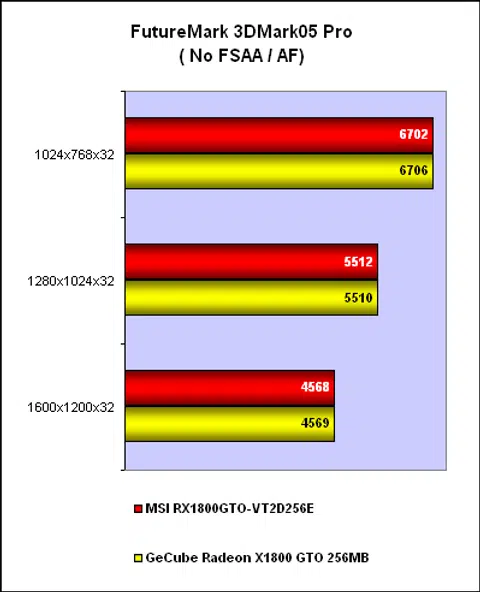
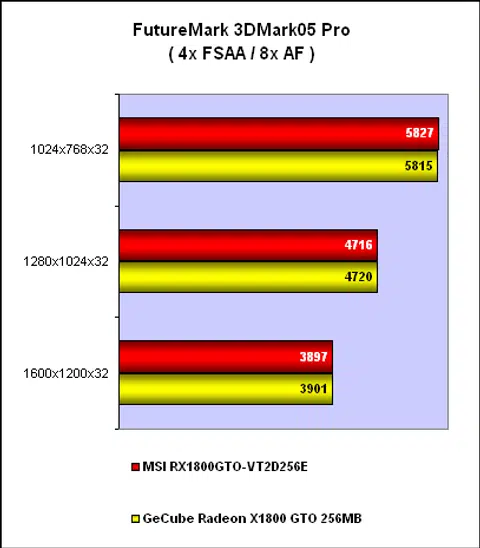
Identical clock speeds and reference cards re-badged by the respective companies (or not, in GeCube's case) meant that there's really no contest between the two cards in our comparison. For they offer virtually the same performance. A few minor points separated the two cards in 3DMark05 and both cards took turns to take the 'lead'.
Results - 3DMark06 Pro (ver .102)
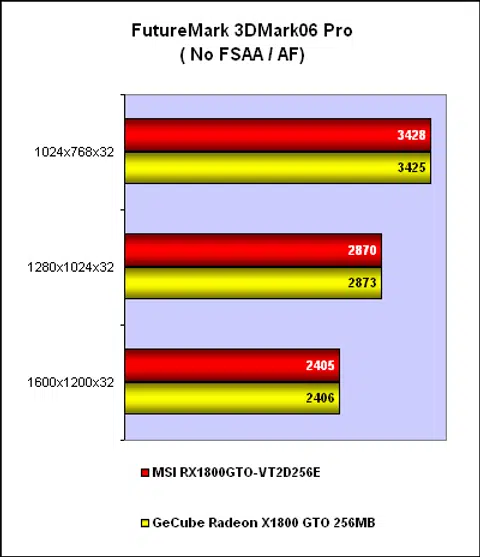
Just like in 3DMark05, there were practically no differences between the GeCube and the MSI. In extreme cases, only one point divided the two in this synthetic benchmark, which was no surprise as both followed the reference design closely.
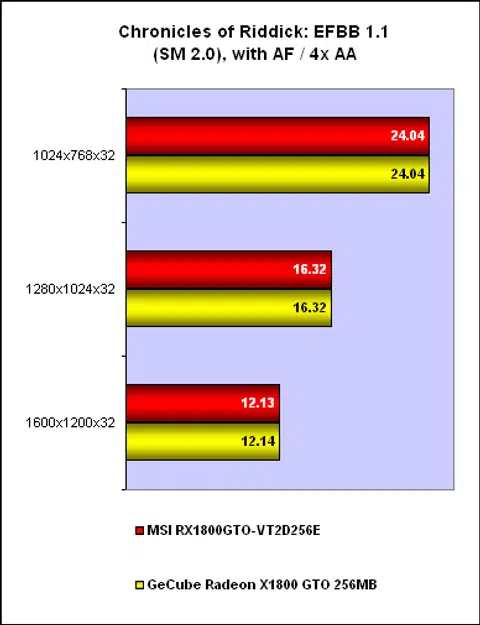
Results - Chronicles of Riddick: Escape from Butcher Bay (OpenGL SM2.0+ Benchmark)
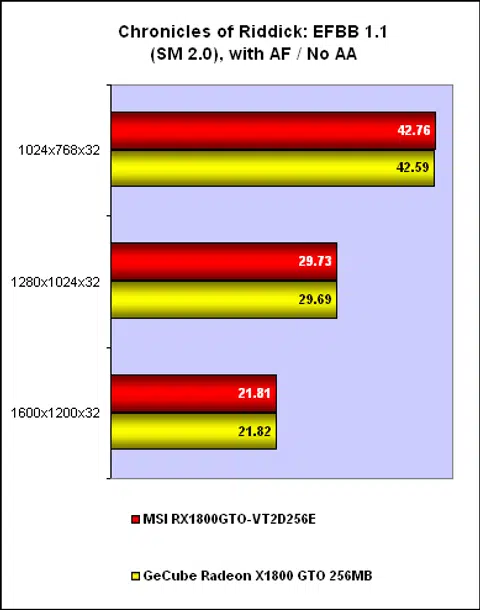
Despite its relative 'age' in the fast paced gaming scene, Chronicles of Riddick has continued to give graphics cards a hard time with its modified Doom 3 engine. Unfortunately, while ATI cards have experienced improved performance in Quake 4 based games thanks to driver optimization, the same hasn't happened with the older Doom 3 engine. Hence, we find both Radeon X1800 GTO cards struggling here, especially so when anti-aliasing was enabled. Of course, most mid-range cards would also encounter some difficulties with this game using anti-aliasing, though NVIDIA's mid-range GeForce 7600 series should fare better here.
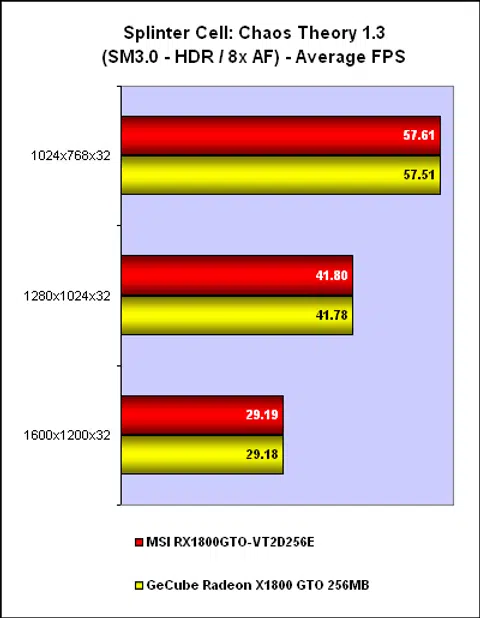
Results - Splinter Cell: Chaos Theory (DirectX 9 Benchmark)
There were hardly any differences between the two cards going by the results we got in Splinter Cell. Even with high dynamic range rendering enabled, the MSI and GeCube were both equally adept and at 1600 x 1200, the performance was still acceptable so by all means, turn on the eye candy.
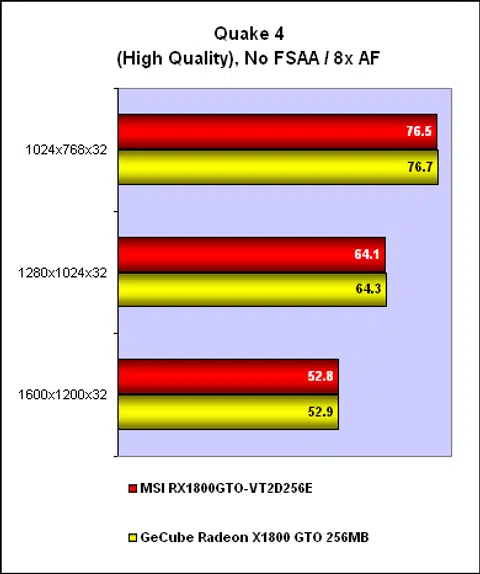
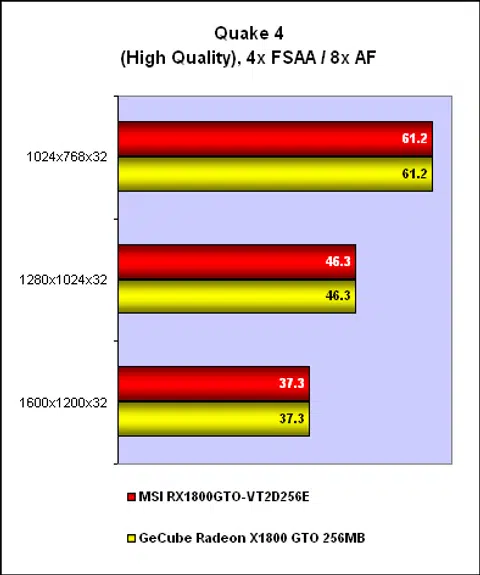
Results - Quake 4 (OpenGL SM2.0+ Benchmark)
Like most of the other benchmarks that we have gone through, the Quake 4 scores for the MSI were again an almost exact copy of the GeCube. Both cards were more than playable in this game for all resolutions and settings.
Temperature Testing
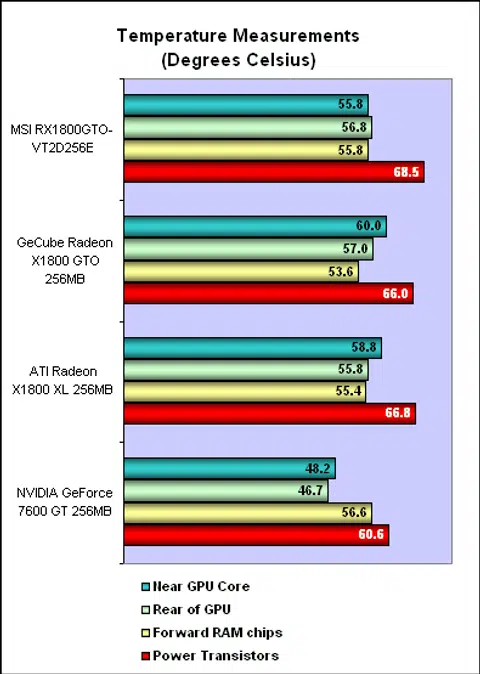
Unsurprisingly, the temperatures on the MSI were consistent with what we had recorded for the GeCube. Both cards used the default cooler so there wasn't too much deviation from each other. Still, the minor deviation encountered was due to a slightly different reference cooler used; MSI card used a cooler that was meant for the Radeon X1800 XL whereas GeCube used one that debuted with the Radeon X1800 GTO. Compared to the GeForce 7600 GT however, the NVIDIA card had the edge with a much cooler core. This is one department where you would be better off going with the green team.
Overclocking
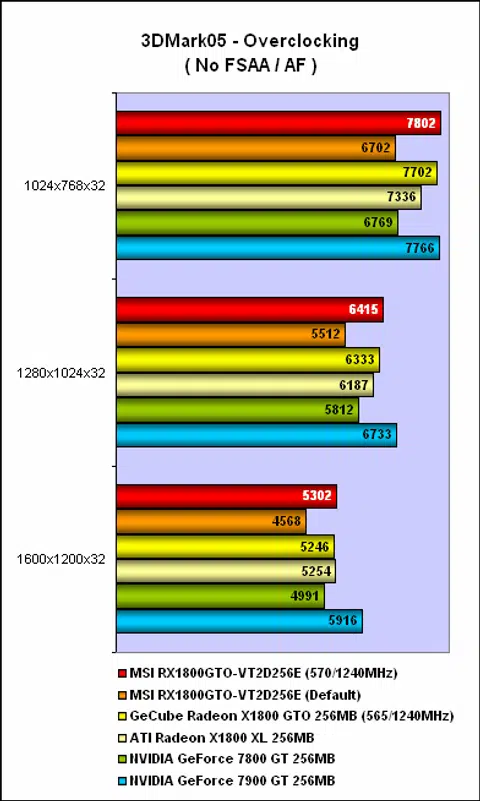
The similarity between the two Radeon X1800 GTO cards extended right down to even their overclocking limits. On paper, the MSI had a slightly better core overclock, by 5MHz. It doesn't even seem worth the effort as the difference in scores between the two cards when overclocked was around 1%. It would be quite unlikely that gamers would notice such a minute margin. Compared to the default clocks though, the overclocked MSI did quite all right, with up to a 15% boost in 3DMark05 scores, so it's at least worth trying.
Conclusion
All the Radeon X1800 GTO cards available now are reference models that are basically similar to each other. Going by the small handful of vendors offering these cards compared to its much more popular mid-range rival, the GeForce 7600 GT, it would be safe to say that we don't really expect to find any more vendors jumping onto this chipset in the near future, even with a price cut. The hard truth is that power consumption and heat output concerns matter nowadays and this is where the more efficient GeForce 7600 GT retains the advantage even if the Radeon X1800 GTO ties it on pricing. At least ATI has the consolation of having the upper hand for intensive anti-aliasing and high dynamic range effects, along with its VIVO feature. Whether that is enough to convince consumers is another matter altogether and a choice that end-users should weigh against their needs.
So far, the rumored price cuts for the Radeon X1800 GTO have not been reflected on online retailers. It could take a while, it could be totally unfounded or it could be that the price adjustments will coincide with the launch of the next 'new' ATI product, the Radeon X1900 GT (expected to be released early May though we are crossing our fingers that it won't be another paper launch) in a concerted bid to regain ATI's mind share. Slated to compete against the GeForce 7900 GT, this new product reuses the more successful R580 core, hence the X1900 moniker and hopefully will add more competition to the upper mid-range by taking advantage of the relatively tight supply of GeForce 7900 GT cards at the moment.
With ATI's recent price cut, the Radeon X1800 GTO has become more competitive with its main rival. But can the vendors capitalize on this with a greater variety of products?
Presently, the choices for a Radeon X1800 GTO are quite limited and since one is about the same as another, it all boils down to its price and bundle when choosing one. Especially as a quick glance through our benchmark results will reveal that the Radeon X1800 GTO cards perform similarly as long as they have the same clock speeds. The MSI RX1800GTO-VT2D256E is no different from the GeCube version. Both also had close and very decent overclocking limits for the more adventurous, while the noise from the cooler is much improved from its Radeon X1800 XL roots.
Therefore, the similarity between most vanilla Radeon X1800 GTO cards only serve to highlight the weakness in MSI's offering, which is its lackluster bundle. While its homebrew applications have their moments, they are an unknown quantity that most end users will hesitate to install on their systems. For a mid-range bundle, the lack of a DVD playback application or a game is not going to cut it, not when formerly cost conscious competitors like GeCube can afford to include them. It is certainly not up to the usual standards that we have come to expect from MSI.
While we are unable to get the official retail price at the time of publication as this is a relatively 'new' offering from MSI, we expect it to be around the average selling price of a Radeon X1800 GTO in the market now. That could be around US$249 if the price cuts are not implemented yet though it could probably be found for less than that. However, it would need a rather more attractive price for us to recommend the MSI Radeon X1800 GTO over the other competing Radeon X1800 GTO cards out there now.
Our articles may contain affiliate links. If you buy through these links, we may earn a small commission.