
Gigabyte GV-NX73T256P-RH (GeForce 7300 GT 256MB DDR2)
The first GeForce 7300 GT we saw from Gainward was very impressive and is perhaps misleading as to the general quality of the GeForce 7300 GT due to its aggressive clock speeds. Gigabyte's version is more modestly clocked and should be more representative of its class. Here's what we found out.

Turbo Powered Low-End
Those who went through our initial article about NVIDIA's latest low-end SKU, the GeForce 7300 GT, would be understandably excited about the surprising performance of the Gainward Bliss 7300GT PCX. While it is no doubt rather refreshing to find a GeForce 7300 series card hitting way above its hierarchy in the benchmarking, in the process eclipsing the GeForce 7600 GS, the fine performance was due to the rather extreme specifications of that limited edition GeForce 7300 GT. Most GeForce 7300 GT cards would more likely stick to their low-end roots and come equipped with inexpensive memory and more mundane clock speeds. Given the freedom to tinker by NVIDIA, one can expect to find quite a range of clock speeds for this product from the usual manufacturing partners. In short, there's no fixed 'standard' GeForce 7300 GT one can use as the base.
Of course, such a situation means that the marketing folks can really stretch the truth and their minds trying to come up with ways to distinguish their products. One typical approach is to introduce a higher clocked special version and benchmark it against the standard version. That is exactly what we found on the box packaging of Gigabyte's GeForce 7300 GT 256MB DDR2, which has been dubbed the TurboForce edition. More importantly, the blurb on the box claims that the Gigabyte is up to 15.1% faster than the "GeForce 7300 GT Standard". But is there really such a thing for the GeForce 7300 GT? So far, there hasn't been much fanfare about the low-end GeForce 7300 GT so the "standard" could be the popular clock speeds from other vendors. Well, we may have no idea about the specifics of Gigabyte's internal lab testing but we are able to give you our own benchmarks in this review. So to find out whether the Gigabyte GV-NX73T256P-RH can live up to its TurboForce hype, here's a look at its illustrated Serious Sam II packaging and technical specifications:
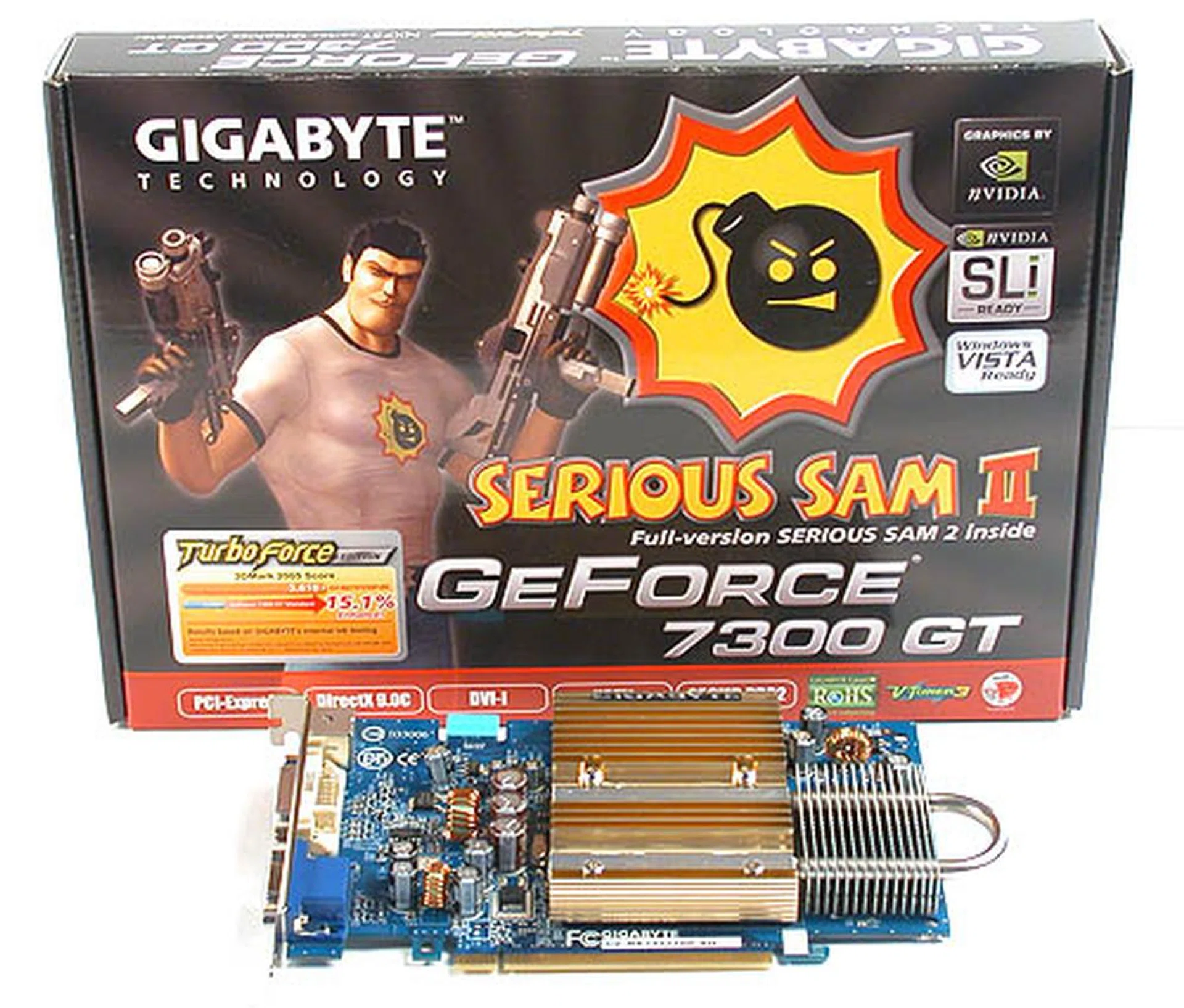
Gigabyte has gone with the Serious Sam II theme for its packaging that will certainly catch the eye of gamers.
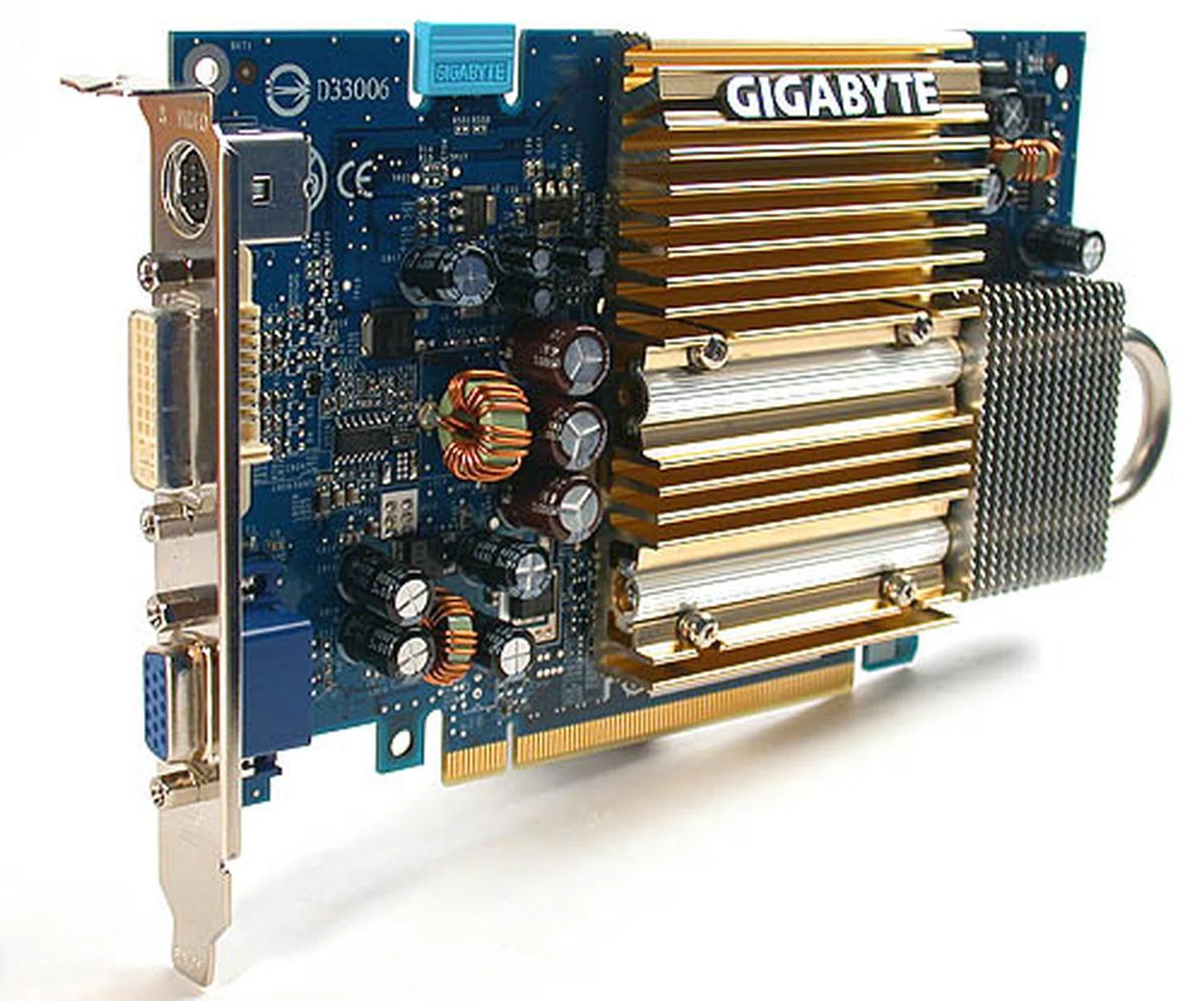
Gigabyte's GeForce 7300 GT 256MB DDR2
Like many low-end graphics products, Gigabyte's version features a passive cooler. While NVIDIA may not have issued any edict regarding the kind of cooling on the GeForce 7300 GT, the trend does appear to favor the silent type. Such a design would emphasize the suitability of the GeForce 7300 GT in HTPC setups and make it more attractive to budding HTPC enthusiasts. The cooler on the Gigabyte utilizes heat pipe technology to transfer the heat to a special section of cooling fins, which should dissipate heat faster than the conventional chunk of aluminum heatsink.
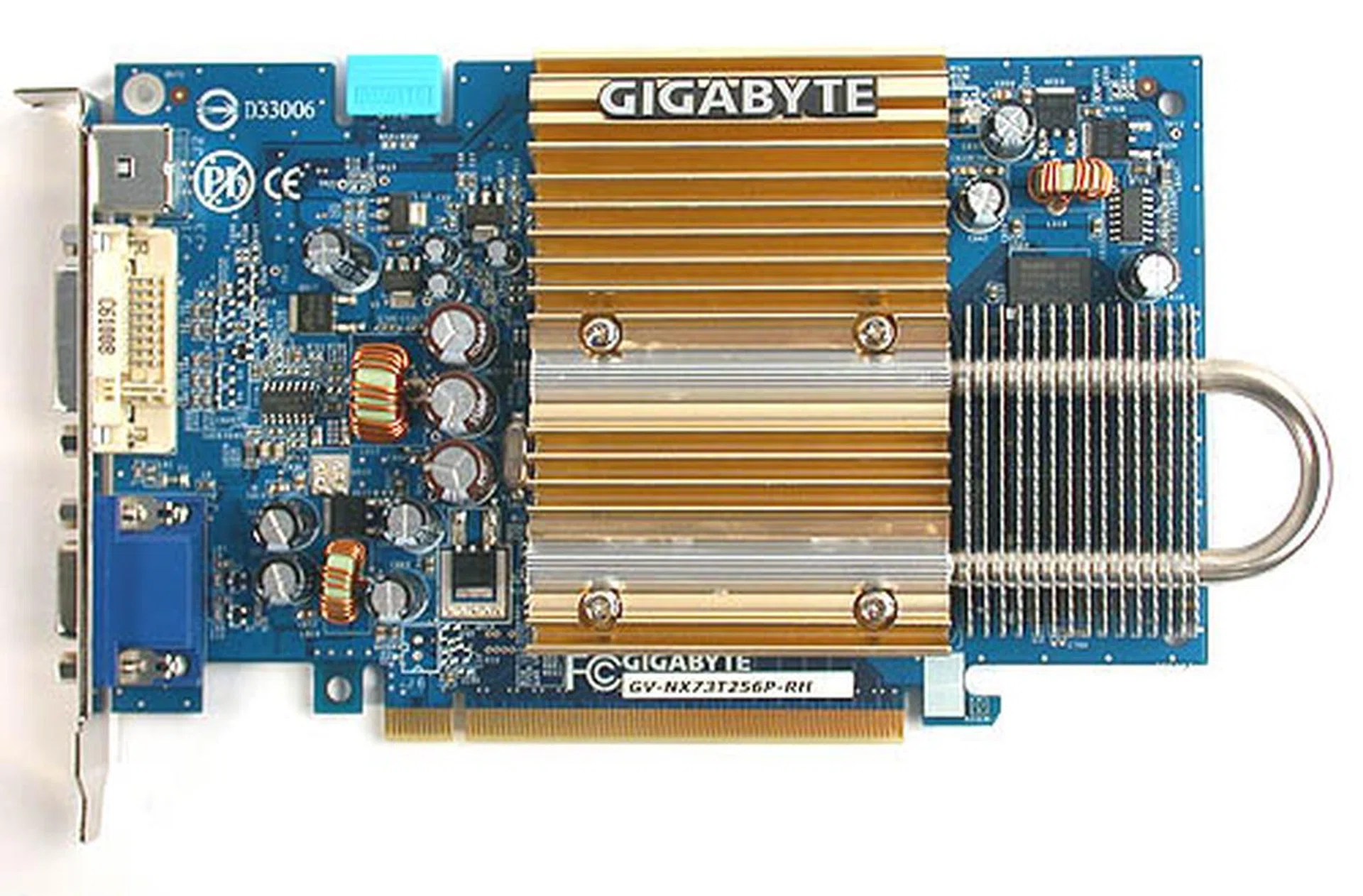
The passive heatsink is not any simple slab of aluminum. A heat pipe mechanism is embedded to spread the heat to the fins. Overall, it looks rather like a padlock.
Gigabyte's idea of TurboForce is to clock the core of its GeForce 7300 GT to 450MHz. As the lower limits of the range specified by NVIDIA for this SKU is 350MHz, the Gigabyte GV-NX73T256P-RH should be faster than some of the slower and cheaper GeForce 7300 GT products out there. In that sense, the Gigabyte probably holds up to its claims of being 15.1% faster than the competition. The DDR2 memory chips are rated at 2.5ns and clocked at 800MHz DDR, which is quite tame compared to the DDR3 memory clocks on the Gainward. So the jaw dropping performance of the Gainward is unlikely to be repeated. However, the modest clock speeds mean that the price of the Gigabyte would probably be more in tune with its low-end image.
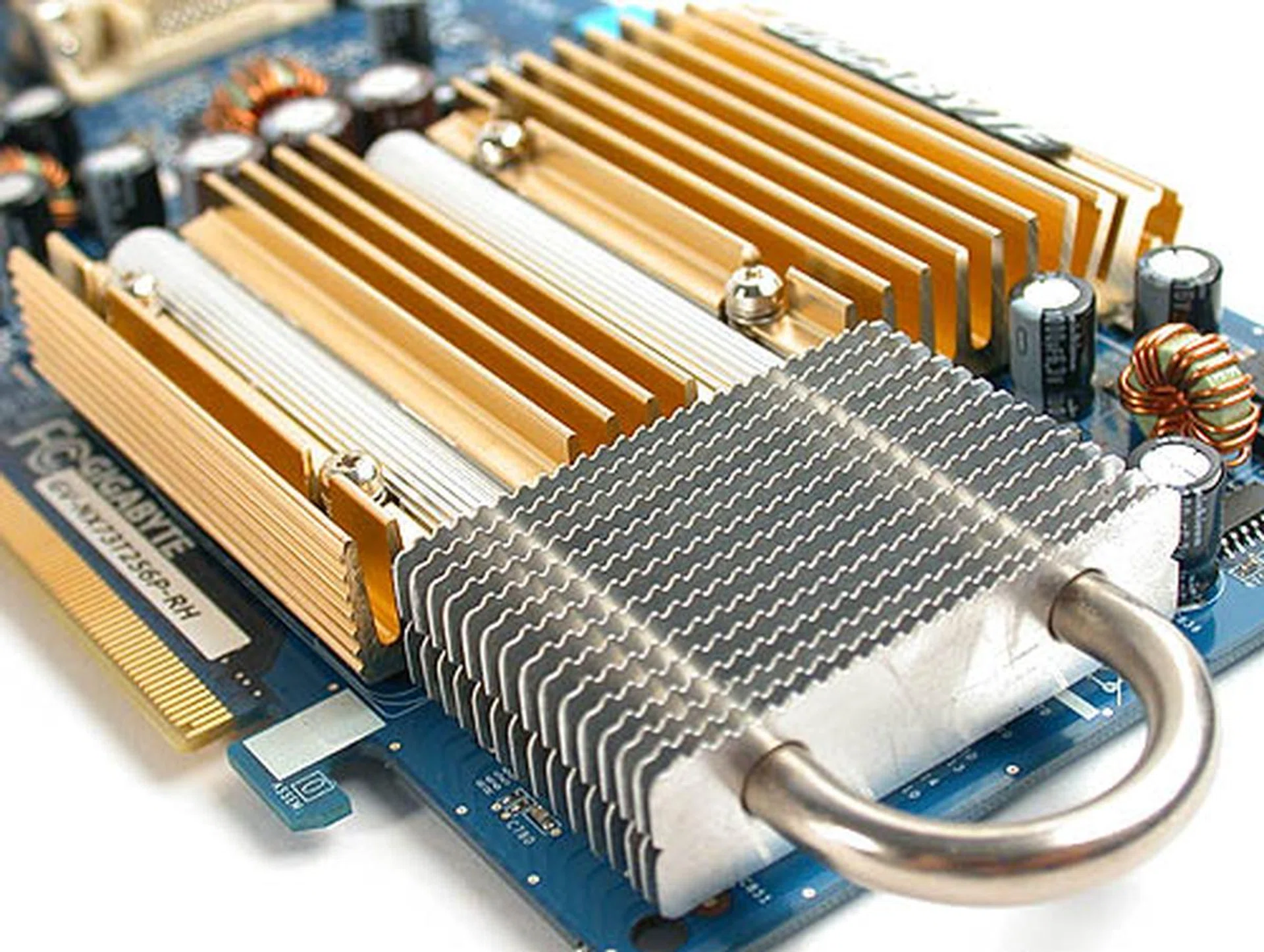
A closer look at the heatsink. While some of the memory chips are beneath the silvery fins, there is no contact so they won't help cool the chips.
Other features for the GeForce 7300 GT include its dual-link DVI output, something that had been previously found on the GeForce 7600 series. The presence of this output means that it can support displays sizes of 30-inch and larger. PureVideo HD is also supported for the GeForce 7300 GT though you would need the latest 91.31 drivers for that to work properly. Unfortunately, for the price that you pay for the Gigabyte, one DVI output is all you'll get; the other output is the usual analog VGA.
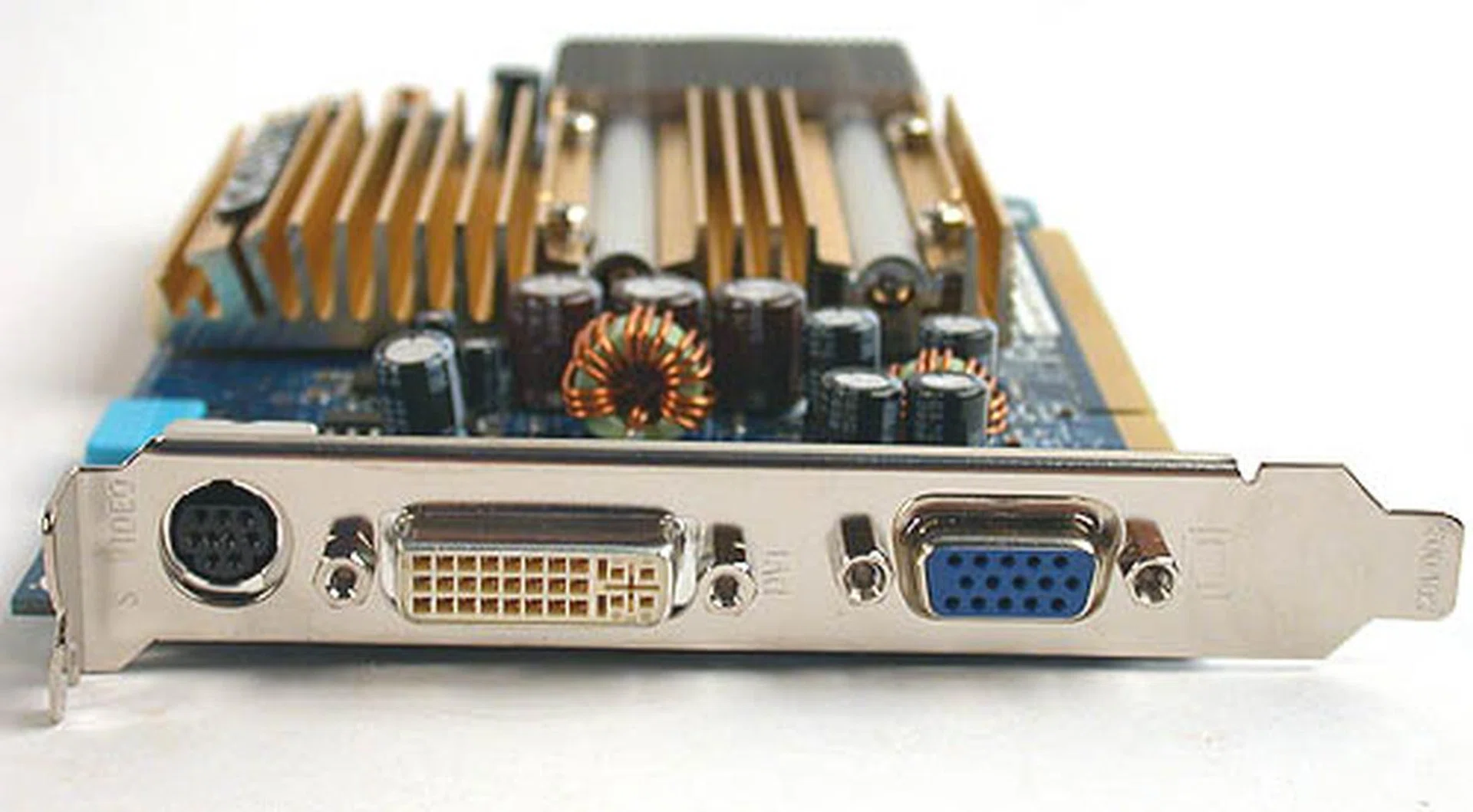
It's a low-end card so the analog VGA output is found instead of the two DVI outputs as most users would have preferred. However, the single DVI is a dual-link output, so that may alleviate some of your disappointment.
Serious Sam II, the sequel to a first person shooter game, which was a sleeper hit, has many colorful environments that should show off the capabilities of the card. Gigabyte obviously knows the desirability of its bundled game and the packaging is hence unabashed in its Serious Sam imagery. Non-gamers have not been forgotten, as a copy of CyberLink Power DVD 6.0 is also included. While this is not the latest version, it is still a very decent application for DVD playback. Gigabyte's own overclocking tool, V-Tuner 2 Plus completes the bundle for those who hope to get a bit more performance from their cards. Here's an inventory list of the items:
- 1 x DVI-to-VGA adaptor
- 9-pin mini-DIN to Component/S-Video dongle
- User Manual
- Quick Installation Guide
- Driver CD (including Gigabyte V-Tuner 2 Plus)
- CyberLink Power DVD 6.0
- Serious Sam II (full game)
Test Setup
MSI's K8N Diamond Plus motherboard and an AMD Athlon FX-55 (2.6GHz) processor were the main components of our test system. We also used low latency DDR400 memory from Kingston, up to 1GB running in dual channel mode. Next, we had a Seagate 7200.7 SATA hard drive, which was then installed with a copy of Windows XP Professional and Service Pack 2. The latest version of DirectX 9.0c was also used.
ForceWare 91.29 was used for all the NVIDIA cards in our benchmarks while the ATI Radeon X1600 XT was on Catalyst 6.5. While there are newer drivers from both ATI and NVIDIA released recently, the scores should hardly deviate from the ones we used. The following benchmarks were tested:
- Futuremark 3DMark05 Pro (version 120)
- Futuremark 3DMark06 Pro (version 102)
- Unreal Tournament 2004 Demo
- Tom Clancy's Splinter Cell 3: Chaos Theory (version 1.3)
- Chronicles of Riddick: Escape from Butcher Bay (version 1.1)
- Quake 4
Results - 3DMark05 Pro & 3DMark06 Pro
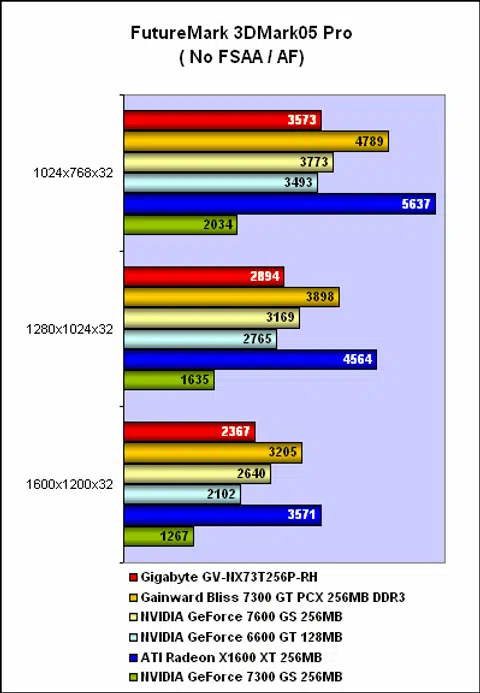
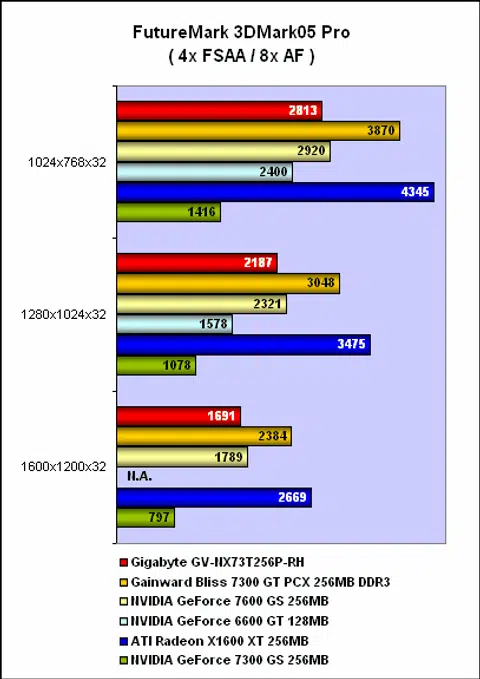
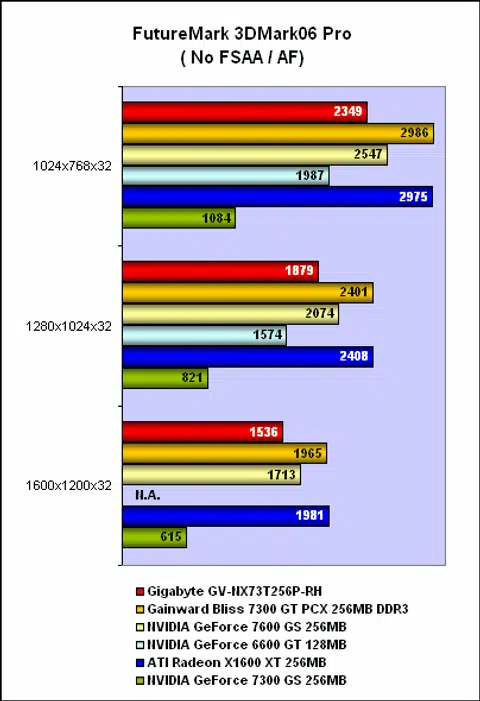
With its more modest clock speeds, the Gigabyte GeForce 7300 GT trailed the speedy version from Gainward by a fair amount in both 3DMark05 and 3DMark06. More importantly, normal service was resumed as the GeForce 7600 GS narrowly held off the challenge of the Gigabyte. ATI fans also have cause to celebrate as its mid-range Radeon X1600 XT emerged tops in 3DMark05 and did very well in 3DMark06.
From the look of things, the Gigabyte may have clock speeds that are rather similar and even superior to the standard GeForce 7600 GS but its lesser number of pixel pipelines was its undoing. Its position in this benchmark was right in between the older GeForce 6600 GT and the GeForce 7600 GS and a fairer reflection of where NVIDIA probably intends the GeForce 7300 GT to be in, rather than the exalted performance of the Gainward GeForce 7300 GT.
Results - Splinter Cell 3: Chaos Theory & Unreal Tournament 2004 (DirectX 9 Benchmarks)
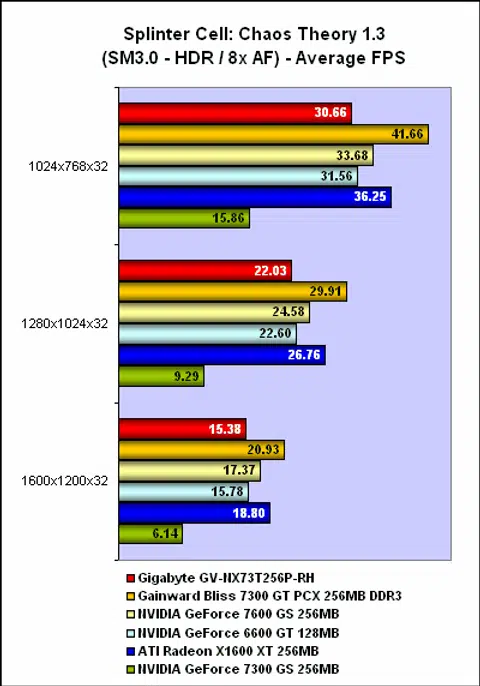
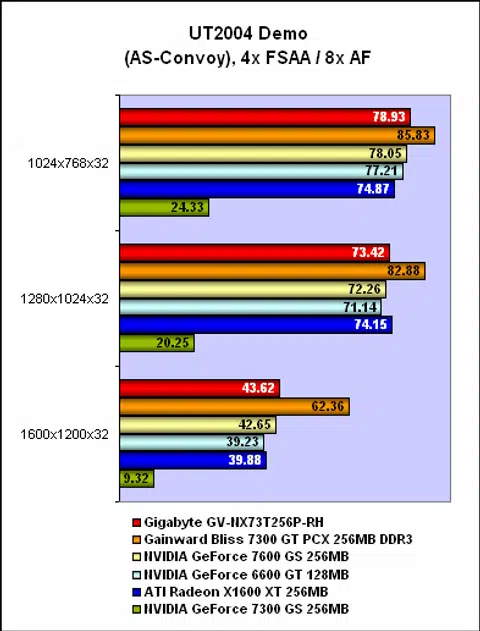
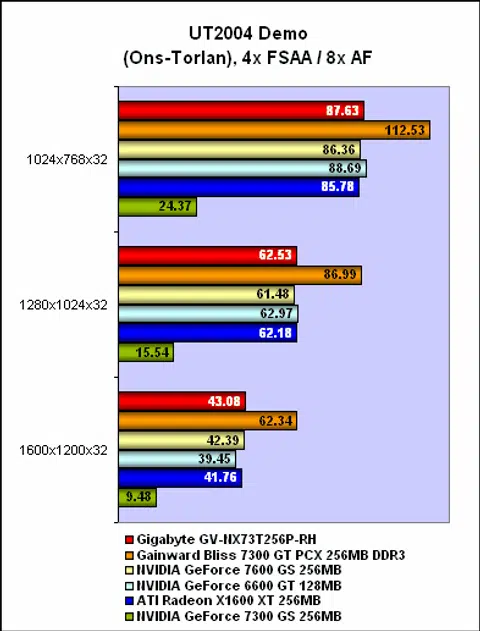
In Splinter Cell we saw the Gigabyte losing out to the GeForce 7600 GS also and even the older GeForce 6600 GT was slightly faster than the new budget alternative. The wide difference between the two GeForce 7300 GTs in this comparison shows the latitude possible in this SKU and hence clock speeds and the type of memory chips used are crucial. In an older game like Unreal Tournament 2004, the Gigabyte GeForce 7300 GT was quite competitive with both the GeForce 7600 GS and the GeForce 6600 GT, as its pipeline limitations were probably not exposed like they were in 3DMark.
Results - Chronicles of Riddick: Escape from Butcher Bay (OpenGL, SM2.0+ Benchmark)
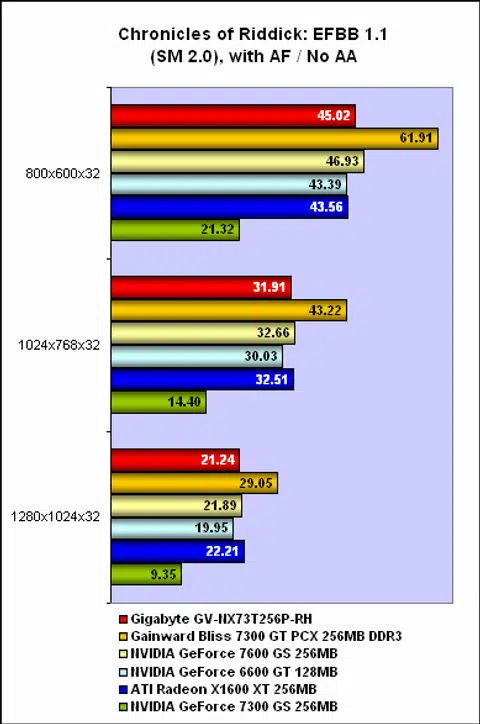
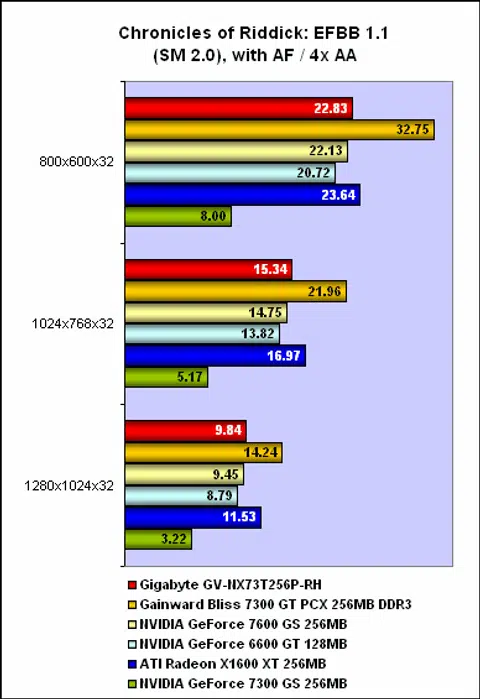
Chronicles of Riddick was another benchmark where quite a number of cards returned rather similar results. This cluster of cards included the Gigabyte GeForce 7300 GT, the GeForce 7600 GS, the GeForce 6600 GT and also the Radeon X1600 XT. Despite its OpenGL roots, which usually favored NVIDIA, the Radeon X1600 XT was quite competitive in performance if not necessarily in price. Meanwhile the GeForce 7600 GS was just about level with the Gigabyte so the supposedly budget card was doing much better than expected.
Results - Quake 4 (OpenGL SM2.0+ Benchmark)
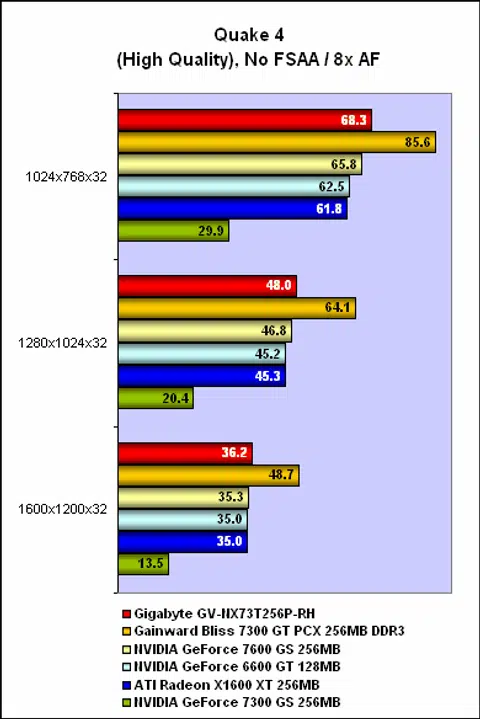
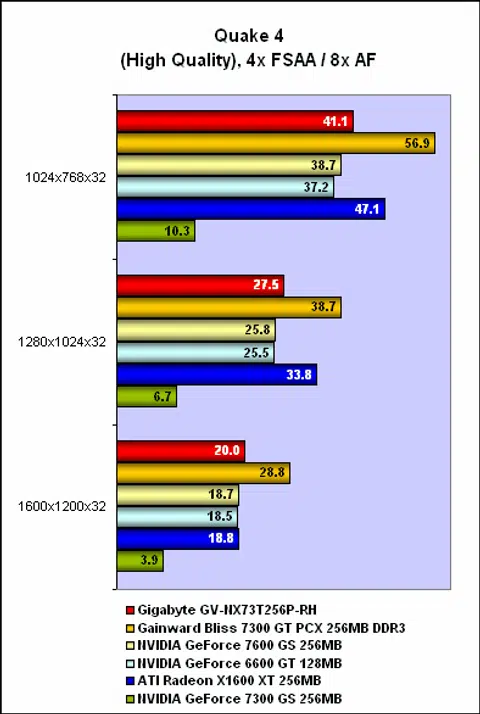
The Gigabyte GeForce 7300 GT also outshone the GeForce 7600 GS in Quake 4, taking a slight lead over its more illustrious cousin. However, it was lagging quite badly behind the high clocks of the Gainward. Improvements in drivers also ensured that ATI cards perform reasonably well when anti-aliasing was enabled and we could see the Radeon X1600 XT producing solid numbers compared to the NVIDIA cards.
Temperature Testing
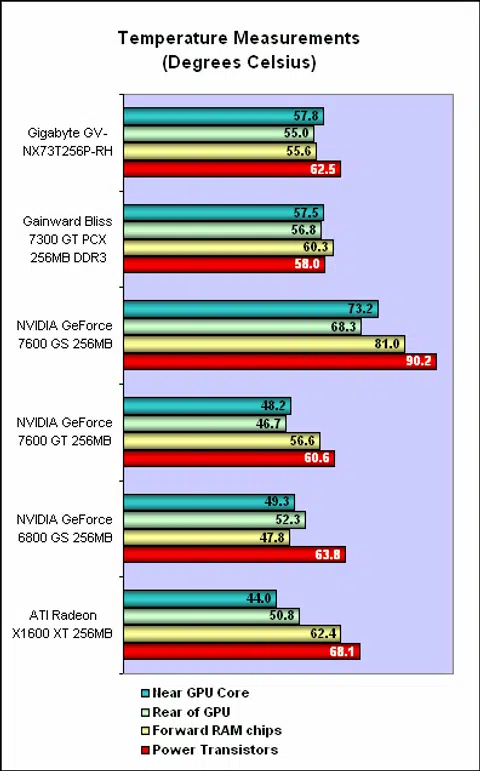
With lower clock speeds, we expected the Gigabyte to run cooler than the Gainward Bliss 7300GT. This was somewhat true but the difference wasn't really significant, as the temperatures of both cards hovered mostly between 55 - 60 degrees and that was with passive coolers for both. That's why you will probably find a lot of vendors opting for fanless heatsinks to cool their GeForce 7300 GTs. Take note that our temperature testing is conducted in our air-conditioned lab where temperatures usually hover at 22 degrees Celsius.
Overclocking
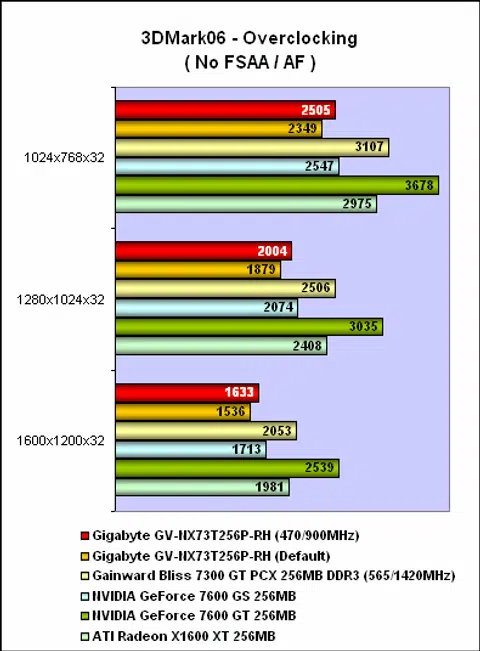
Frankly, we were hoping for better overclocks than the ones we eventually got with the Gigabyte. Maybe we were influenced by the outstanding performance of the Gainward but alas, the Gigabyte was not even close to the Gainward in terms of overclocking. We only managed a very minor increase in clocks that led to a small gain of 6% in 3DMark06. That was still very far behind the Gainward's default speeds. To be fair, the Gigabyte did have a smaller passive heatsink and had slower memory chips so the outcome wasn't too unexpected.
Conclusion
For the mainstream consumer, the GeForce 7300 GT offers another low-end alternative to the ubiquitous integrated graphics found. Together with the more affordable GeForce 7300 GS, NVIDIA has bolstered its low-end offerings to cater to different needs. The almost unprecedented amount of flexibility in terms of the clock speeds for the GeForce 7300 GT means that this chipset can span the entire low to mid-range segment. As we have already seen with the Gainward, with the right blend of hardware and frequencies, it likely even obsoletes NVIDIA's own GeForce 7600 GS. However, again we have to caution that not every GeForce 7300 GT is equal and checking its clock speeds carefully before making a choice between the various offerings would probably save you some grief.
It may not be the best card to play Serious Sam II as the packaging suggests, but it should provide a decent gaming experience provided you keep to reasonable resolutions and settings.
For the Gigabyte GV-NX73T256P-RH, its aims are decidedly more modest. Its clock speeds fall roughly in the middle of the prescribed frequencies and so Gigabyte's version of the GeForce 7300 GT is more, shall we say, down to earth. It has a narrow edge over the GeForce 7600 GS for some benchmarks while at the same time, conceded a few too. Generally, you should expect competitive results with the GeForce 7600 GS.
If you already have a GeForce 6600 GT, the Gigabyte GeForce 7300 GT does not provide that much of an incentive to upgrade, unless the dual-link DVI and the better PureVideo support found in the GeForce 7 series is something that you require. The passive cooler should also skew it in favor of HTPC users, especially since gaming performance is not their main priority. Besides, the GeForce 7300 GT should perform decently in most games at 1024 x 768 without enabling too much eye candy.
Being a low-end mainstream product, price probably ranks among the higher considerations for the GeForce 7300 GT. For the Gigabyte, it can compete against the GeForce 7600 GS for overall performance but the best thing is that it's priced lower than a GeForce 7600 GS. With the GeForce 7600 GS costing around S$200 - S$220 (around US$125 - US$140), the Gigabyte GV-NX73T256P-RH has the price edge, given that it's available locally at around S$160 (US$100). It is precisely this combination of price and performance that makes the GeForce 7300 GT an excellent choice for those who just require a decent budget graphics card. Is there any more reason to get a GeForce 7600 GS anymore?
Our articles may contain affiliate links. If you buy through these links, we may earn a small commission.