
Canon IXUS 300 HS - A Cut Above
The Canon IXUS 300 HS combines the best of beauty, size and brawn for a compact digital camera. Find out why as we give you our findings of this refreshing little camera.

Introduction
The Canon IXUS 300 HS is no ordinary compact camera. The first hint is its amazing design, with cut lines more reminiscent of a Lamborghini super car than an average point and shoot camera. The second is its fast F2 lens - the only other Canon compact camera to have it is the more expensive . The last hint is the new HS moniker tagged after the IXUS 300 name. Canon calls HS their 'revolutionary' system, which combines a back-lit CMOS sensor with their DIGIC processing engine to produce images with lower noise levels.
Revolutions aside, we found good reasons to love the IXUS 300 HS (with some caveats). Hit the jump for more performance details in this review.

Design & Handling
The Canon IXUS 300 HS is an inspired work of art. Someone somewhere paid a great deal of care and attention on the IXUS 300's detailing, and it shows, from the angled and ribbed flashlight, to the wide, boisterous sides. The sharp, angular lines of its body make you feel like you're cradling a Lamborghini instead of a compact camera every time you hold it. Its stainless steel body gives it a sheen not seen on other cameras, and imparts upon it a solid heft.
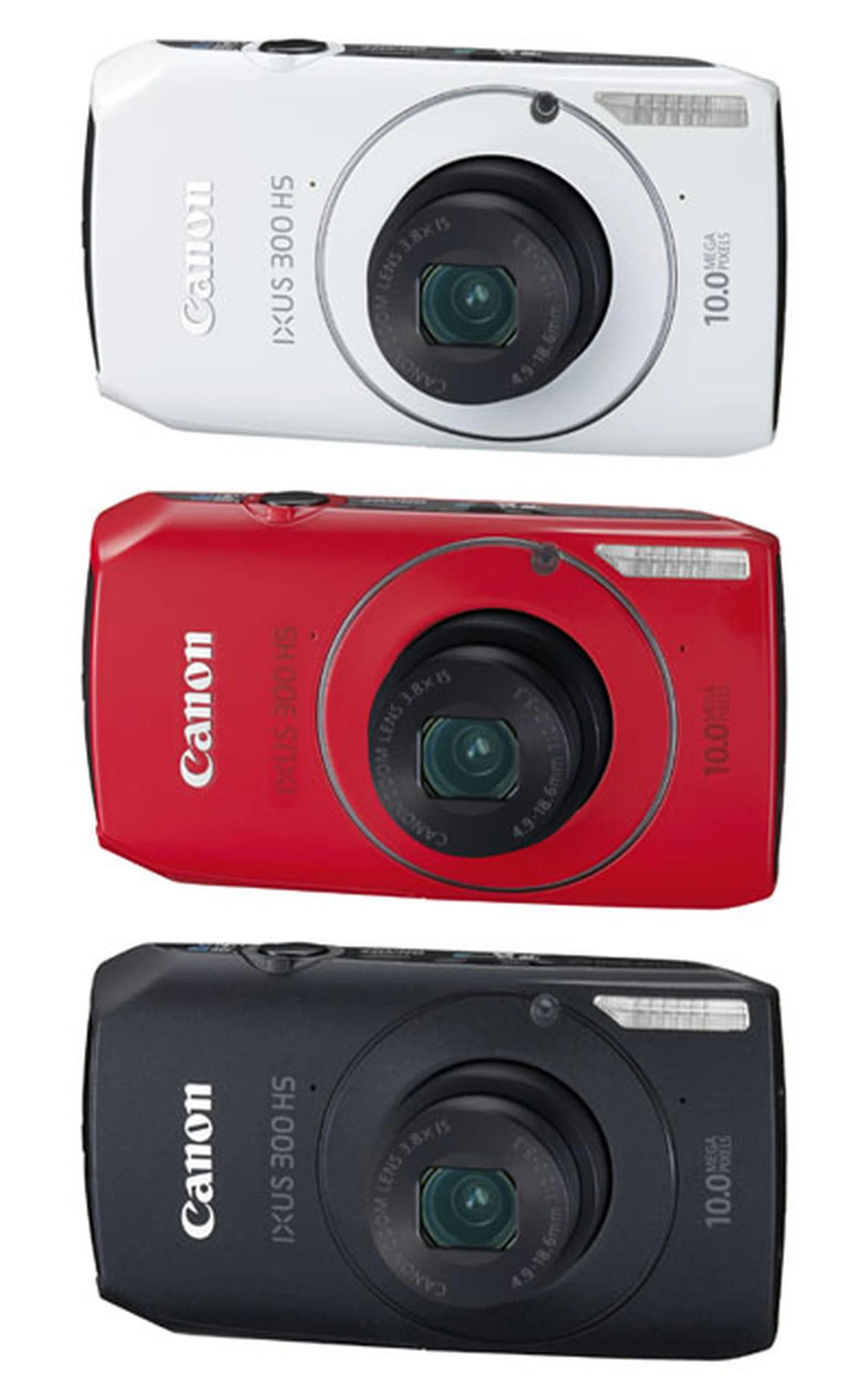
The IXUS 300 HS comes in three stunning colors.
Instead of detracting from the experience, its denseness makes you pause and consider it - like the respect you give a super car when you address its pedal, the IXUS 300 HS' denseness makes you feel like you're using a camera that's a cut above its peers. The IXUS 300 HS possesses a distinctive design with its own voice, and pictures don't do the materials justice - you have to hold it and feel it against the light to appreciate it.
All this attention to its aesthetic form would be less than useful if it disrupts the camera's functionality, and luckily it doesn't - in fact, there's only one thing we don't like about the IXUS 300 HS' physique. Everything else, including the angularly shaped Mode, Power and Zoom controls feel like they're the right sizes at the right places.

The top panel is aptly shaped to complement the angular lines of the IXUS 300.
The back panel is free of extraneous elements. It's mostly taken up by a large 3-inch screen, and complemented by only three buttons, one of which occupies the center of the scroll wheel. The two buttons by the side of the scroll wheel, Play and Menu, are cut at angles, complementing the IXUS 300's bold lines. It's astonishingly clean, and perhaps a bit too clean.

Note the clean rear of the camera - almost too clean to believe!
While the Play and Menu buttons are clearly marked out, the four functions of the scroll wheel (which doubles up as a directional pad) that the four directions control, aren't labeled. For example, pressing the wheel up gives you exposure controls, while pressing right brings on the flash control. The IXUS 300 HS helpfully displays a reminder graphic while starting up the camera to inform you which is which, but going forward depends on your memory, and this is the one place where the camera's physical controls stumble. It doesn't help either that the scroll wheel sometimes feels too small for our large thumbs, but this quibble is subjective.

The graphic shown to remind you which of the four scroll wheel's directional buttons control what. The physical scroll wheel itself is unmarked - great for looks, troublesome for use.
Surprisingly, the IXUS 300 offers more control than we would have expected of a compact camera of its class. Exposure controls lets you under or over-expose your shot. Go beyond Auto mode, and you can set the IXUS 300 on Aperture or Shutter priority (but not fully manual).
Switching between modes is done via the on-screen menu, which is based off a two-step bar on the left. We prefer Canon's older model of menu changes, with individual settings laid out across the top and bottom of the screen, as scrolling up and down for options can get tiresome, especially with the aforementioned problem of big thumbs on a small scroll wheel. So even though manual controls are present, this is an easier camera to use simply set to Auto or Program mode, which is what we think most IXUS 300 HS owners will do anyway.

The two-step side menu bar. Scrolling for options you can't see can be troublesome.
Performance
Most point and shoot users will find the shots of the IXUS 300 HS to be of pleasing quality. Canon promises better than average ISO performance with the HS system, a combination of the camera's back-lit sensor and DIGIC processor. As promised, ISO performance is superb from out testing, producing clean shots up to ISO800, while ISO1600 shots had lower noise compared to other cameras in this class. Amazingly, the IXUS 300 HS' shots at ISO3200 had even less noise compared to the more expensive and larger sensor equipped Canon S90! But that low-noise performance seemed to have come at the cost of an overly aggressive noise suppression system.

The IXUS 300 HS compares favorably to the older IXUS 120 IS, and even has less noise than the 'step-up' model, the PowerShot S90.
While resolution ranks a high 14LPH vertical by 16LPH horizontal on our test charts, we noticed strange compression artifacts lurking amongst the lower resolution lines. Fringing and strange, overly smooth areas in some of our shots point to an aggressive noise reduction engine, which seemed to smother noise at the cost of detail.

Pixelated artifacts can be seen in the vertical lines, which should be clean, in this blow-up of our resolution chart test.
A wide F2 aperture helps you shoot at faster shutter speeds in low-light settings. It also helps you get the soft, blurry background effect known as bokeh. However F2 is only available at the lens's widest, which is a 28mm equivalent, better suited for architecture shots and shots in confined spaces, rather than close portraits. Still, it's a welcome addition as the only other Canon compact camera to get an F2 lens is the S90, which sells for S$150 more.

An F2 lens helps you achieve the soft background effect usually reserved for DSLRs. Shot at F2, ISO800.
Options like Miniature Effect make what you shoot look like little toys, while Fisheye gives you a faux-fisheye lens effect. Another feature called High-Speed Burst lets you shoot up to 8 shots per second, at 2.5MP, up to 250 shots at one time, with slight pauses in-between. The resulting shots are more pixelated than usual, but it's another fun tool in the IXUS 300's arsenal. Zoom lovers should take note that the IXUS 300 HS offers only 3.8x optical zoom. We found 3.8x enough in our tests (it is the 35mm equivalent of 105mm after all) but compact camera owners used to the average 5x zoom might not like taking a hit.

The Miniature Effect automatically blurs out the top and bottom parts of the photo, and punches up the saturation to make real things look like little toys. Image shot at F5.3, ISO500.
The IXUS 300 HS also shoots at 1280 x 720 pixels resolution with adequate quality but the onboard microphone seemed to pick everything up without distinction. The camera can also shoot in slow-motion, which records at 320 x 240 pixels without sound, but it turns out more pixelated than usual video.
Overall, we found the image quality to be above average. We can't say we agree with the decision to sacrifice detail over noise, but we're guessing the average compact camera user won't mind.
Sample Images
These are sample images shot with the Canon IXUS 300 HS. The images have not been post-processed and are copyright to SPH Magazines. We kindly ask that you do not reproduce them elsewhere. Click to see the original full resolution images (which are rather large).

F5.3 at 1/500 sec, ISO250.

F2 at 1/40 sec, ISO800.

F3.2 at 1/40 sec, ISO3200.

F5.3 at 1/30 sec, ISO800 with Miniature Effect.
Conclusion
There's a lot to like about the Canon IXUS 300 HS. Handling is mostly good, best on Auto, although more manual options are available. ISO performance is excellent, but at the expense of some clarity. We're guessing that only pixel peekers would mind as most compact camera users should find the IXUS 300 a capable shooter. At S$599, the IXUS 300 HS is positioned on the high-end spectruem of compact cameras, but that extra gets you so much more in terms of style and performance. And for the design-conscious, there really is no peer today that beats the Canon IXUS 300 HS for sheer style.

The Canon IXUS 300 HS has a unique blend of design, style and performance that perhaps never existed on a compact camera. For the fashion conscious needing a capable compact, look no further.
Our articles may contain affiliate links. If you buy through these links, we may earn a small commission.