
Q3 2006 Midrange GPU Shootout
With virtually all the present generation of graphics cards already on the table, it's timely to conduct a short investigation on which is the best midrange graphics card for your budget. We gathered six such chipsets from both ATI and NVIDIA and ran them through our select benchmarks. Care to lay your bets?
Answering the Question
Anyone who has dabbled in the computing scene should be intimately familiar with the modern phenomenon known as fanboyism. Derived from the term 'fanboy', which originated from the comics scene and gradually expanded in both usage and scope to describe any individual obsessed with the pursuit of certain geek related hobbies, this colorful addition to the English vocabulary retained much of its negative associations (especially to an non-partisan observer) when it made the short hop over to the technology sector.
According to the online Wikipedia (aptly a magnet for its own brand of fanboyism), fanboy refers to someone who is slavishly supportive of his or her 'cause', which can be an operating system, hardware manufacturer or programming language. The Internet explosion of the past decade has only empowered these fanboys to unite and air their views via online forums and blogs. In a medium where relative anonymity encourages people to express their opinions without self-moderation, things can quickly disintegrate into flame wars between the opposing camps. Nowhere in the computing scene exemplifies this better than the competitive graphics scene, where there are only two major manufacturers of discrete 3D graphics cards. The presence of common and repeatable benchmarks only fuels the competition, leading to particularly virulent mud slinging.
For those who are die-hard supporters of either ATI or NVIDIA, nothing will change your minds about your next graphics card purchase. So you can stop reading now, or go ahead and interpret our results in a manner where you can best gloat over the other side. But for the rest whose overriding concern is getting the best performance for their dollar, we aim to show you exactly that for the crowded midrange graphics segment. As the presence of this popular thread on our forums testifies, picking the right graphics card - part of the ritual undergone by all enthusiasts when planning their next system - can be bewildering, especially with all the similar suffixes and labels. While we generally agree with most of the recommendations made possible by this unofficial community effort, we felt that it was timely to answer the question with some benchmark results, if only to validate the recommendations.
Hence, we have rounded up six possible contenders for the midrange price segment, loosely defined as graphics cards that cost between US$80 - US$250. These estimated list prices (exclusive of delivery costs or rebates) are taken from price comparison websites and online retailers. We have also tried to include the local prices; perhaps that may also alert you to the premium you pay the distributors for local service and support. Meanwhile, our stated price range is broadly based on what chipset manufacturers themselves consider their midrange. The table below compares the various graphics chipsets in the spotlight of this article and some of its features and other technical details:
GPU/VPU | NVIDIA GeForce 7600 GT 256MB | NVIDIA GeForce 7600 GS 256MB | NVIDIA GeForce 7300 GT (128/256MB) | ATI Radeon X1800 GTO 256MB | ATI Radeon X1600 XT 256MB | ATI Radeon X1600 PRO 256MB |
Core Code | G73 | G73 | G73 | R520 | RV530 | RV530 |
Transistor Count | 177 million | 177 million | 177 million | 321 million | 157 million | 157 million |
Manufacturing Process (microns) | 0.09 | 0.09 | 0.09 | 0.09 | 0.09 | 0.09 |
Core Clock | 560 MHz | 400 MHz | 350 - 575MHz | 500MHz | 590MHz | 500MHz |
Vertex Shader Pipelines | 5 | 5 | 5 | 8 | 5 | 5 |
Rendering (Pixel) Pipelines | 12 | 12 | 8 | 12 | 12 | 12 |
Texture Mapping Units (TMU) | 12 | 12 | 8 | 12 | 4 | 4 |
Raster Operator units (ROP) | 8 | 8 | 8 | 12 | 4 | 4 |
Z Compare Units | 16 | 16 | 16 | 12 | 8 | 8 |
Memory Clock | 700MHz (1400MHz DDR3) | 400MHz (800MHz DDR2) | 667 - 1500MHz DDR2/3 | 500MHz (1000MHz DDR3) | 690MHz (1380MHz DDR3) | 390MHz (780MHz DDR3) |
DDR Memory Bus | 128-bit | 128-bit | 128-bit | 256-bit | 128-bit | 128-bit |
Memory Bandwidth | 22.4GB/s | 12.8GB/s | 10.6 - 24.0GB/s | 32.0GB/s | 22.1GB/s | 12.5GB/s |
Ring Bus Memory Controller | - | - | - | 512-bit (for memory reads only) | 256-bit (for memory reads only) | 256-bit (for memory reads only) |
PCIe Interface | x16 | x16 | x16 | x16 | x16 | x16 |
Molex Power Connector | NIL | NIL | NIL | Yes | NIL | NIL |
Multi GPU Technology | Yes (SLI) | Yes (SLI) | Yes (SLI) | Yes (CrossFire) | Yes (CrossFire) | Yes (CrossFire) |
DVI Output Support | 1x Dual-Link &
1x Single-Link | 1x Dual-Link &
1x Single-Link | 1x Dual-Link &
1x Single-Link | 2x Dual-Link | 1x Dual-Link &
1x Single-Link | 1x Dual-Link &
1x Single-Link |
Average Local Street Price (S$) | ~ S$305 | ~ S$205 | ~ S$155 | S$369 - S$429 | ~ S$271 | ~ S$200 |
Estimated Online Price (US$) | ~ US$173 | ~ US$119 | ~ US$85 | ~ US$200 | ~ US$129 | ~ US$110 |
The Midrange Contenders
We decided to narrow down our contenders into the following price categories in order to differentiate and judge them fairly, based on their performance, features and price. There's also a short refresh of the various chipsets, in case you have forgotten them. You can also click on the related links for more in-depth coverage of a specific card.
US$151 - US$250 Category
The two contenders here are the heavyweights of the midrange segment. First, from ATI, we have the Radeon X1800 GTO, a stopgap reinforcement that was meant to counter NVIDIA's GeForce 6800 GS (incidentally we did not include this card in our roundup because we wanted to compare the present generation of cards) but which found itself eventually lined up against the then newly launched GeForce 7600 GT. From our unscientific survey of local retailers, the Radeon X1800 GTO is not easily available in local stores. Of the five stores that we patronized, only three carried the Radeon X1800 GTO. Probably as a result of this, the prices of this card can vary from S$369 to S$429. Naturally, there were more variety and models online (though not by much more) and the average price of US$200 seems more reasonable too. It could be that the local price is more 'sticky' and less affected by official price cuts mandated by ATI due to the relatively small number of retailers carrying it (and hence the lower turnover rate). Another thing to note is the presence of a Rage Theater ASIC onboard, which adds VIVO functionality, a feature that is not present on most standard GeForce 7 series cards, but it's standard on all Radeon X1800 GTO models.
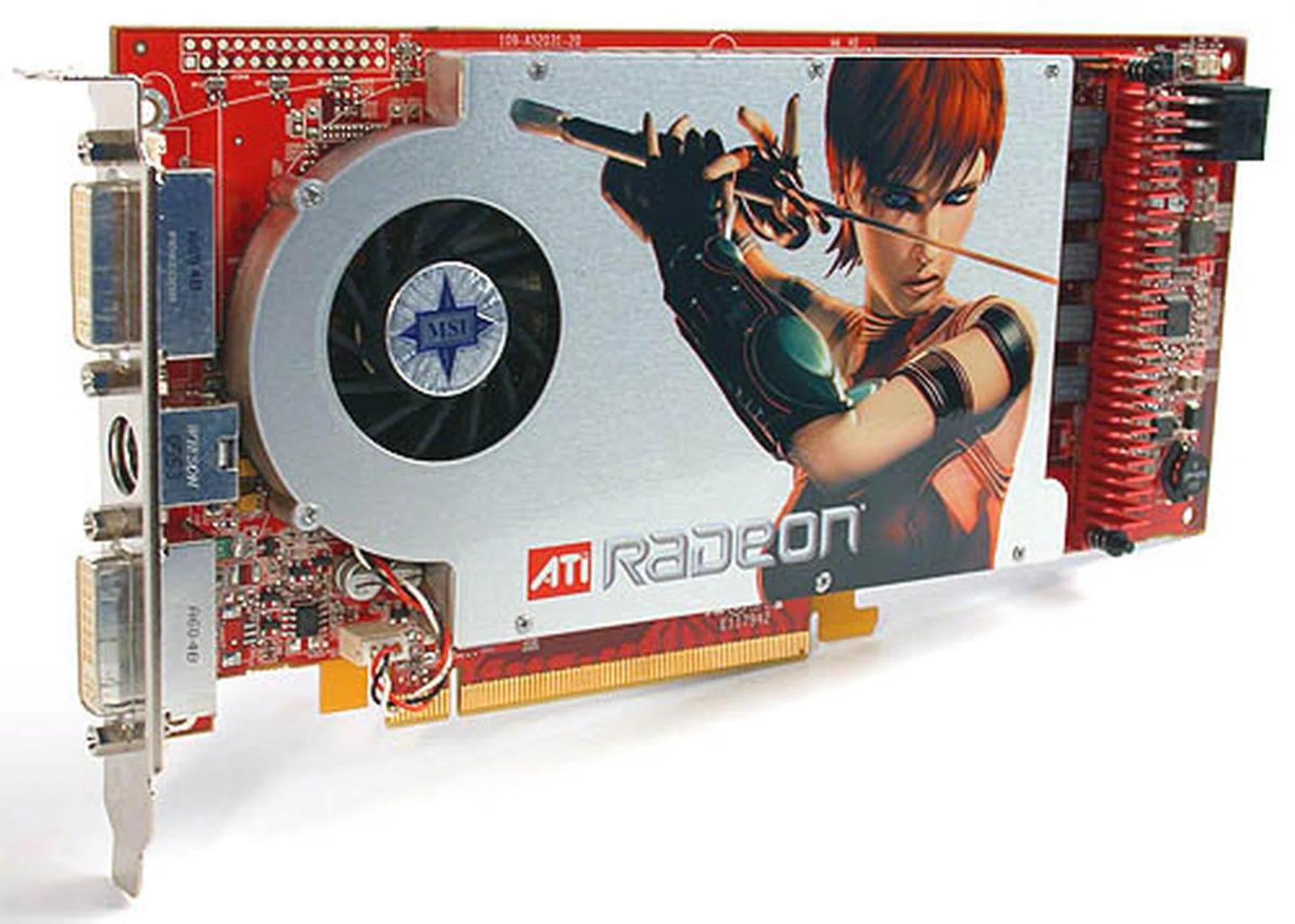
All the Radeon X1800 GTOs that we have seen are reference models, which means you get a giant cooler on a rather long PCB. There's also a Rage Theater ASIC hidden below the cooler. Can you tell that this X1800 GTO is from MSI?
NVIDIA's GeForce 7600 GT was launched with much fanfare at this year's CeBIT and going by the many variants and models released since, it has gained much traction with both the manufacturers and consumers. The designated successor to the popular GeForce 6600 GT, the 7 series version shared many similarities with its predecessor, from the positioning to the attractive price performance ratio. The streamlined core also meant lower cost and consumers can now enjoy dual-link DVI outputs from this new card. While the memory bus width remained at 128 bits, the faster core and memory speeds ensured that it stays competitive. The association with the best-selling GeForce 6600 GT also helps and the GeForce 7600 GT is one of the more popular cards in retail now, with offerings from many brands. Prices therefore tend to be quite competitive and while they may differ in clock speeds and cooling approaches, a typical GeForce 7600 GT can be had for around US$173.
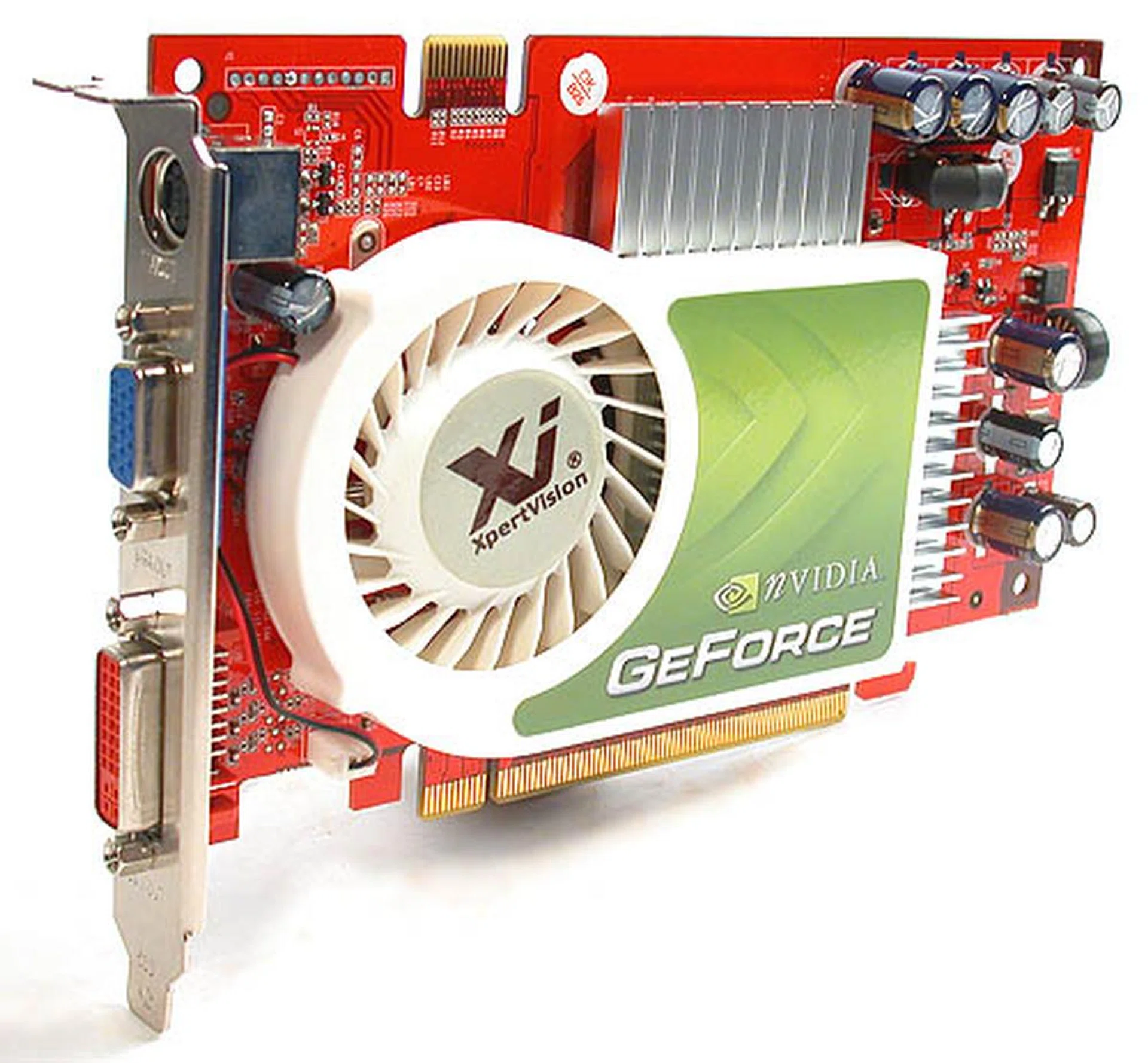
The already excellent price performance ratio of the GeForce 7600 GT improved further with this overclocked version from XpertVision. A deserved winner of our Most Value for Money award, this card exemplifies the customization found in many GeForce 7600 GT cards. To be fair in our overall judgement of this class of cards, we used the standard reference clocked version.
US$100 - US$150 Category
ATI's intended midrange representative of the Radeon X1000 series was the Radeon X1600 XT. At its debut, we found its performance in 3DMark05 quite startling, due to the heavy emphasis on shader processing prowess of this chipset. No doubt ATI felt that the trend in PC games justified their decision but in quite a few games, the new midrange Radeon was not that much faster than the GeForce 6600 GT as developers failed to follow the lead. We also took issue with the noisy cooler on the reference model and a couple of other retail models, though that has improved somewhat with subsequent models from the usual vendors, especially with the passively cooled versions. Beware of the all-passive models as they can generate a fair bit of heat though. Performance took a slight boost with newer drivers while the US$129 average retail price of this card puts it lower than the typical GeForce 7600 GT and improves its price performance ratio. Unfortunately, NVIDIA has already planned a rival for this card in the form of the GeForce 7600 GS.
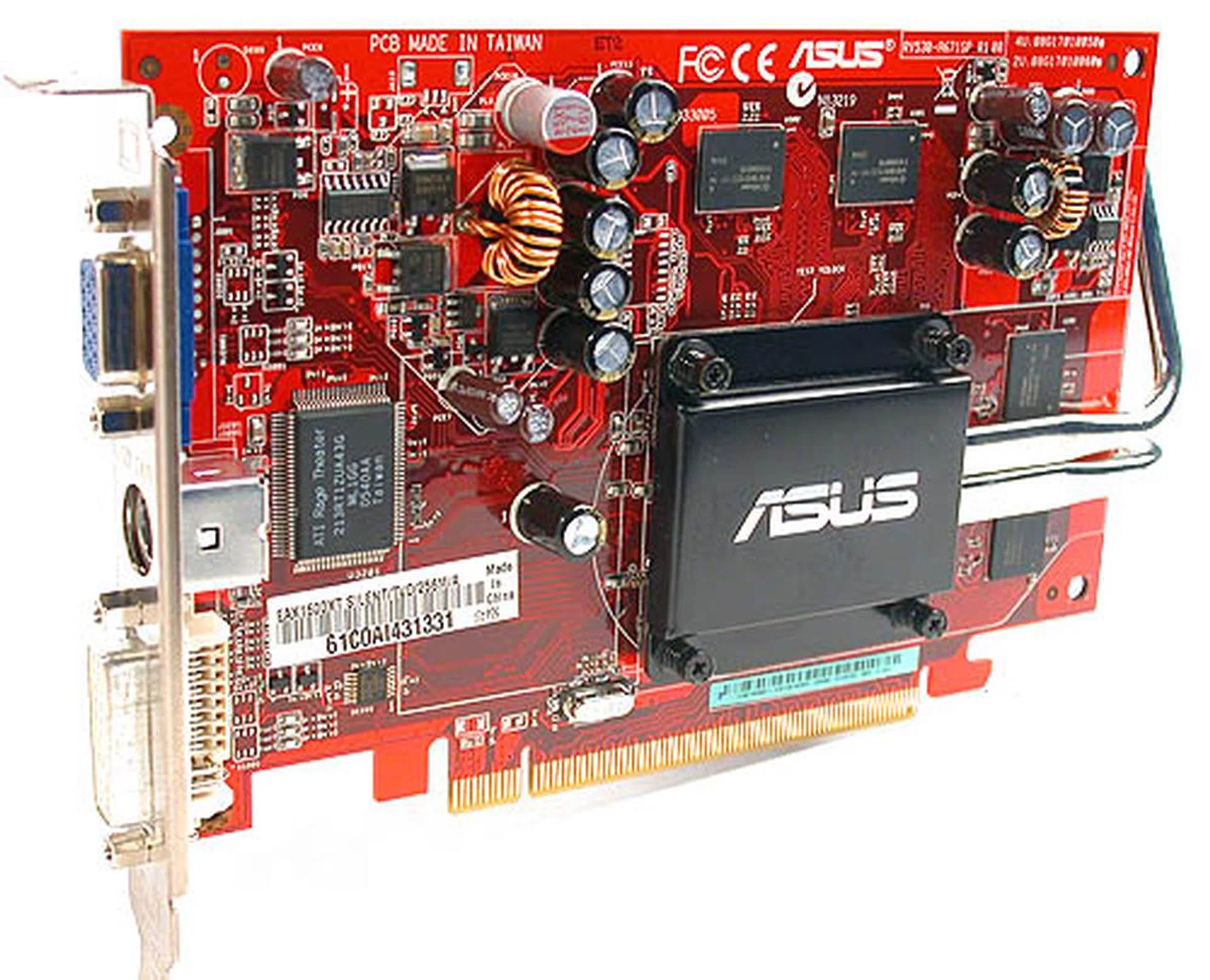
The silent version of the Radeon X1600 XT is a great improvement from the noisemaker that was the reference design. However these carry a higher premium. We've used a standard fanned version for competitive comparison in this article, which best represents the majority.
So we come to the lesser known GeForce 7600 GS, which we felt has been overshadowed by the faster GeForce 7600 GT. The recent introduction of the GeForce 7300 GT has also added more competitive pressure on this particular chipset. However, in its price range, it has an excellent price advantage over the Radeon X1600 XT, especially coupled with its more than decent performance. While we feel that the GeForce 7600 GT looks to be more popular, there is no lack of GeForce 7600 GS cards in stores here and over the Internet. Its attractive pricing of around US$119 on the average already gives it the edge over the Radeon X1600 XT.

The latest attempt by ASUS to add more spice to the GeForce 7600 GS. This rather ambitious version combines unique passive cooling with 512MB of memory and overclocked core and memory frequencies. Talk about excessive. However, the enhancements are not as effective as it seems on paper. In any case, we've stuck to the reference class variant in this shootout with normal clocks and a 256MB frame buffer.
US$80 - US$99 Category
Finally, we move to the lower tier of the midrange, where some of these cards may possibly be considered as low-end by more exacting users. For less than a hundred bucks, these cards should allow you to play most modern games comfortably at minimal settings. This means a maximum resolution of 1024 x 768 and depending on the game and exact specifications of the card, disabling some of the eye candy options in the game might be required. And then, you may just get a barely passable gaming experience. However, if you mostly dwell on MMORPG, adventure, turn-based and yesteryear games, this segment of graphics cards can serve you very well.
First up, we have the lower clocked member of ATI's Radeon X1600 series, the Radeon X1600 PRO. The drastic drop in memory clock speeds in particular, has a massive and detrimental effect on performance. Whether the unique features of the Radeon X1000 series, like Avivo technology and Shader Model 3.0 support are attractive enough on their own to convince users to buy into the technology when faced with these mediocre benchmark scores is debatable. For those who are interested, the Radeon X1600 PRO hovers around the US$100 mark though there a couple of models that cost less than that.
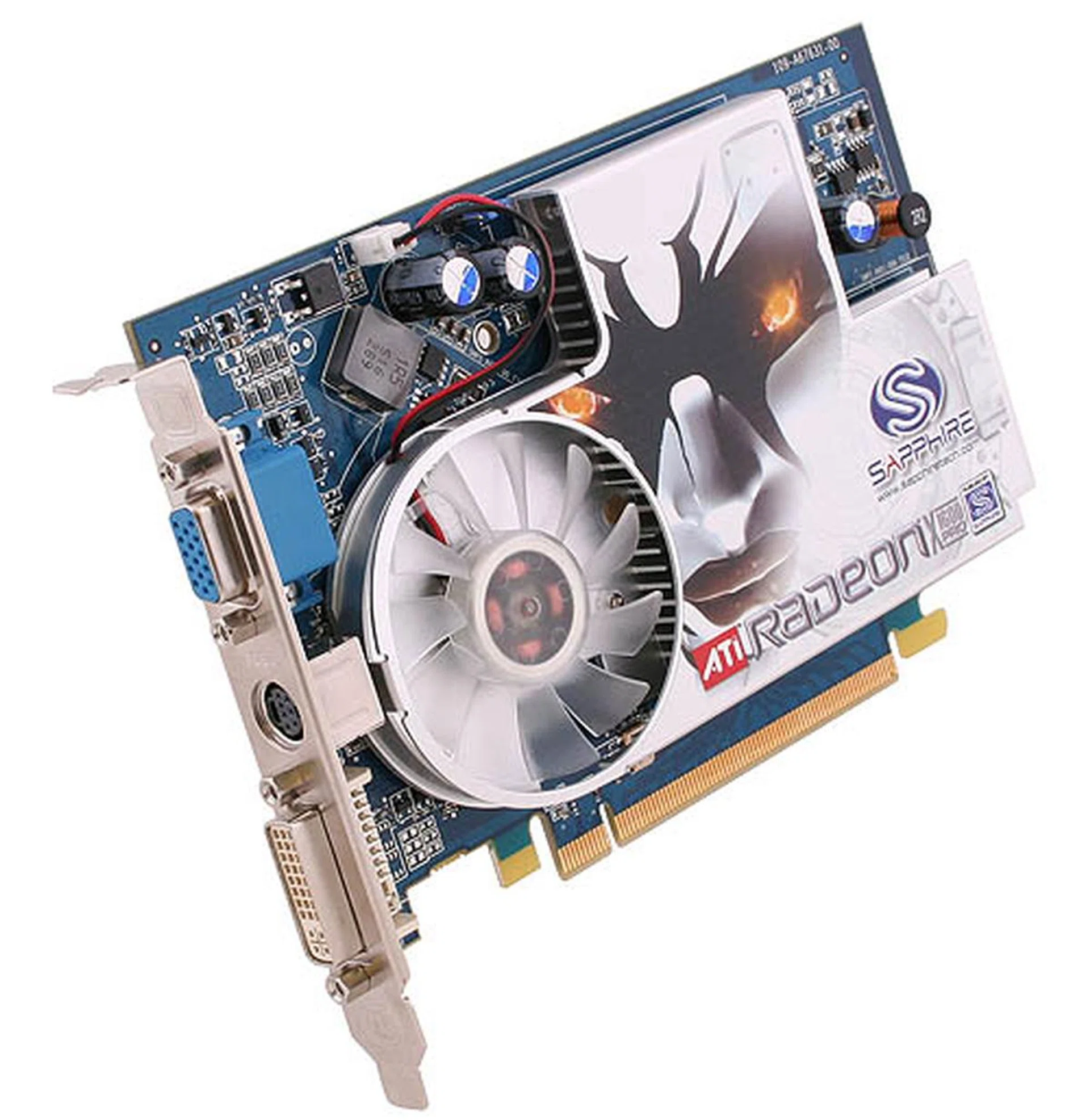
We haven't actually covered a retail version of this less powerful member of ATI's Radeon X1600 series for a full review but those on a budget may consider it if only for the technology found in the Radeon X1000 series. There are also AGP variants for users still stuck on older motherboards.
As for NVIDIA, its latest lower midrange darling seems to be the GeForce 7300 GT. This new chipset reuses the G73 core found on the higher GeForce 7600 series but with some pipelines disable to distinguish between the two. However, this is balanced by potentially high clock speeds. NVIDIA has allowed manufacturers to customize the configurations of their GeForce 7300 GT and we have seen special editions capable of beating the GeForce 7600 GS, along with cheaper ones that have clock speeds of only 350MHz compared to the 575MHz of the fastest ones. Therefore, the prices for the GeForce 7300 GT can vary quite drastically, though at the moment, we have only seen limited models so far locally at S$155, as this is a relatively new product. From what we found, the average price for this from online retailers is around US$85 and you'll probably get a 256MB variant using DDR2 memory. In our comparison, we've a GeForce 7300 GT DDR2 TurboForce card that's clocked at 450/800 MHz DDR and is available within this stipulated price bracket. Furthermore, its clock speeds present itself as a sweet spot between the lowest and highest clocked GeForce 7300 GT cards and should represent this category of cards quite well.
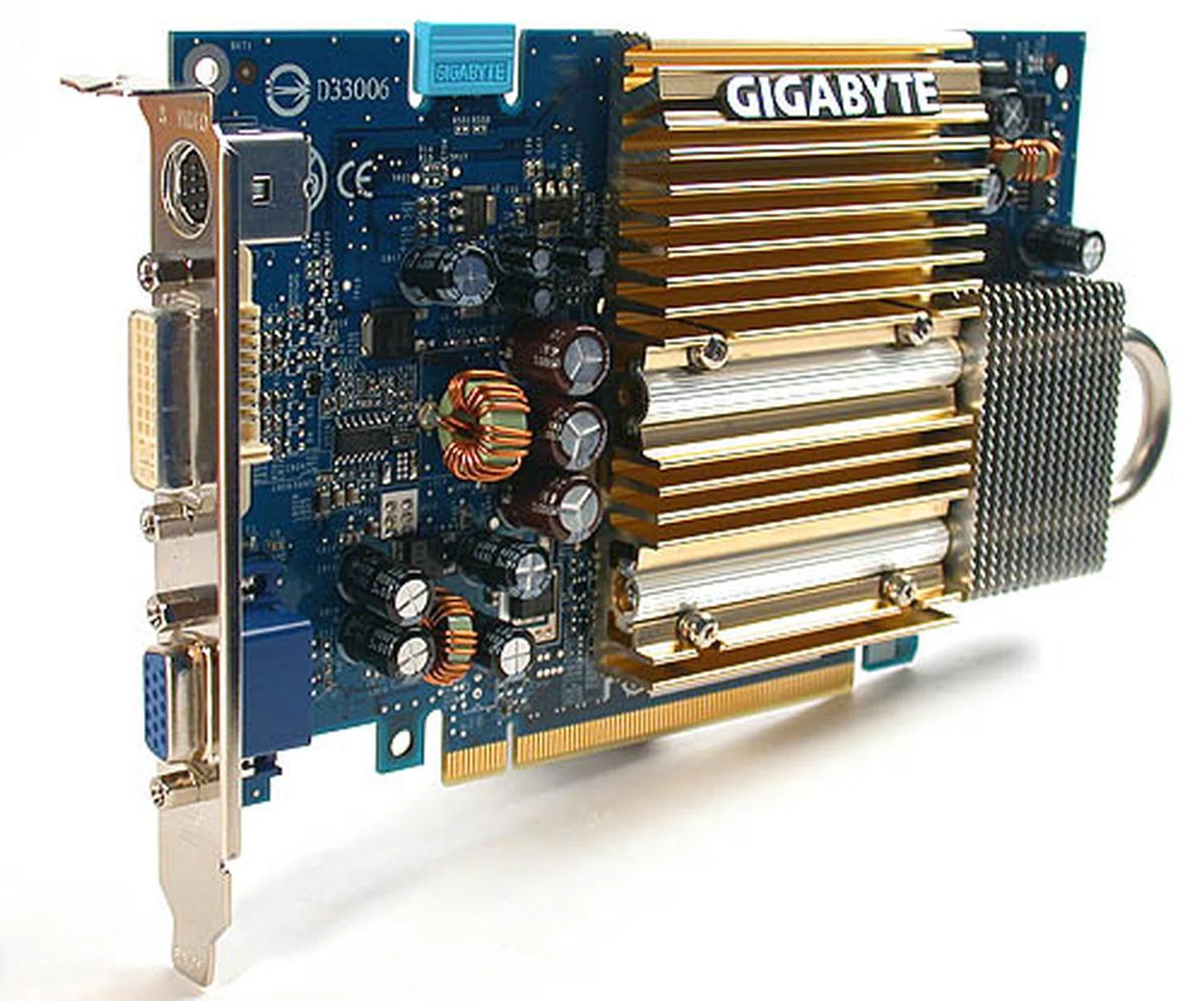
The newest member to the NVIDIA stable, the GeForce 7300 GT spans the low to midrange due to the broad specifications set by NVIDIA. Vendors are jumping onto this bandwagon because these relatively affordable graphics cards should be quite popular with the mainstream audience. Enthusiasts on a budget may also be pleasantly surprised at the performance from some of the faster variants.
Test Setup
All the graphics cards were benchmarked on a common test bed anchored by a MSI K8N Diamond Plus motherboard. An Athlon FX-55 (2.6GHz) processor and 1GB of low latency Kingston DDR400 RAM (dual channel mode) were installed, along with a Seagate 7200.7 SATA hard drive. The operating system of choice (rather the only realistic one for gaming) is Microsoft's dominant Windows XP Professional, which we had to patch with the latest Service Pack 2 and other updates. The latest DirectX 9.0c update was also installed to ensure that all the games ran without any issues.
The NVIDIA representatives were all tested with the beta ForceWare 91.29 drivers while Catalyst 6.5 was used for the ATI contingent. Altogether, we included six graphics cards from the present generation, three from each chipmaker. To show how much we have progressed (or not) from the previous generation of graphics cards, we have included the midrange favorite of many enthusiasts, NVIDIA's GeForce 6600 GT as the baseline which we would compare our cards against, giving us up to seven sets of benchmarks.
For this comparison, we decided to streamline our usual benchmarks so as to minimize any known bias for or against any chipset manufacturer. However, we did have to consider the present gaming scene such that the games we included would be the more popular game titles or game engines that would stress the 3D capabilities of these midrange chipsets. Below is the list of benchmarks tested:
- Futuremark 3DMark05 Pro (version 120)
- Futuremark 3DMark06 Pro (version 102)
- Tom Clancy's Splinter Cell 3: Chaos Theory (version 1.3)
- F.E.A.R
- Quake 4
Results - 3DMark05 Pro & 3DMark06 Pro
One of the big names when it comes to benchmarking, Futuremark's series of graphical tests has firmly entrenched itself in the industry, having gone through six revisions since 1999. Despite some controversial incidents in the past regarding its objectivity as a benchmark, 3DMark is a staple among hardware enthusiasts and review sites due to its ease of use and availability for casual users. The large installed user base also helps, along with the online comparison feature that allows enthusiasts to find out where their custom configurations rank.
We decided to include both the latest version, 3DMark06 and the older 3DMark05 because the newer 3DMark06 severely ups the ante on challenging your graphics subsystem and the typical midrange system may find it much too intensive. Users with these systems are unlikely to have transitioned to 3DMark06, hence 3DMark05 is still useful as a comparison, though its shader intensive tests would seem to give ATI's architecture the edge over NVIDIA.
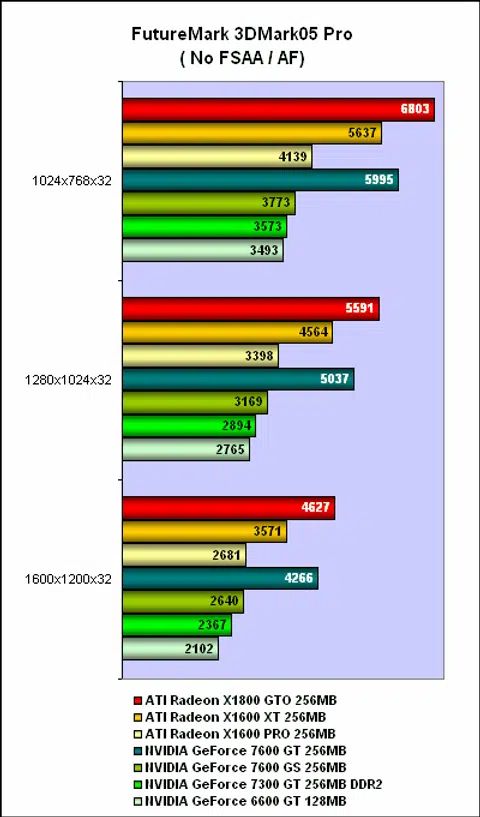
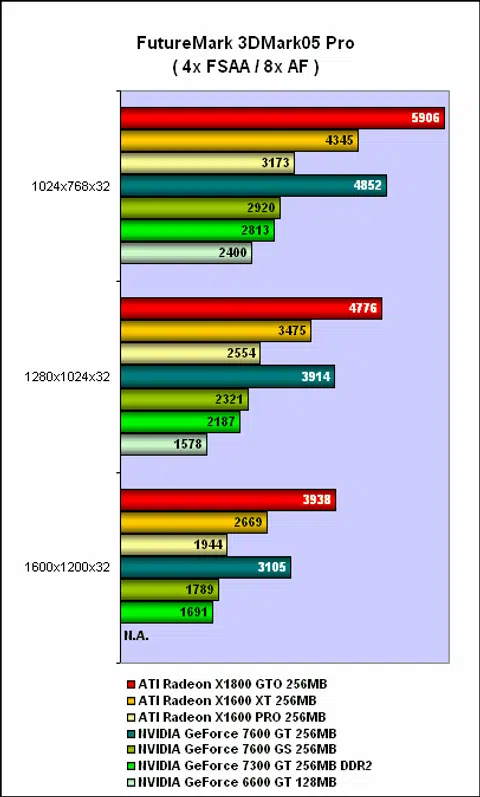
As the results for 3DMark05 show, ATI cards all did extremely well for this benchmark, with the Radeon X1800 GTO leading the way. NVIDIA's GeForce 7600 GT only managed a slight lead over the Radeon X1600 XT and was distinctly behind the GTO. Even the weakest from the red team was able to match the GeForce 7600 GS in this benchmark and this situation remained throughout the testing, with or without anti-aliasing.
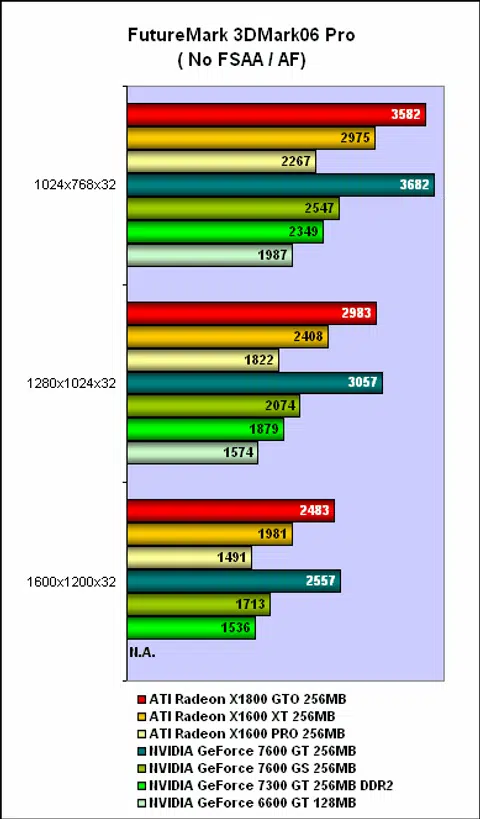
It was a closer fight between the top representatives from both sides in 3DMark06. The gap between the Radeon X1800 GTO and the GeForce 7600 GT was quite narrow at around 3%. However, the Radeon X1600 XT still outscored the GeForce 7600 GS for this benchmark. An indication of how much more intensive is the 3DMark06 version - the older GeForce 6600 GT could not complete the final test at 1600 x 1200 due to its 128MB frame buffer. Another point to note is that NVIDIA cards are incapable of finishing this benchmark at all settings. Due to its core architecture, they are unable to combine High Dynamic Range (HDR) rendering when anti-aliasing is enabled.
Results - Splinter Cell: Chaos Theory (DirectX 9 Benchmark)
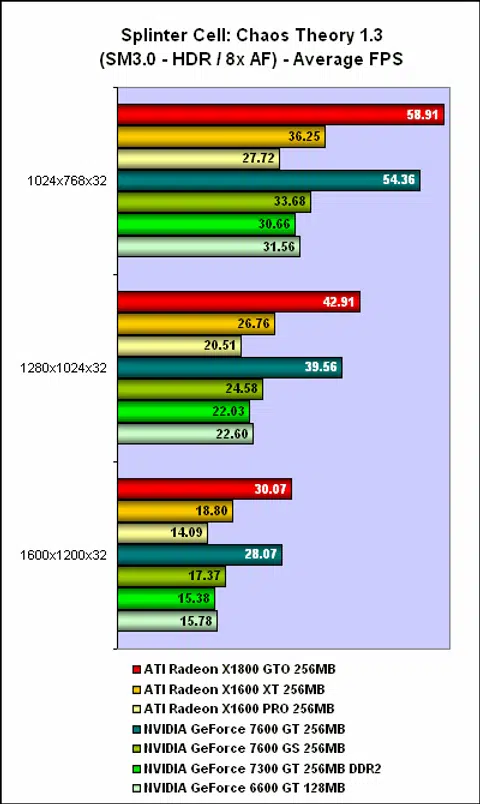
There are probably quite a few more recent titles out there compared to Splinter Cell: Chaos Theory (it's been available for more than a year) but for a midrange shootout, this game poses enough challenges and its stealthy style of game play is a refreshing change from the typical shoot fest. We tested the cards with HDR and the Radeon X1800 GTO emerged as the winner, comfortably ahead by between 3% between 7%. With the exception of the Radeon X1600 PRO (the slowest of the lot), all the ATI cards did reasonably well against the NVIDIA contingent. An interesting result was the decent performance of the GeForce 6600 GT, which was quite playable at around 30 frames per second at 1024 x 768.
Results - F.E.A.R (DirectX 9 Benchmark)
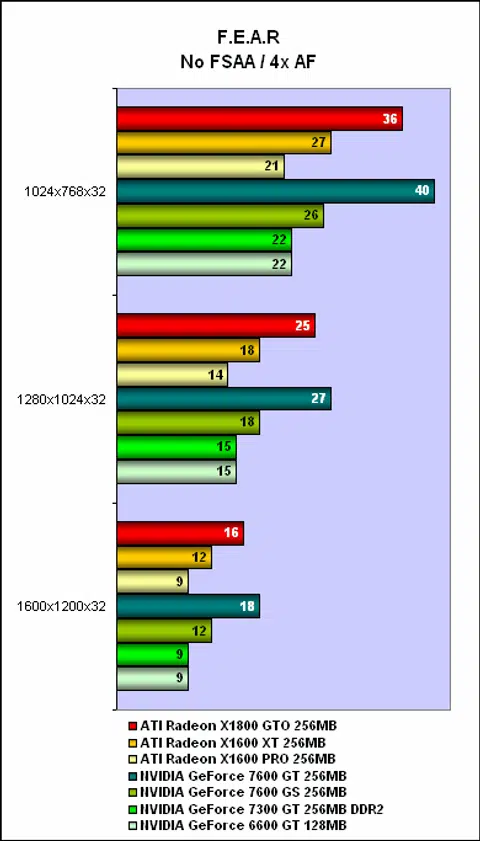
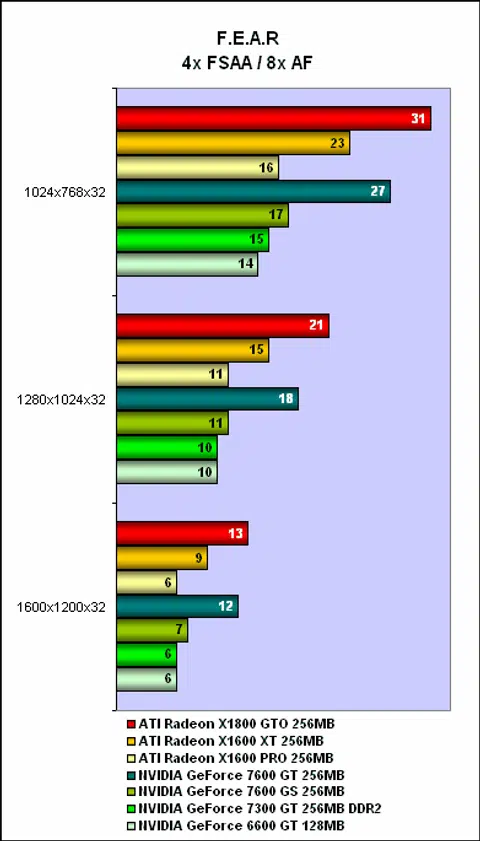
When it was first released, F.E.A.R made its mark for bringing even high-end graphics cards to their knees thanks to its use of the latest graphics advancements. Hence, this game was duly selected as one of our benchmarks. With most of the settings set to high, we managed to get playable performance from only two cards in the midrange segment, naturally the Radeon X1800 GTO and GeForce 7600 GT and that too at 1024 x 768. For the other cards, we would recommend that you thumb down the in-game graphics quality settings to avoid a slideshow experience. Overall, ATI cards seem to handle the transition to anti-aliasing more gracefully, as the drop in frame rates was less drastic compared to NVIDIA. However, that point may be moot as the best ATI card here, the Radeon X1800 GTO barely manages to produce decent frame rates in the first place with anti-aliasing. This shows that ATI has a superior graphics engine, but not necessarily helpful at this level of play.
Results - Quake 4 (OpenGL SM2.0+ Benchmark)
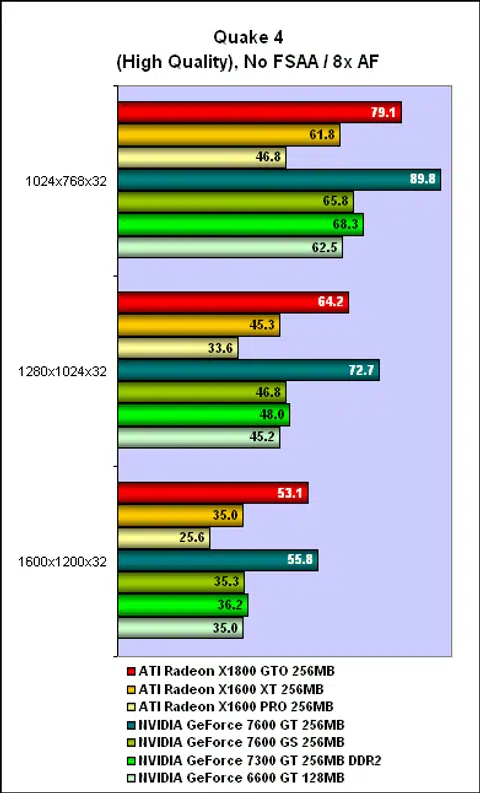
There would probably be quite a few ATI fanboys jumping on us for including Quake 4 in our benchmark list. Historically, ATI hasn't done that well compared to its rival for OpenGL games but to give the red team credit, they have improved the performance of their cards with tweaks in the Catalyst drivers. Especially with antialiasing enabled, the effect has been quite noticeable and we feel that it would be wrong to write ATI off here. Besides, the Quake franchise and game engine is still one of the marquee names in the industry and quite a number of games have been and will be utilizing the various engine versions. Meaning, it's difficult to avoid the Quake engine unless first person shooters are not your cup of tea.
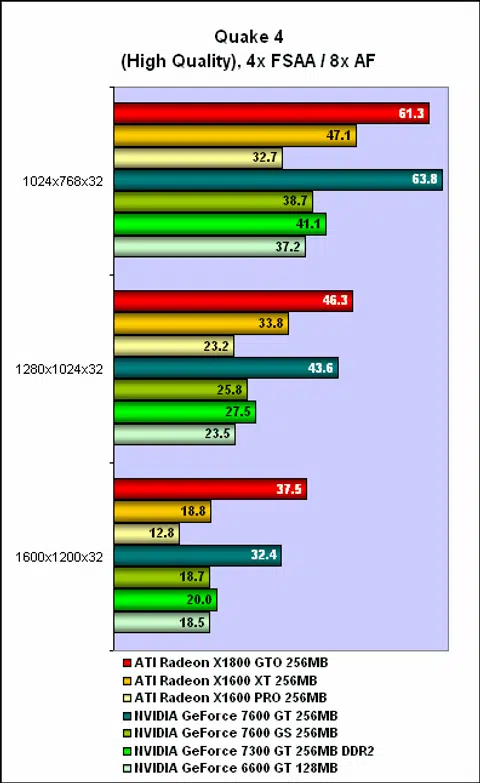
And the results do show the impressive gains made by ATI for Quake 4. The Radeon X1800 GTO puts up a stern challenge to the GeForce 7600 GT and only just lost out when antialiasing was not enabled. So perhaps it wasn't that much of a surprise when the X1800 GTO overtook the GeForce 7600 GT at the higher resolutions with antialiasing enabled. The second ranked ATI card, the Radeon X1600 XT also showed competitive scores and fared quite well against the NVIDIA cards. It even lead the GeForce 7600 GS when anti-aliasing was enabled, dispelling any notion that ATI cards are not up to the challenge of OpenGL games like Quake 4. Also, despite the fact that we are looking at midrange cards, games too are taking advantage of the greater rendering power available to them so with the antialiasing enabled, 1024 x 768 is your best bet for reasonable performance. Fortunately, that too seems to be a resolution favored by many users still. However, if you are not very particular of gaming quality, you can opt to forgo antialiasing and bump up the resolution by a notch. Some prefer the latter method because it yields the same net effect and is actually less taxing on the graphics card.
Aggregate Performance
The purpose of doing this survey of the midrange graphics segment and their performance in certain popular benchmarks and games allows us to find out which graphics card gives you the best value in this segment. It also allows us to find out how much we have progressed from the previous generation of GPUs. To answer these questions, we have aggregated our benchmarks results to form a composite index for all the cards tested. Using the midrange symbol of the last generation, the GeForce 6600 GT as the baseline, we compared how this generation of chipsets fared against it. For those who want more specific results, here is a table summarizing the performance gains moving on from the GeForce 6600 GT to each of the newer cards:
Performance Gain / Loss Compared against the NVIDIA GeForce 6600 GT 128MB | ATI Radeon X1800 GTO 256MB | ATI Radeon X1600 XT 256MB | ATI Radeon X1600 PRO 256MB | NVIDIA GeForce 7600 GT 256MB | NVIDIA GeForce 7600 GS 256MB | NVIDIA GeForce 7300 GT 256MB DDR2 |
3DMark05
(No FSAA / AF) | 102.96% | 64.43% | 21.86% | 82.09% | 14.06% | 5.46% |
3DMark05
(4x FSAA / 8x AF) | 174.37% | 100.63% | 47.03% | 125.10% | 34.38% | 27.90% |
3DMark06
(No FSAA / AF) | 84.89% | 51.35% | 14.92% | 89.76% | 29.97% | 18.80% |
Splinter Cell
(SM 3.0, HDR, 8x AF) | 88.44% | 16.82% | - 11.07% | 74.35% | 8.07% | - 2.69% |
Quake 4
(No FSAA / 8x AF ) | 36.72% | - 0.50% | - 25.69% | 51.91% | 3.74% | 7.05% |
Quake 4
(4x FSAA / 8x AF) | 82.32% | 24.67% | - 14.07% | 75.92% | 4.73% | 11.52% |
F.E.A.R
(No FSAA / 4x AF) | 67.93% | 24.70% | - 3.94% | 85.91% | 22.42% | 0.00% |
F.E.A.R
(4x FSAA / 8x AF) | 117.38% | 57.14% | 9.64% | 91.43% | 17.38% | 3.57% |
As for the benchmarks used to create this composite index below, we took one set of results from each of the benchmarks (to avoid overweighing the importance of any benchmark), meaning where we've more than one set, i.e. with and without anti-aliasing, we would choose the appropriate results to use. For instance in F.E.A.R, we took the set of results without anti-aliasing. This is because with the eye-candy turned up, all the cards involved in this comparison returned rather pathetic and unplayable scores, which we felt would not reflect the actual performance setting of an actual gamer. Similar considerations affected our decision to opt for the same approach for Quake 4. However, we did choose the anti-aliasing set of results for 3DMark05, since that was a synthetic test of GPU prowess and should distinguish the limits of each GPU.
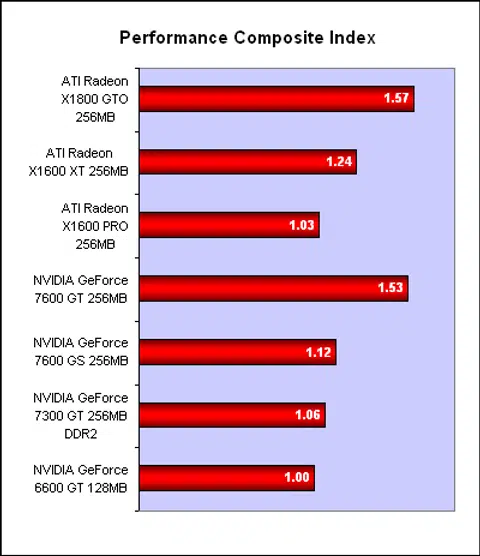
Finally, we compared the performance of the cards against that of the GeForce 6600 GT and aggregated the difference (mostly performance gain) with respect of the veteran card. So in the index below, the GeForce 6600 GT assumes the baseline with a score of 1.00. The score of 1.57 for the ATI Radeon X1800 GTO for example, means that it is up to 57% faster than the GeForce 6600 GT. From our index, ATI's Radeon X1800 GTO had the best performance for our set of benchmarks, narrowly beating the GeForce 7600 GT. The much better performance of the GeForce 7600 GT compared to the Radeon X1600 XT was also the reason why ATI had to reinforce its midrange with the Radeon X1800 GTO earlier this year. In any case, the ATI's solutions had the best absolute performance when compared to NVIDIA's equivalent competitors. However, at what cost is this performance achieved? Is the performance advantage linear to its price tag? The following page focuses on the performance-to-price ratio that will answer these questions.
Price Performance Index
This section is where we finally answer the question of which midrange graphics card provides the best value. To get our results, we surveyed the prices of similarly configured models of each chipset from online price comparison websites to get an average retail price (which has been listed in the table of the very first page of this article). This means that it's possible to find even cheaper deals for your preferred chipset with some patience over the Internet. Then, we used our results from the composite performance index to derive this price performance index as illustrated below. Just note that higher figures mean more performance per dollar spent:-
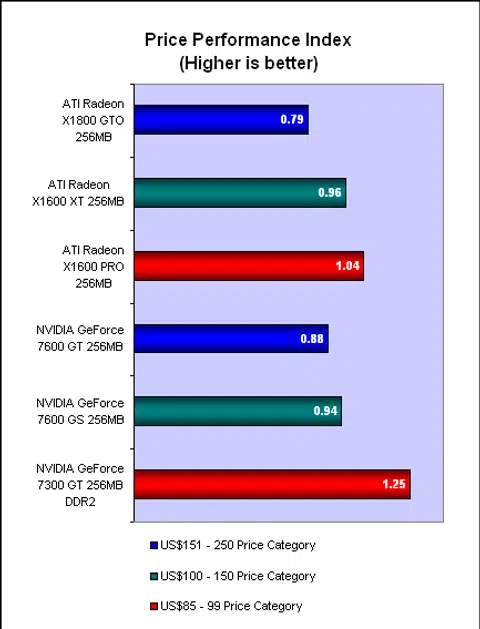
Surprised at the result for the GeForce 7300 GT? The NVIDIA cards emerged as having the superior performance per dollar ratio for each distinct price category mentioned. This is mainly because of their more competitive pricing and performance that's not all that different from ATI's pedigree. Of course, there are exceptions when one could argue for the other side. For example, all ATI cards are capable of rendering HDR with anti-aliasing enabled, something that NVIDIA is unable to replicate easily without developer support. The only downside to that is for midrange cards, the likely severe performance hit for using HDR may render this issue academic. The Radeon X1800 GTO also comes with VIVO functionality and for some users that could justify the higher price tag. Also, we found that some of the 'lesser' cards (performance-wise) topped the table for this particular measurement. That too is also reasonable with hindsight that the much lower prices of these cards more than offset the performance gap. However, for those who need the frame rates, it may not be too useful to rely on this index to choose your graphics card because some games require a certain amount of competence to run properly. This index does however still serve its purpose when interpreted correctly by comparing the price performance index within the appropriate price category of graphics cards - which is our main reason for this page in the first place.
Conclusion
At the risk of sounding politically incorrect and more than a bit shallow, we would like to venture that appearances are everything. Or as we paraphrase it for this context, public perception is paramount for any business. Economists have always known that their 'science' is not grounded in immutable laws of nature. Instead, the world's economy works on a complex balance of trust and confidence. After all, it does seem rather foolhardy to trust a system where money and assets are exchanged invisibly through information flows and in our modern age, without any human intervention even. So how does that relate to the graphics industry as we understand it?
First, an interesting morsel of information – for the second quarter of this year, NVIDIA actually lost market share in the desktop graphics segment to ATI despite the seemingly successful launch of its GeForce 7600 and GeForce 7900 series. Surprising as it may sound, the reality is that OEMs are the big players in the market that sign huge volume deals with various vendors and that their impact is not only limited to integrated solutions. They extend to desktop graphics and they more than anything, decide the fate of total graphics sales. Hence, despite our observations that NVIDIA has accrued much mind share among consumers for its discrete graphics offerings, the bottom line turned out to be otherwise.
Therefore, this article serves to confirm if our usual midrange graphics recommendations (akin to our perceptions) have any basis in reality by testing the card's worthiness with benchmarks and taking in account the prevalent retail price now. So far, things seem to be going according to script, with NVIDIA scoring very well for in our price performance index, though the Radeon X1800 GTO was the best absolute performer in our benchmarks.
Before we declare the winners for each price category, we would like to reiterate that there are other factors that should influence your buying decision besides price and performance. Namely, temperature, noise output and power consumption. Luckily, for most of the chipsets that we have seen, there are so many variants, from overclocked ones to passive coolers that for any given chipset, you should be able to find the appropriate card to fit your needs. However, we do have to admit that NVIDIA has the edge here, as evident from the fact that all three of its chipsets highlighted here have silent, passively cooled versions and have been found to be running cooler than the ATI's passively cooled counterparts time and time again from our testing. Even the fanned versions of NVIDIA cards were found to be operating quieter and cooler than ATI's bunch. Power consumption too would seem to favor the green team due to the more efficient architecture of the GeForce 7 series. ATI does have its own merits, from qualitative aspects like perceived image quality to technological features not possible on the NVIDIA cards. Meanwhile, ATI is slated for one last push in October with the upcoming Radeon X1950 XT and X1650 XT that may turn the tide against NVIDIA, though we have to wonder if they are appearing too late in the game to have much impact.
So here are our winners for the various price categories. For the lower scale midrange segment, the outstanding GeForce 7300 GT beats all comers with its excellent price performance ratio (the best of the bunch) and the flexibility of the chipset means that consumers may have a wide choice of configurations to choose from. The Radeon X1600 PRO may find traction among OEMs however, but since we're dealing with the retail scene, it is only appropriate that our Winner for the US$80 – US$99 price category goes to the NVIDIA GeForce 7300 GT.
The Winner for the US$100 – US$150 price category was a closer affair, as these two chipsets are mostly similar in features and performance. In the end, price had to be the tie breaker between the two and based on its price performance ratio, we chose the NVIDIA GeForce 7600 GS as our winner. While pure performance swayed in favor of the Radeon X1600 XT, it was only at its best in synthetic benchmarks, but the less expensive GeForce 7600 GS showed that it's equivalently competitive in actual games, which is what matters most. Furthermore, the GeForce 7600 GS has a lower power envelope and is available with passive coolers by stock, meaning that it's silent. You can definitely get a Radeon X1600 XT in silent versions too, but they are going to be quite a bit more expensive that you would think if topping up to the next performance rung would be a better option. The choice is yours, but the GeForce 7600 GS is our logical winner.
Finally, for the cream of the midrange crop, the more expensive GeForce 7600 GT versus the Radeon X1800 GTO, NVIDIA's solution was once again our pick. The Radeon X1800 GTO had a slight lead against the GeForce 7600 GT in the performance stakes. But we felt that price was an equally important consideration in this segment, though as we had repeated before, if you value the VIVO functionality found on practically all Radeon X1800 GTO cards and other ATI-only features, then the Radeon X1800 GTO is your only choice within this price bracket. On the other hand, if you doubt that you will be playing your HDR games with anti-aliasing (which we tend to agree given the midrange GPU's caliber), then the better value for your dollar and our Winner for the US$151 – US$250 price category would undoubtedly be the NVIDIA GeForce 7600 GT.
 |  |
|  |
|  |
Our articles may contain affiliate links. If you buy through these links, we may earn a small commission.