
Intel Core 2 Quad Q9550/Q9450 - 45nm Prevails
After a long wait, DIY enthusiasts finally get a wider spread of 45nm processors. Case in point today is the performance review of the Intel Core 2 Quad Q9550 and Q9450 processors that will eventually retire the current Kentsfield quad-core processors. So read on to see how the newcomers fare.
More 45nm Goodness for Quad-Core Processors
Intel has been successfully retailing 45nm processors since the last quarter to 2007, but as per recent tradition, they've only debuted a single 'champion' SKU in retail with the Core 2 Extreme QX9650. Acting as a showcase to their engineering prowess, the QX9650 is 3.0GHz processor with 12MB of L2 running on a 1333MHz FSB. Though expensive, Intel does have all the advantage to charge a premium as it desires since the competition could barely churn enough Phenom processors at launch (not to mention any competitive ones). Intel on the other hand, has made strategic offerings to best support its overall production of Penryn and Harpertown processors (both of which are 45nm processor codenames) for the desktop and workstation segment respectively.
By the mid of first quarter in 2008, Intel has built up enough volume to expand its 45nm processor family in all segments. The workstation segment saw the introduction of low-powered 50W TDP based Harpertown processors with lower voltage operation, while the high performance notebook segment is slowly introducing the Intel T9000 and T8000 series 45nm processors that feature more cache than its predecessors and supports the new architectural enhancements found on the 45nm processor designs. And finally for the DIY enthusiasts, Wolfdale dual-core and more Penryn 45nm processors have begun populating the retail stores. Case in point today is the performance review of the Intel Core 2 Quad Q9550 and Q9450 processors that will eventually retire the current Core 2 Quad 6000 series processors. Here's how Intel's desktop quad-core processor lineup looks like at the moment:-
Processor Model / ProcessorCharacteristics | Clock Speed | L2 Cache | Front Side Bus (MHz) | Max TDP (W) | Estimated Price (US$) |
Core 2 Extreme QX9650 | 3.00GHz | 6MB x 2 | 1333 | 130 | $999 |
Core 2 Quad Q9550 | 2.83GHz | 6MB x 2 | 1333 | 95 | $530 |
Core 2 Quad Q9450 | 2.66GHz | 6MB x 2 | 1333 | 95 | $316 |
Core 2 Quad Q9300 | 2.50GHz | 3MB x 2 | 1333 | 95 | $266 |
Predecessor Quad-Core Models | |||||
Core 2 Extreme QX6850 | 3.00GHz | 4MB x 2 | 1333 | 130 | $999 |
Core 2 Quad Q6700 | 2.67GHz | 4MB x 2 | 1066 | 95 | $530 |
Core 2 Quad Q6600 | 2.40GHz | 4MB x 2 | 1066 | 95 | $266 |
As you can see, there's even a Core 2 Quad Q9300 processor. We've not yet received a sample of this model, so our article today will concentrate on the performance aspects of the Core 2 Quad Q9550 and Q9450 processors. Note that all the newer quad-core Penryn processors that don't fall under the Extreme labeling manage a more friendly 95W TDP qualification. Combined with the Penryn's architectural enhancements, specifications and price points, the new Core 2 Quad series is easily the recommended choice even without serious evaluation. Who wouldn't want more for less? That's exactly what the new 45nm processors deliver, so read on to see where exactly the newer comers stand among the more prevalent Intel quad-core processors to-date.
Test Setup
For benchmarking processors in 2008, we've placed more emphasis to update our benchmarks with more up-to-date versions and a few new rendering and gaming benchmarks for a more balanced overview and impact of the processors in these often used workloads. Additionally, we've updated the testbed as well to better reflect the gamer's point of view in processor advancements by using an Intel X38 motherboard and a GeForce 8800 GT graphics card.
For this article, we'll primarily be comparing against Intel's own quad-core processors since AMD's Phenom poses no challenge to it. As such we'll have results from Core 2 Quad Q6600, Q6700, Q9550 and Q9450 processors as well as the Core 2 Extreme QX6850 and QX9650. Pay careful attention to the performance of the Q9550 as it can often match up to the QX6850 and isn't much slower than the QX9650, making it an ideal choice on the high-end.
With that said, the following testbed configurations will be used throughout our comprehensive benchmarking segment:-
Intel Core 2 Quad-Core Testbed Configuration
- ASUS P5E3 Deluxe (Intel X38 Express chipset)
- Intel Core 2 Extreme QX9650, QX6850, Intel Core 2 Quad Q9550, Q9450, Q6700 and Q6600
- 2 x 1GB Kingston HyperX DDR3-1333 memory modules (CAS 7. 7-7-20)
- 2 x 1GB Kingston HyperX DDR3-1333 memory modules @ DDR3-1066 (CAS 7. 7-7-20) - for 1066MHz FSB processors only
- Seagate Barracuda 7200.10 200GB SATA hard disk drive (one single NTFS partition)
- ASUS GeForce 8800 GT 512MB - with NVIDIA ForceWare 169.21
- Microsoft Windows XP Professional with Service Pack 2
Benchmarks
The following benchmarks were used in this review:-
- BAPCo SYSmark 2007 Preview v1.02
- SPEC CPU2000 v1.3
- Futuremark PCMark 2005 Pro
- Lightwave 3D 7.5
- 3ds Max8 (SP2)
- Cinebench 10
- XMpeg 5.0.3 (DivX 6.8 encoding)
- Futuremark 3DMark06 v1.1
- AquaMark3
- World in Conflict v1.05
- Crysis v1.1
Results - SPEC CPU2000 v1.3
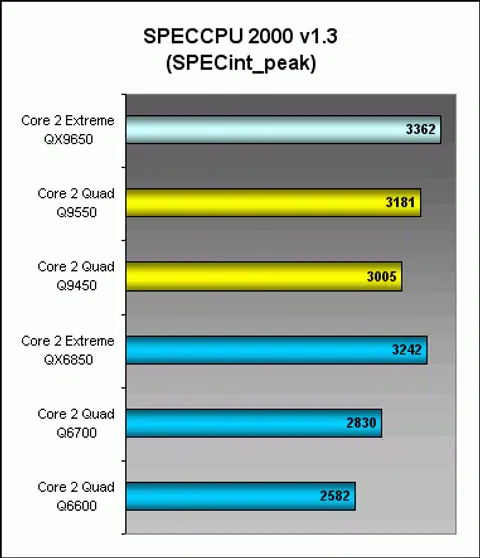
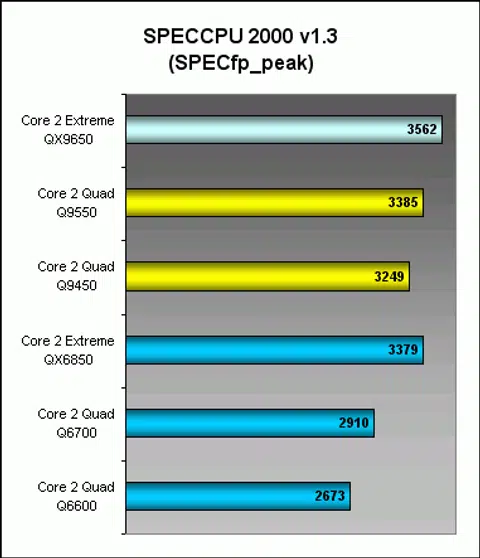
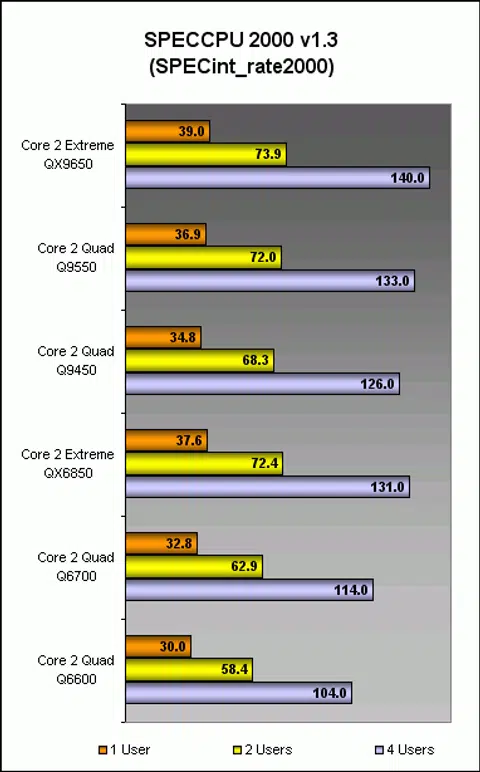
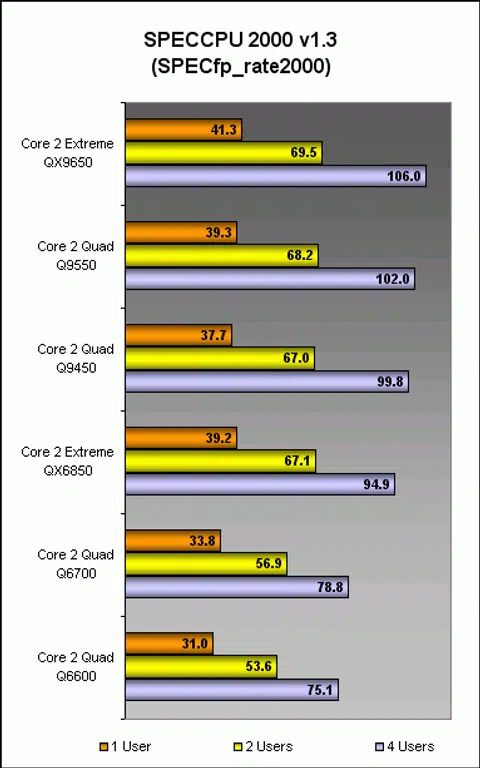
The peak scores for integer and floating point performance of both the new quad-core processors in SPEC CPU2000 1.3 are much better than their predecessors clock-for-clock thanks to the increased cache and enhancements to the base Core microarchitecture as seen in our first Penryn processor review of the Core 2 Extreme QX9650. As seen from the graph below, the Core 2 Quad Q9550 easily matches up against the older Core 2 Extreme QX6850 while the Q9450 has much better performance than the similarly clocked Q6700 processor.
Results - SYSmark 2007 Preview v1.02
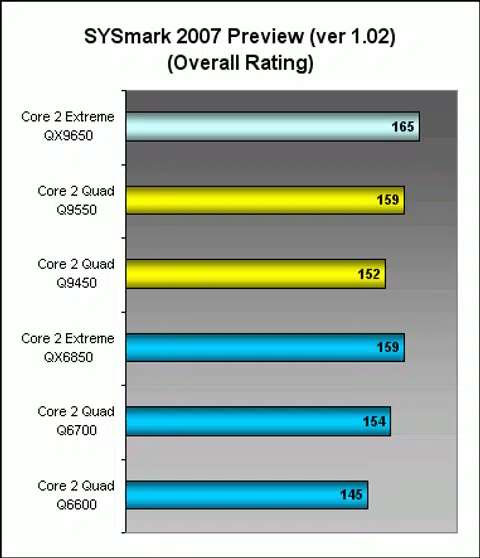
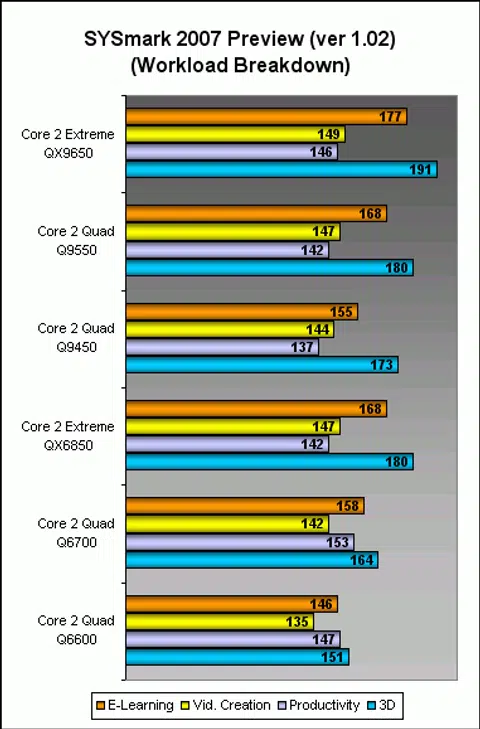
In the newer SYSmark 2007 Preview of Bapco's real-world user simulation benchmarking program, the results again sort of mimicked what we found in SPEC CPU2000 tests. The Core 2 Quad Q9550 was just as fast the Core 2 Extreme QX6850 while the Q9450 was almost on par with the Q6700 processor. Even the detailed scoring breakdown has similar performance curves, so there was nothing out of the obvious.
Results - Futuremark PCMark05
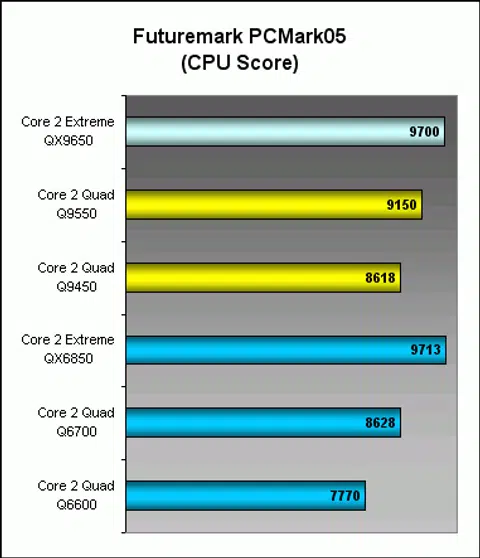
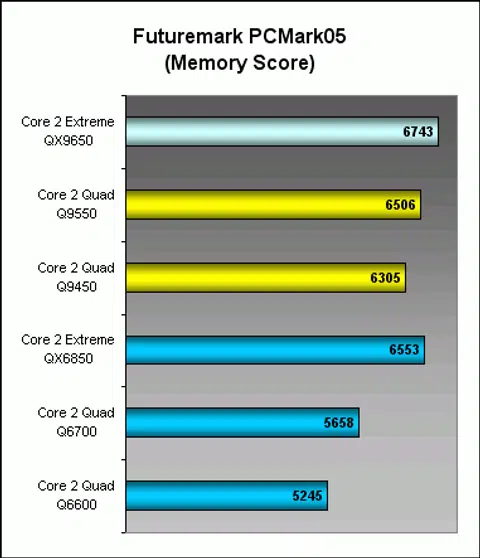
PCMark05's subsystem testing once again identified similar findings where the new Penryn-based quad-core processors performed better than their 'equivalent spec'd' predecessors. The better memory performance can be attributed to the larger cache as well as the improved caching and memory management techniques found on the 45nm processors.
Results - Lightwave 3D 7.5
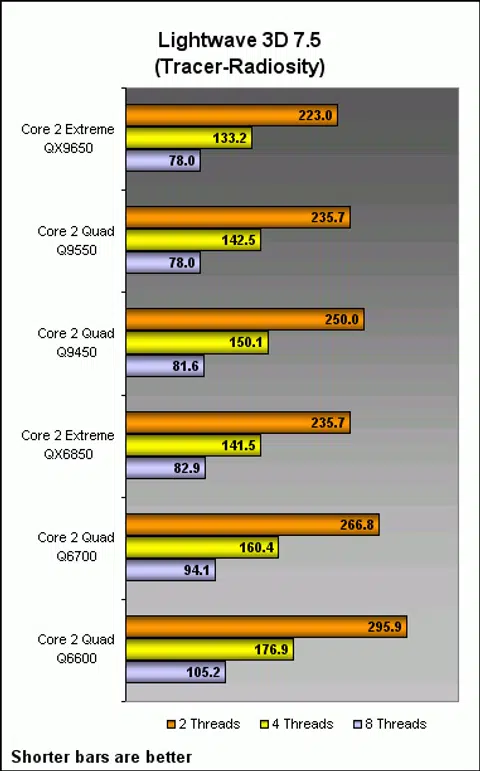
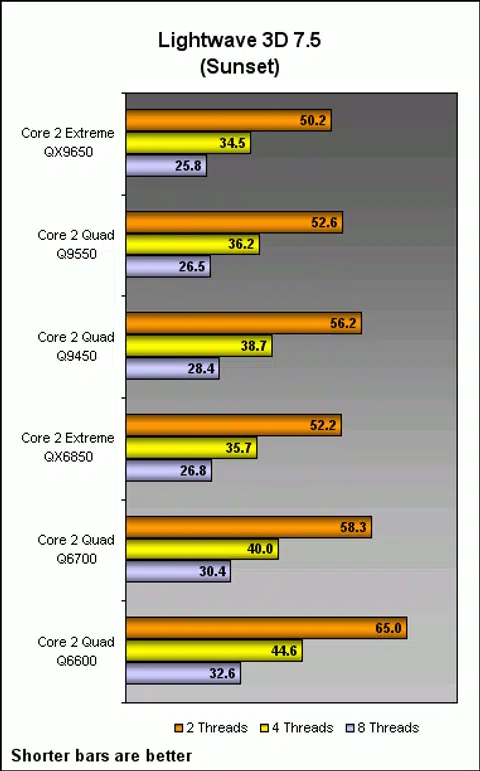
Moving on to rendering tests in Lightwave 3D, we again find consistent performance among the newcomers. In fact, the Q9550 and Q9450 processor actually fared slightly better than their 'competing' predecessors, the QX6850 and Q6700 processors respectively.
Results - 3ds Max 8 (SP2)
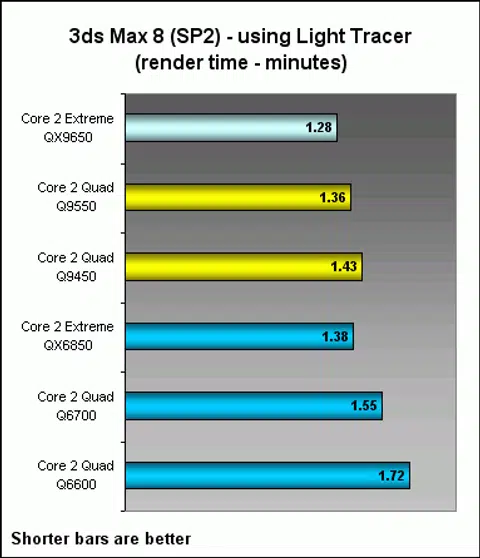
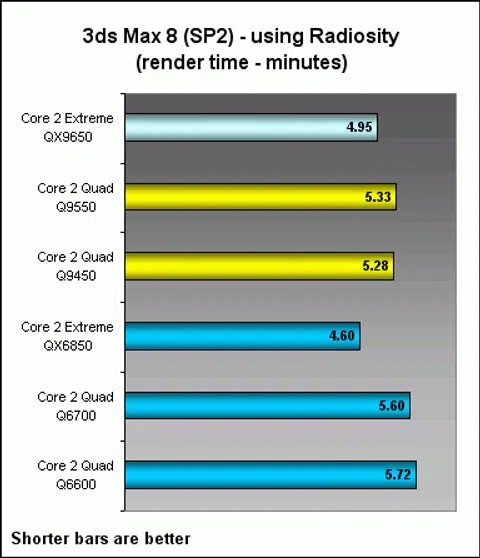
New to our benchmarking rounds is the Autodesk's 3ds Max 8, which is yet another popular rendering program. Using a popular benchmarking workload, dragoncharacter.rig and rendering it using Light Tracer and Radiosity advanced lighting options, we obtained the following results. The latter test produced a slightly mixed bag of results, but using the Light Tracer algorithm, we obtained steady results as expected. Generally, the newer quad-core processors are living up to their claims.
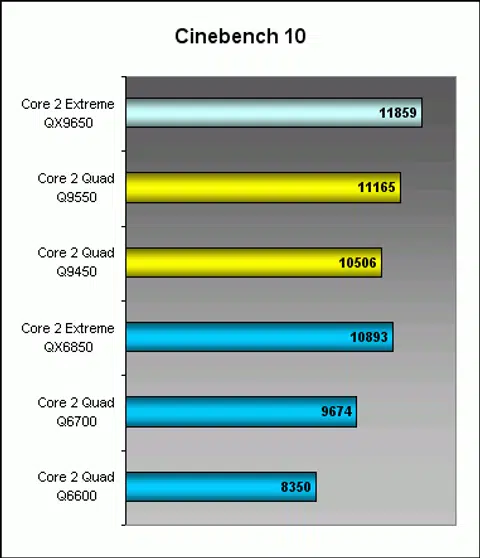
Results - Cinebench 10 and XMpeg 5.03 (DivX 6.8 Encoding)
Cinebench 10, a highly-threaded synthetic rendering benchmark, again reflected of what we've been seeing over the last few pages.
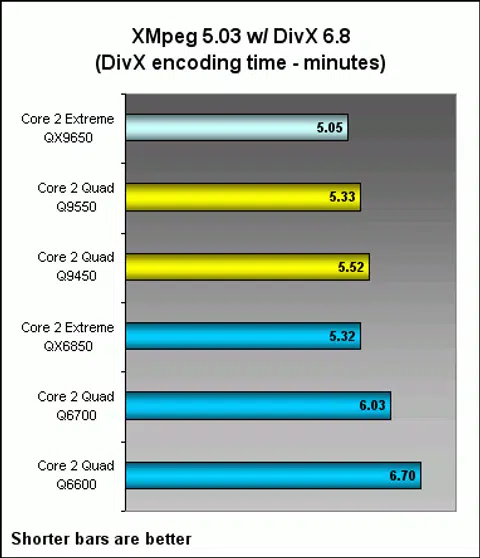
Moving on to video encoding using XMpeg and the latest DivX 6.8, performance here too was up to expectations as the Q9550 matched up against the QX6850, while the Q9450 bettered the old Q6700 in the cost to specifications department that also helped achieved its better performance.
Results - Futuremark 3DMark06
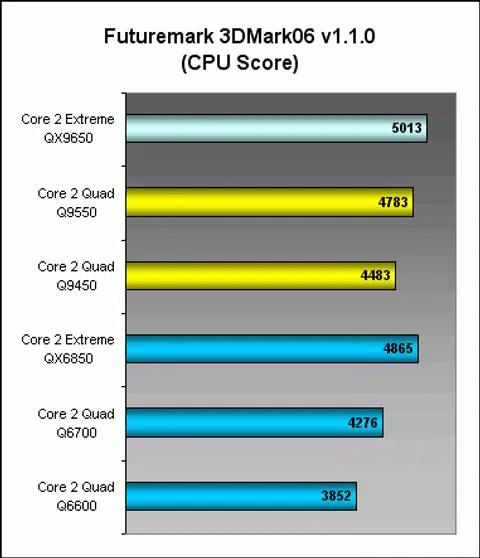
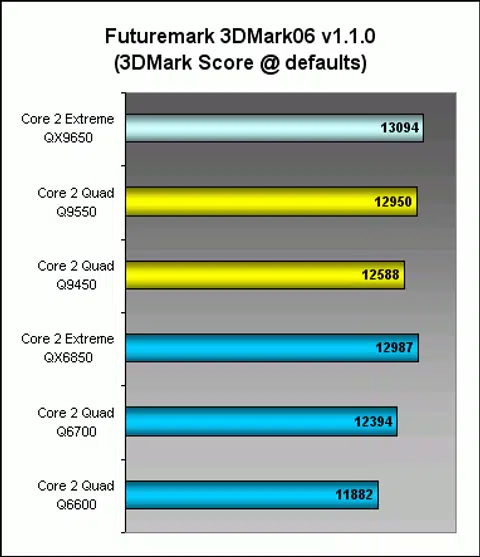
In the first glimpse of gaming performance, 3DMark06 tests too iterated what we've been enforcing in our many benchmarks.
Results - AquaMark3
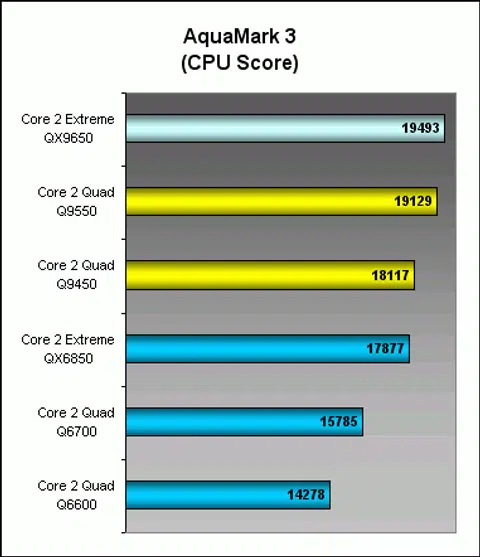
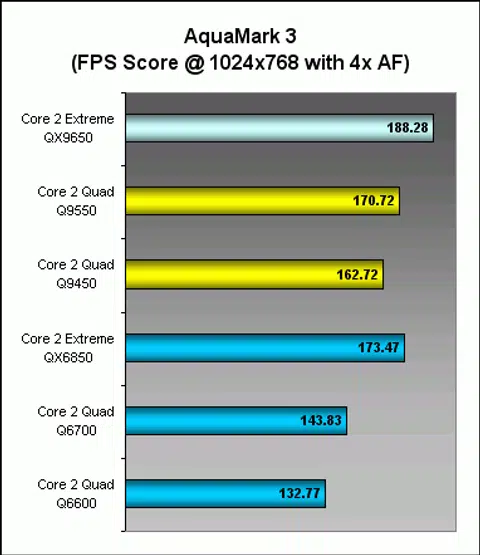
Using the old but reliable AquaMark engine for quick performance testing, we found the Penryn processors excelling against the older Kenstfield processors by a good margin, both in the CPU and graphics test results.
Results - World in Conflict & Crysis
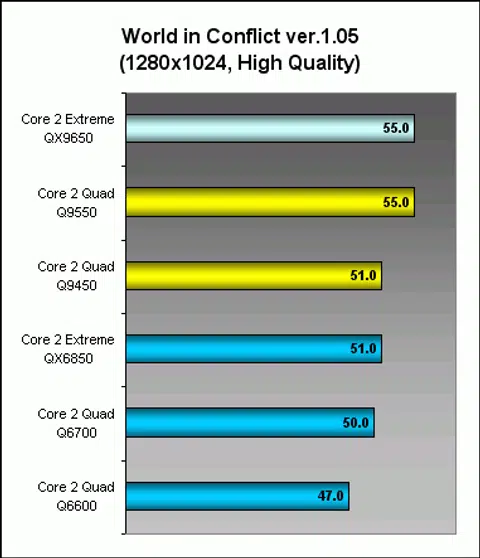
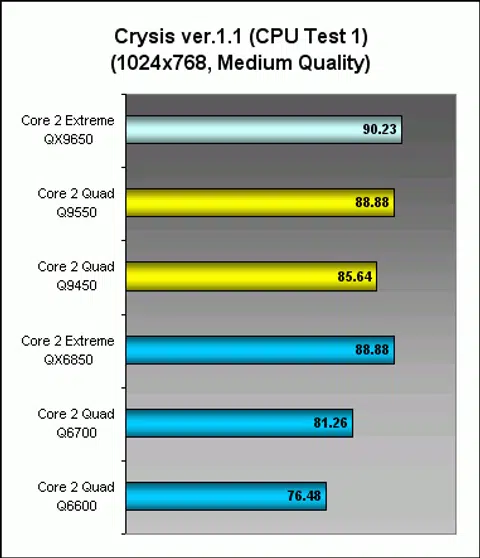
Last but not least, we take a look at the CPU's influence in a couple of the newest games of today - World in Conflict and Crysis. Do be reminded that the testbed is fitted with a GeForce 8800 GT graphics card to ascertain real-world performance as this is one of the more popular high-end graphics cards that is sought after these days.
As seen in the graph below, even in the newest games, the new Penryn processors hold the performance lead. Whether you can differentiate the results in real usage is another point altogether, but for certain the Penryn processors help to squeeze more performance with all other settings/hardware being constant.
Power Consumption
Apart from the slightly better performance of the newer Penryn-based Core 2 Quad Q9550 and Q9450 processors than their 65nm counterparts, power efficiency has been the other big selling point. We were completely sold with the results when we first reviewed the QX9650 last year and we're glad to note that the Q9550 and Q9450 carry on the same tradition as you'll soon see below.
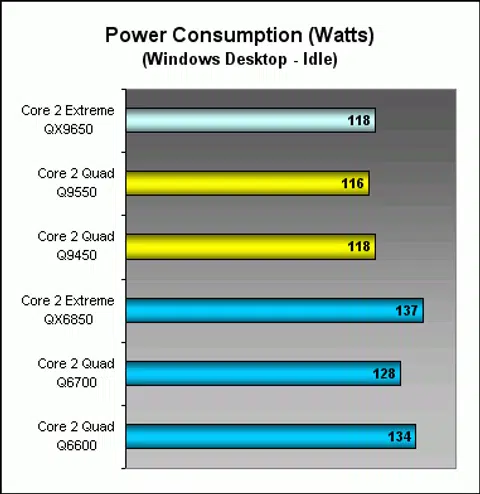
Idling in Windows Desktop
Using a power meter at the power outlet to collectively measure the entire system's power draw, the newcomers at idle save anywhere between 10 to 15% of the usual power draw on systems running a Kentsfield processor. That's a tidy amount of power savings from not doing anything and it's inline with what the QX9650 processor achieved.
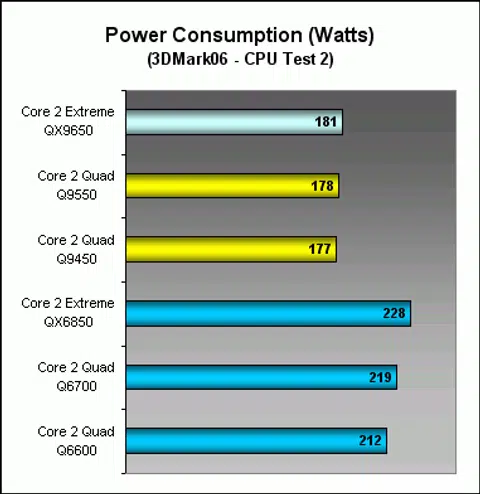
3DMark06 CPU Test 2
The power savings figures start to get interesting once we start to load the system. In this 3DMark CPU testing routine, the CPU is heavily taxed, but the GPU isn't involved much. As it stands now, a Q9550 is able to achieve nearly 30% power savings as opposed to an old Core 2 Extreme QX6850 - both of which perform quite similarly in a number of benchmarks we've seen so far.
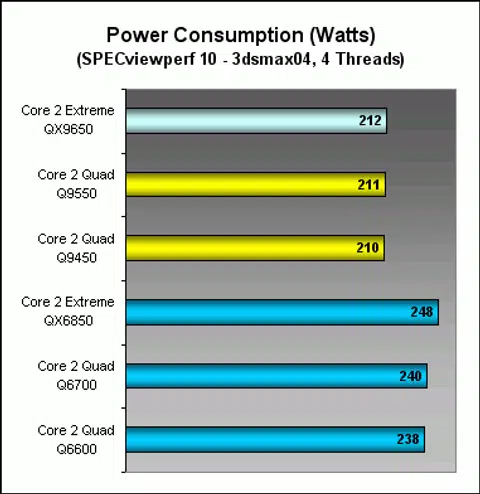
SPECviewperf 10 Full System Loading - Quad Run
From our various ongoing benchmarks day to day, we've identified that the quad-threaded 3dsmax viewset in SPECviewperf 10 to be one of the more taxing scenarios as it maximized all the CPU cores and quite a bit of the GPU as well. It is in fact more taxing than 3DMark06. In such a test scenario, we found that all the Penryn based processors managed an average of 15% power savings over the older Kentsfield 'counterparts'.
Concluding Remarks
After the many pages of benchmarks, we guess the writing on the wall is pretty clear that Intel's Penryn-based processors have more than proved their worth. After all clock-for-clock, the Penryn processors we tested to-date (the QX9650, Q9550 and Q9450) easily best the older outgoing Kentsfield processors (QX6850, Q6700 and Q6600) by a margin of a few percentage points to more than 10% depending on the test scenario. And while their price points are similar to old Kentsfield models, the new processors actually deliver more for less from a clockspeed perspective. Throw in industry leading performance-per watt factor into the mix and you have a winner. Simply said, there's no comparison to rival the figures we've shown you in this article. Sadly the AMD Phenom processors do the opposite - less performance at more power and we've all the results coming in a forthcoming article to back our views as well.
In any case, while the outlook for Intel is good, the availability at the retail level isn't quite as expected. Not all models are consistently available and vendors seem to take turns offering one variety or the other - especially the high-end variety for the moment. Partly the OEM demand is higher than expected and partly because Intel hasn't stepped up enough to keep all markets contended with their 45nm lineup. We highly doubt they would slip to give AMD a chance to lap up the demand (not that they've any in that range to offer), but it is a small thorn that we hope Intel will soon address.
Our articles may contain affiliate links. If you buy through these links, we may earn a small commission.