
Energy Efficient CPUs Ahoy! Phenom X4 9350e & 9150e Tested
AMD has achieved a small milestone of being first to offer 65W TDP quad-core processors with their new Phenom X4 9350e and 9150e processors. However their low clock speeds could be trouble against Intel's fast dual-core offerings. Can AMD's new Phenom X4 still hold its ground? We give you the lowdown.
The New Phenom X4 9350e & 9150e
It has been quite the turnaround for AMD in recent weeks. First, there was the unexpected buzz about AMD/ATI's new Radeon HD 4800 series. Reviewers and users have been unanimous in declaring these new graphics cards a return to form and competitiveness for ATI. The fact that market leader NVIDIA slashed prices of its GeForce 9800 GTX says it all about the new cards' immediate impact on the graphics scene.
Then there was the launch of AMD's new Puma platform for notebook at Computex, along with a number of design wins that inspired confidence that we could be seeing an alternative to Centrino 2 (which was delayed). Plans are also afoot for AMD to enter the ultra-portable segment with a new platform (Shrike) incorporating a 45nm chip with ATI's integrated graphics sometime next year.
It has been a hectic and generally fulfilling June for AMD but the company is poised to continue its momentum. Today, AMD announced the addition of three new processors to its Phenom family. The most powerful of the trio is a new 'Black Edition' (with unlocked multiplier), the Phenom X4 9950, which is clocked at 2.6GHz, 100MHz faster than the other Phenom 'Black Edition', the X4 9850. At a maximum TDP of 140W, the new 9950 will have a significantly higher TDP than any of AMD's existing quad-core processors which are rated at 125W. One can consider the 9950 and 9850 to belong to the same 'lineage', as both are the only Phenoms now to operate on a 2.0GHz HyperTransport Bus, with a similarly clocked memory controller.
The other two however is a different proposition entirely. While the 9950 is meant for those who value performance over other considerations, the other Phenom quad-core CPUs are a new class of energy efficient processors from AMD. With an 'e' suffix behind their model numbers to signify its difference, the first two of these new processors, the 9350e and 9150e have the lowest maximum TDP of any quad-core processor in the market now at just 65W, placing it in dual-core territory for power consumption. Even Intel's new 45nm Yorkfield quad-core processors are rated higher at 95W.
AMD expects these three new processors to be available in retail shortly after its 1st July debut and while the X4 9950 predictably becomes the most expensive Phenom processor at US$235, the new energy efficient processors are listed at US$195 for the 9350e and US$175 for the 9150e, placing it in direct competition against some of Intel's dual-core offerings and older, 65nm quad-core processors. Below is a short summary of the new Phenom X4 processors launched:-
Processor Model / ProcessorCharacteristics | Clock Speed | L2 Cache | L3 Cache | HyperTransport Bus (3.0) | Memory Controller Speed | Max TDP (W) | Estimated Price (US$) |
Phenom X4 9950 'Black Edition' | 2.6GHz | 512KB x 4 | 2MB | 2.0GHz | 2.0GHz | 140 | $235 |
Phenom X4 9350e | 2.0GHz | 512KB x 4 | 2MB | 1.8GHz | 1.8GHz | 65 | $195 |
Phenom X4 9150e | 1.8GHz | 512KB x 4 | 2MB | 1.6GHz | 1.6GHz | 65 | $175 |
Current AMD Phenom Processors
With the introduction of the three new processors, the following is an updated specification table of all the triple and quad-core Phenom processors currently in AMD's lineup.
Processor Name | AMD Phenom X4 | AMD Phenom X4 (Energy Efficient) | AMD Phenom X3 |
Processor Model | 9950 'Black Edition', 9850 'Black Edition', 9750, 9650, 9550 | 9350e, 9150e | 8750, 8650, 8450 |
Processor Frequency | 2.6GHz, 2.5GHz, 2.4GHz, 2.3GHz, 2.2GHz | 2.0GHz, 1.8GHz | 2.4GHz, 2.3GHz, 2.1GHz |
No. of Cores | 4 | 4 | 3 |
Front Side Bus (MHz) | - | - | - |
HyperTransport Bus | 2.0GHz (9950 and 9850 only), 1.8GHz | 1.8GHz (9350e), 1.6GHz (9150e) | 1.8GHz |
L1 Cache (data + instruction) | (64KB + 64KB) x 4 | (64KB + 64KB) x 4 | (64KB + 64KB) x 3 |
L2 Cache | 512KB x 4 | 512KB x 4 | 512KB x 3 |
L3 Cache | 2MB | 2MB | 2MB |
Memory Controller | Integrated Dual Channel (up to DDR2-1066) | Integrated Dual Channel (up to DDR2-1066) | Integrated Dual Channel (up to DDR2-1066) |
TDP (W) | 95 - 140 | 65 | 95 |
Instruction Set Support | MMX, SSE, SSE2, SSE3, SSE4a | MMX, SSE, SSE2, SSE3, SSE4a | MMX, SSE, SSE2, SSE3, SSE4a |
Execute Disable Bit | Yes | Yes | Yes |
Intel EM64T / AMD64 | Yes | Yes | Yes |
Enhanced Intel SpeedStep Technology (EIST) / AMD Cool 'n' Quiet | Yes | Yes | Yes |
Virtualization Technology | Yes | Yes | Yes |
Packaging | AM2+ | AM2+ | AM2+ |
Process Technology | 65nm SOI | 65nm SOI | 65nm SOI |
Processor Codename | Agena | Agena | Toliman |
Die Size | 285mm² | 285mm² | 285mm² |
No. of Transistors | 450 million | 450 million | 450 million |
Test Setup
In this article, we'll be paying close attention to the processors retailing around the same ballpark as the new Phenom X4 energy efficient processors. Officially, AMD has the most affordable quad-core processors at below the US$200 mark, but Intel's Core 2 Quad Q6600 has been in retail online for US$199 at the point of review (even though Intel's recommended list price is much higher). So the Core 2 Quad Q6600, as well as the Core 2 Duo E8400 and E8200 models will be thrown in the comparison as well to see how they handle. AMD's contingent will be represented by the Phenom X4 9650, 9550 and the Phenom X3 8750 processors - all of which are priced below US$200 too.
The important thing here is that AMD is knowingly pricing their energy efficient processors at the same price point as their better performing parts that have a 95W TDP. So you'll really have to be biting their power savings angle to appreciate and invest in these new lower clocked processors. More interestingly, how would the aging Intel Q6600 part hold up against these new 65W TDP rated Phenom processors, as well as the newer Intel E8000 series Core 2 Duo processors of the same power rating? That's what this comparison would be about.
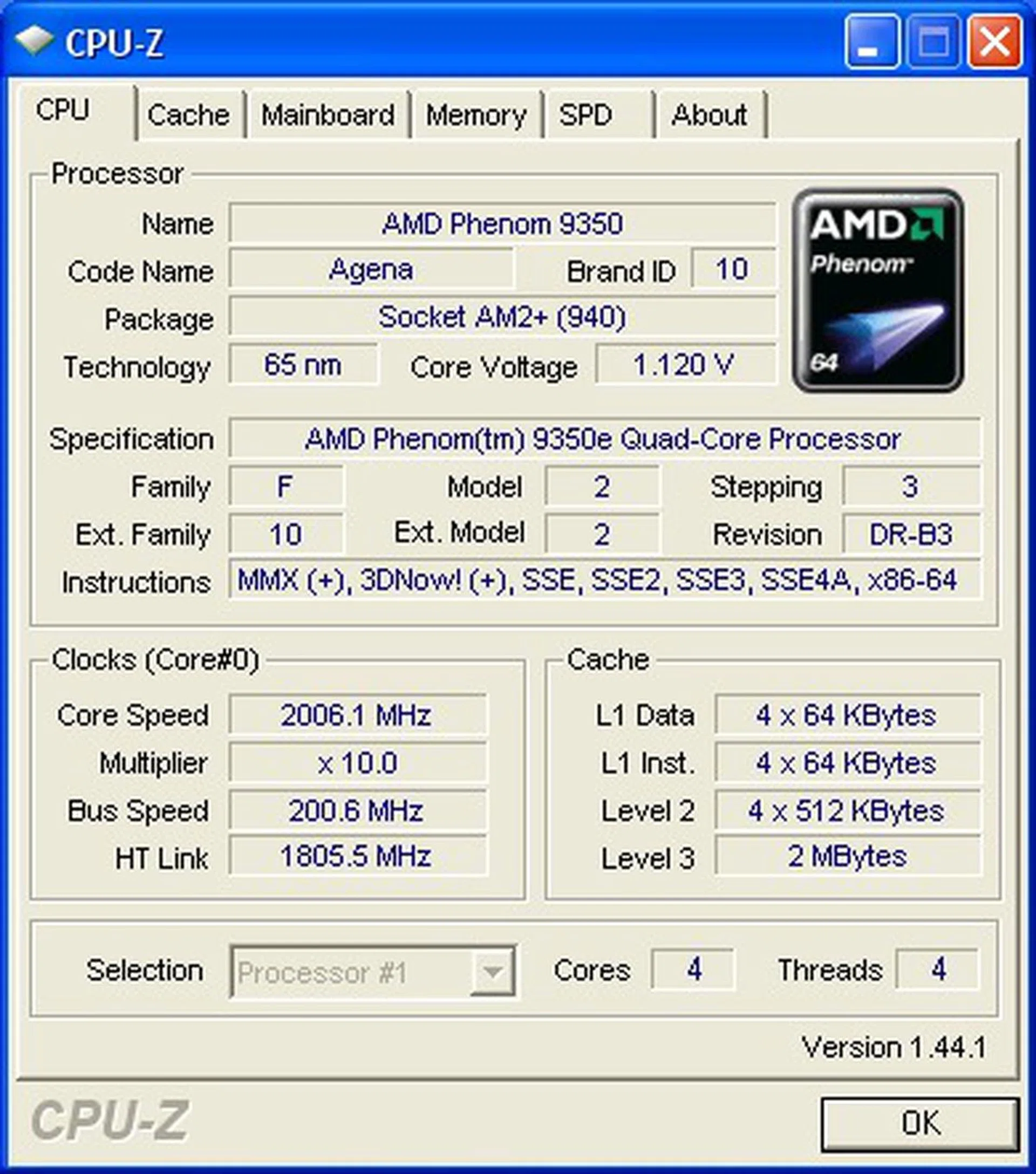
Note the specs of the Phenom X4 9350e processor.
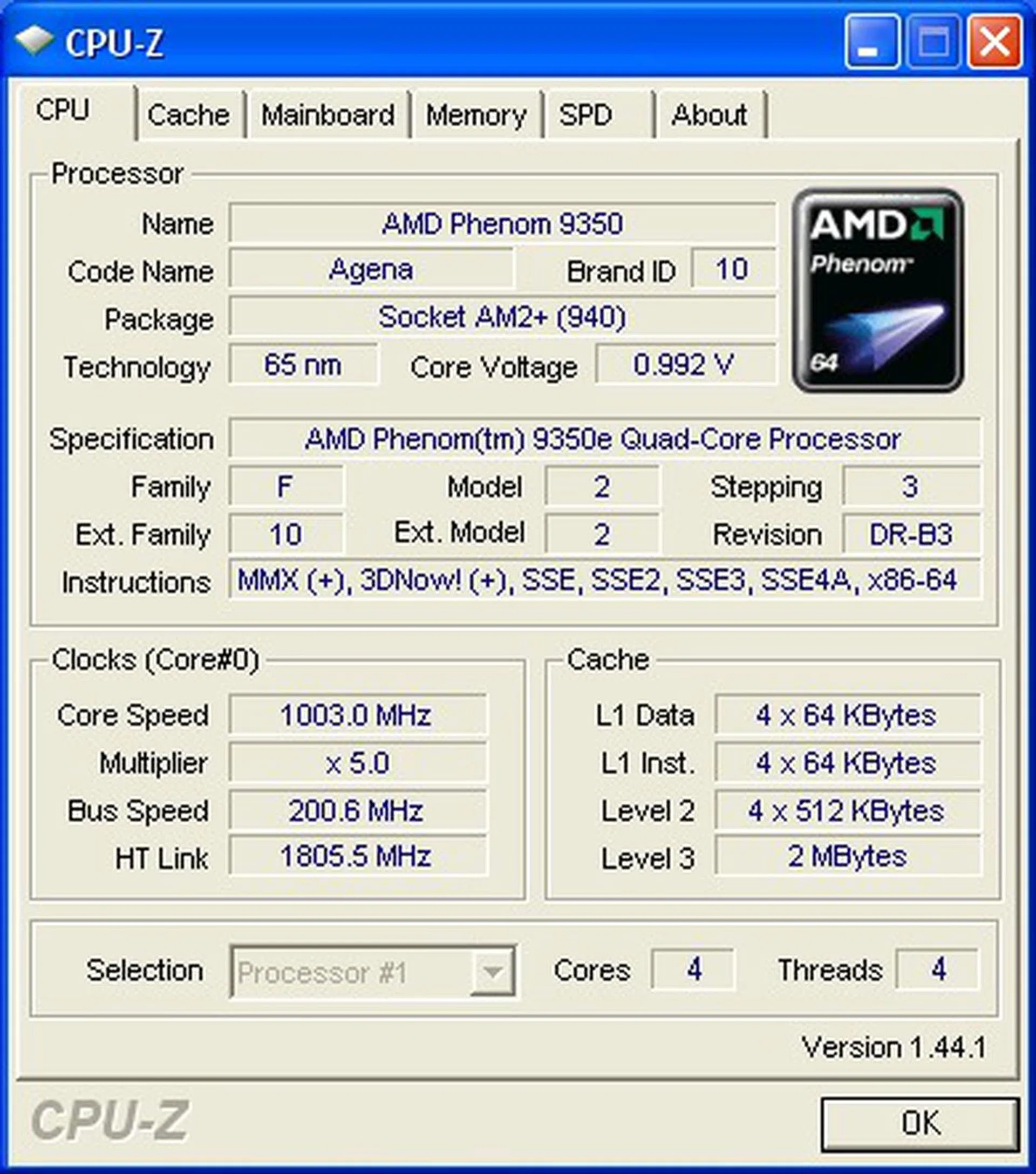
When AMD's power savings feature kicked in, Cool 'n' Quiet, we noted the much lower 1GHz idle clock speed and sub-1V operation.
We had some issues with the AMD testbed configuration running the memory at DDR2-1066 although it is supported by the processor. However, we've found that the latest motherboard BIOS is able to run the memory at DDR2-1066 - albeit a bit flaky. As such, we've kept all our testing at DDR2-800 and that went smooth.
With that said, the following testbed configurations will be used throughout our comprehensive benchmarking segment:-
AMD Phenom Testbed Configuration
- ASUS M3A32-MVP Deluxe Wi-Fi (AMD 790FX chipset)
- AMD Phenom X4 9650, 9550, 9350e and 9150e
- AMD Phenom X3 8750
- 2 x 1GB Aeneon DDR2-1066 memory modules @ DDR2-800 (CAS 5. 5-5-15)
- Seagate Barracuda 7200.10 200GB SATA hard disk drive (one single NTFS partition)
- ASUS GeForce 8800 GT 512MB - with NVIDIA ForceWare 169.21
- Microsoft Windows XP Professional with Service Pack 2
Intel Core 2 Quad/Duo Test Configuration
- ASUS P5E3 Deluxe (Intel X38 Express chipset)
- Intel Core 2 Quad Q6600, Core 2 Duo E8400 and E8200
- 2 x 1GB Kingston HyperX DDR3-1333 memory modules (CAS 7. 7-7-20)
- 2 x 1GB Kingston HyperX DDR3-1333 memory modules @ DDR3-1066 (CAS 7. 7-7-20) - for 1066MHz FSB processors only
- Seagate Barracuda 7200.10 200GB SATA hard disk drive (one single NTFS partition)
- ASUS GeForce 8800 GT 512MB - with NVIDIA ForceWare 169.21
- Microsoft Windows XP Professional with Service Pack 2
Benchmarks
We encountered an issue installing BAPco's SYSmark 2007 Preview on the system and this was verified by AMD in its own testing. Hence we will be skipping this particular benchmark for the article, leaving us with the following:-
- SPEC CPU2000 v1.3
- Futuremark PCMark 2005 Pro
- Lightwave 3D 7.5
- 3ds Max8 (SP2)
- Cinebench 10
- XMpeg 5.0.3 (DivX 6.8 encoding)
- Futuremark 3DMark06 v1.1
- AquaMark3
- World in Conflict v1.05
- Crysis v1.1
Results - SPEC CPU2000 v1.3
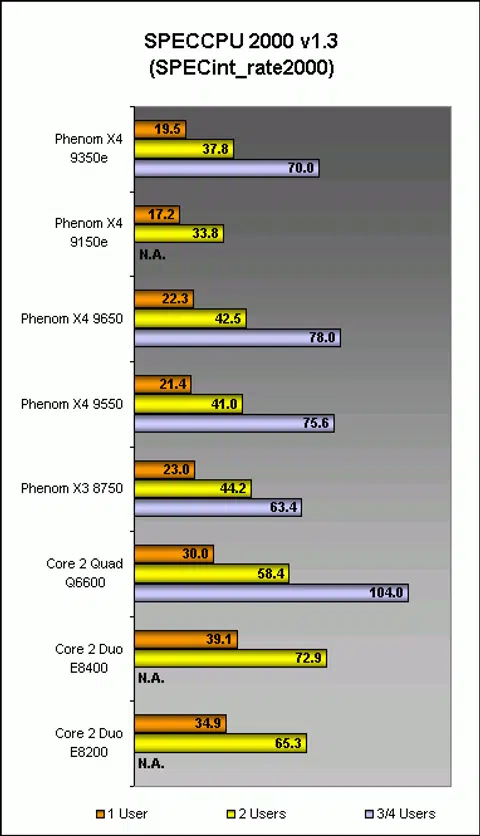
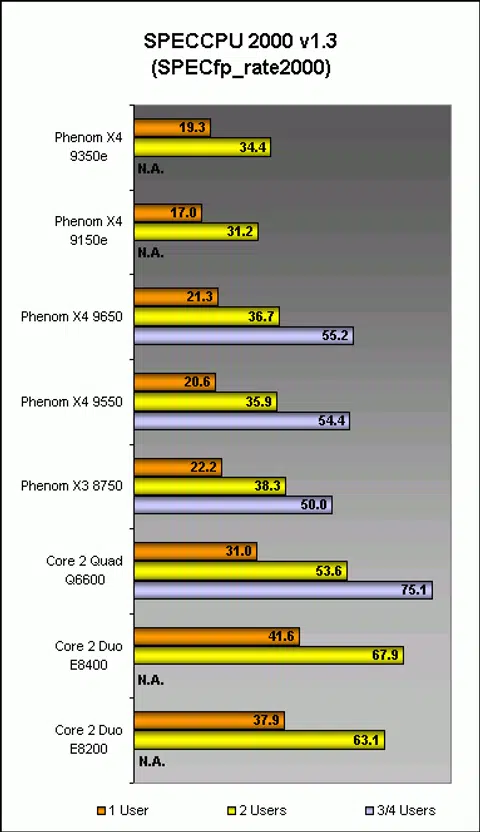
As usual, we'll set the basics straight by checking out how the new Phenom X4 9350e and 9150e processors fair in their integer and floating-point performance with SPEC CPU2000. The first pair of results is from the speed tests, which predominantly scale with clock speed, but we've long established in our original Phenom X4 review that the CPU architecture also plays a part where the AMD contingent took back seat in the tests. With even lower clocked processors of these new energy-efficient AMD processors, the results are worse still. The Core architecture combined with the high clock speeds of the equivalently priced Core 2 Duo series make their presence felt here.
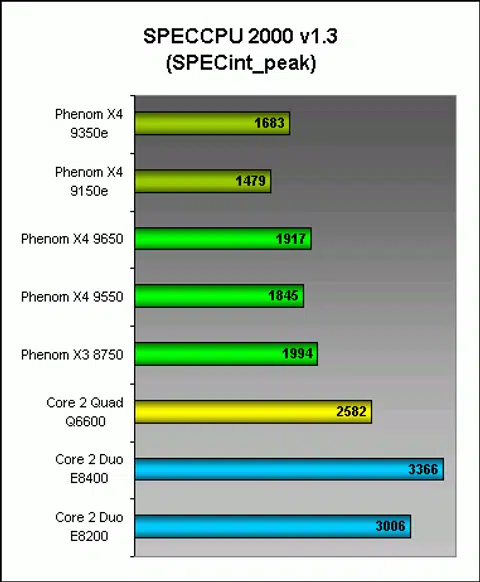
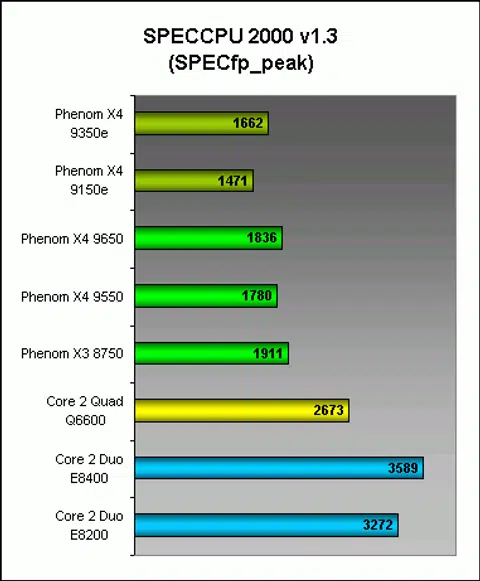
Moving to SPEC CPU's rate tests that simulate running multiple copies of the workload the outcome is better, but not by much. We encountered errors in obtaining some of the four-user results, but even if you put that aside and compare with the results obtained, the fact doesn't change that the Core 2 Duo processors' dual-user results almost rival those of the new Phenom X4's quad-user results in the integer workload and gets an upper hand in the floating-point workloads, it's the same scenario we're seeing all over again when we first compared the higher-end Phenom processors.
Results - Futuremark PCMark05
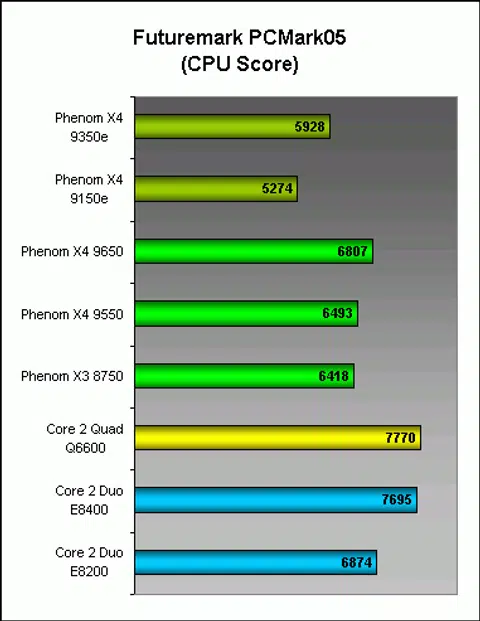
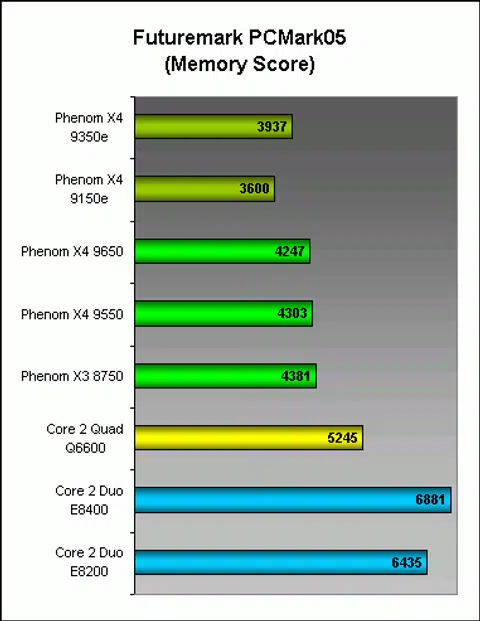
PCMark05's subsystem testing once again identified similar findings as what we've seen earlier and points to the Phenom's weaker core clock speeds and CPU architecture. Even the memory subsystem isn't spared.
Results - Lightwave 3D 7.5
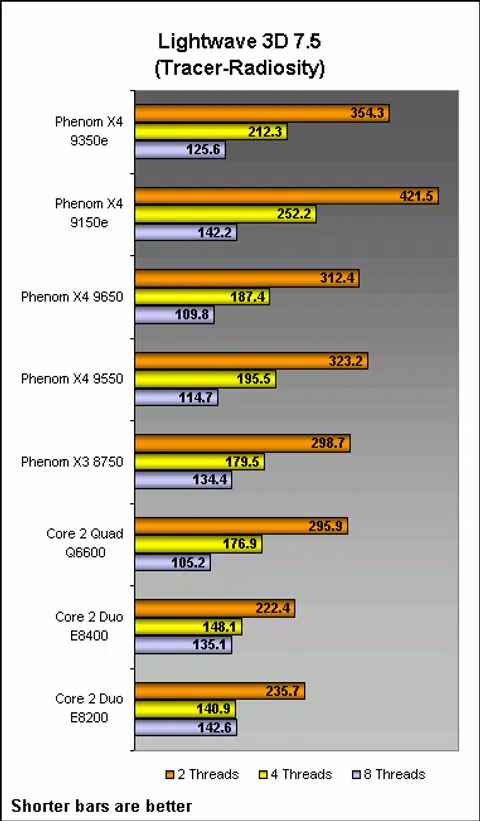
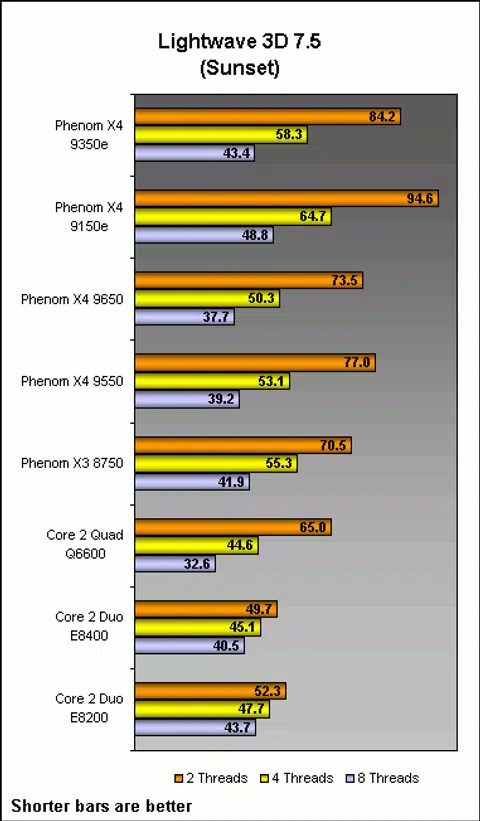
The Phenom X4 9350e and 9150e managed a decent foothold against the equivalent TDP and priced dual-core Intel processors
- but only at very taxing workloads such as at 8 threads on this rendering software. Even then, it was just barely matching up against them. Throw in the Core 2 Quad Q6600 processor into the picture and the AMD pair instantly pushed into a lower performance rung. Of course the Q6600 processor is a higher 95W TDP part, but it is in the same price segment for consideration.
Results - 3ds Max 8 (SP2)
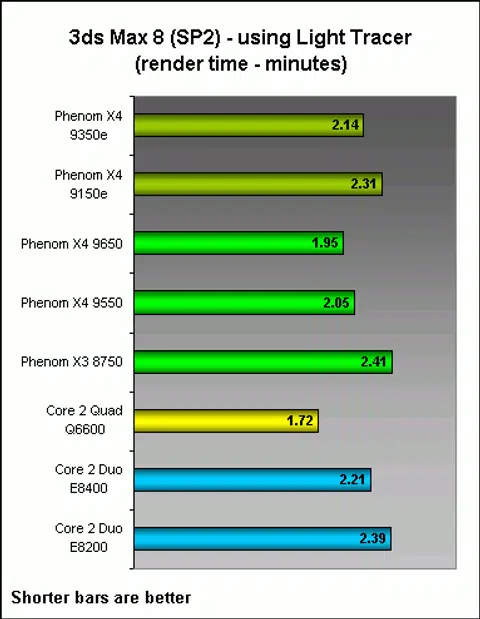
In a newer rendering benchmark using Autodesk's 3ds Max 8, we used a common benchmarking workload, dragoncharacter.rig and rendered it using Light Tracer advanced lighting option. While it goes without saying that the newcomers are slower than the similarly priced Phenom X4 9650 and 9550 parts, this is one of the few programs where quad-core processors show their usefulness and both the energy efficient AMD processors are faster than the Phenom X3 8750.
The results are also better than those of the higher clocked dual-core Intel processors and that's good news for the Phenom X4 9350e and 9150e CPUs. Now if only more workloads are of this caliber, AMD might have a better chance to give Intel some competition, but as expected, dollar-for-dollar, the Core 2 Quad Q6600 is still a much speedier option at the expense of higher power consumption. So it's a close call in terms of tradeoff between characteristics of the processors and what one wants to achieve.
Results - Cinebench 10
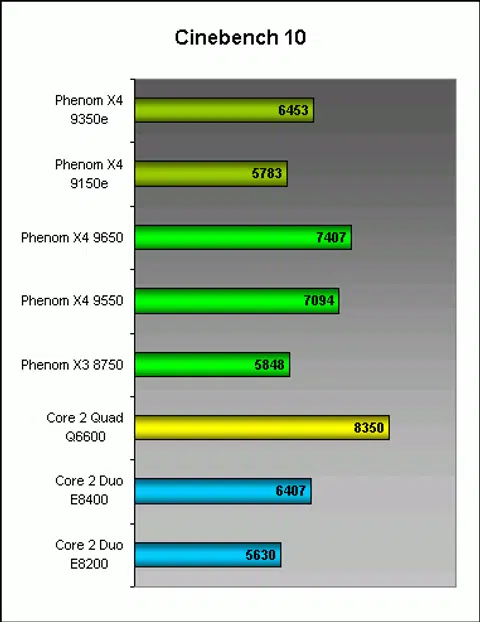
Cinebench 10 is a highly-threaded synthetic rendering benchmark, and as such the quad-core processors get the lead, albeit Intel's Q6600 is again at the helm here. Comparing within a similar processor TDP band, namely 65 watts, both the Phenom X4 9350e and X4 9150e are just barely faster than the equivalent Core 2 Duo E8400 and E8200 processors. The difference is barely discernable in real-world.
Results - XMpeg 5.03 (DivX 6.8 Encoding)
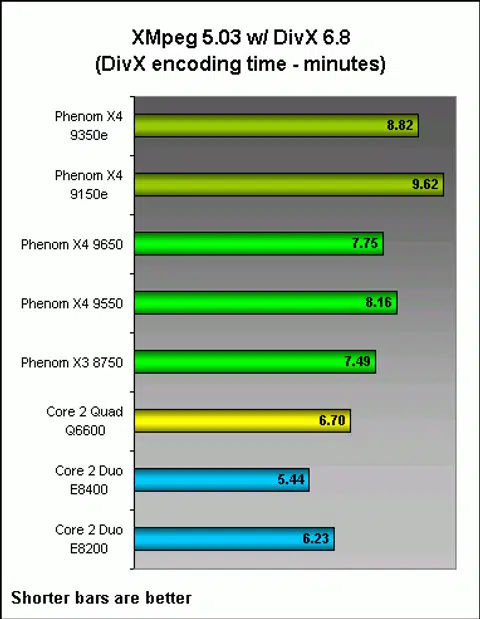
With a huge clock speed disadvantage on the new AMD energy efficient parts, the encoding time of a 1GB DVD video file was much longer than AMD's other offerings and that of the competition. Clearly clock speeds play a more prominent role here as quad-core processors don't yet offer any tangible gain over the equivalently clocked dual-core model in this test.
Results - Futuremark 3DMark06
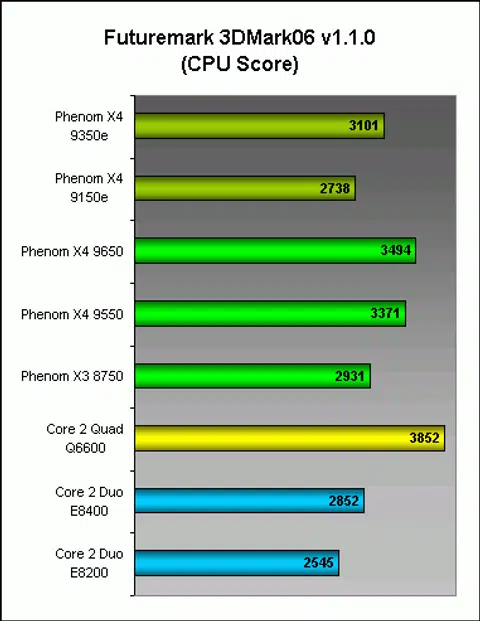
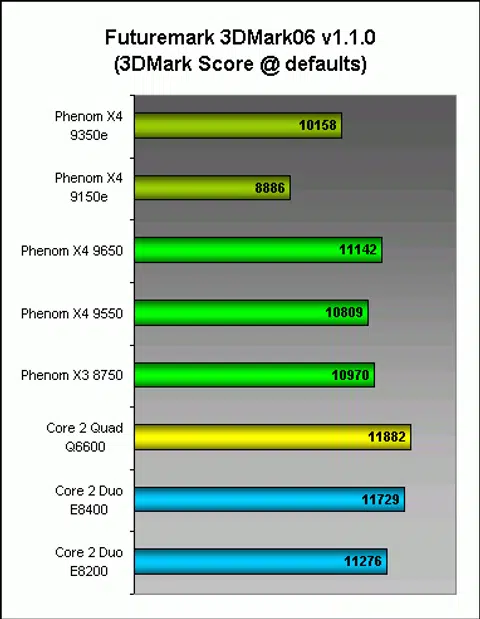
In the first glimpse of gaming performance, 3DMark06 tests, the CPU scores look decent for the newcomers, but when looking at the actual 3DMark scores, it's not good at all. In fact, the 9150e saw a much bigger drop in performance, which probably indicates its inability to feed the GeForce 8800 GT to keep its performance going.
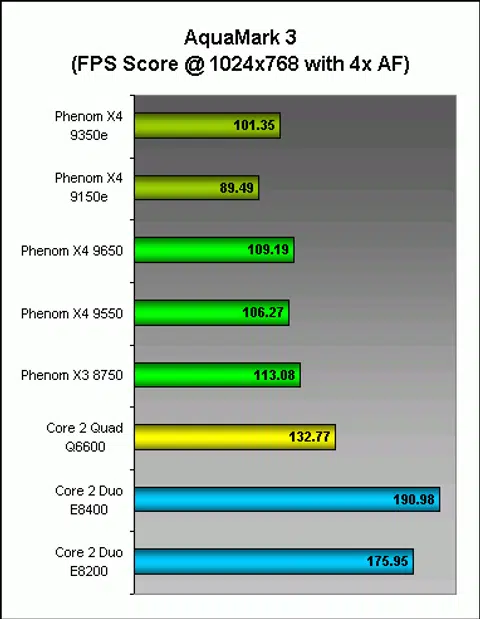
Results - AquaMark3
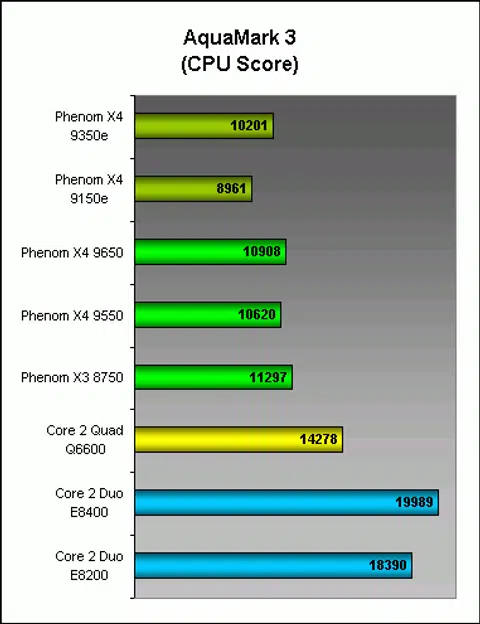
Using the old but reliable AquaMark engine for quick performance testing, we found quite a big performance discrepancy between AMD and Intel's processor offerings.
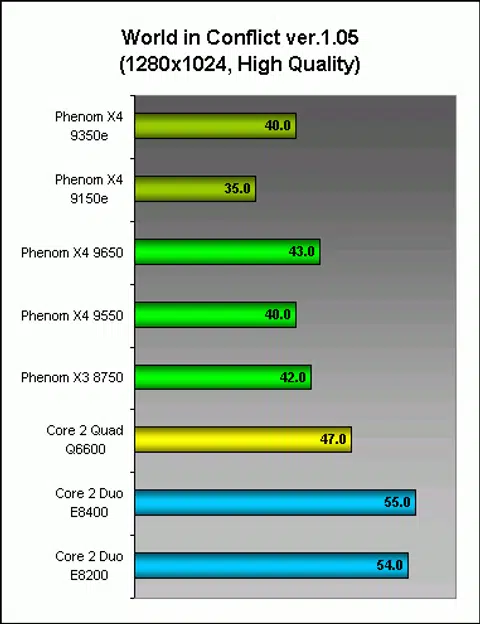
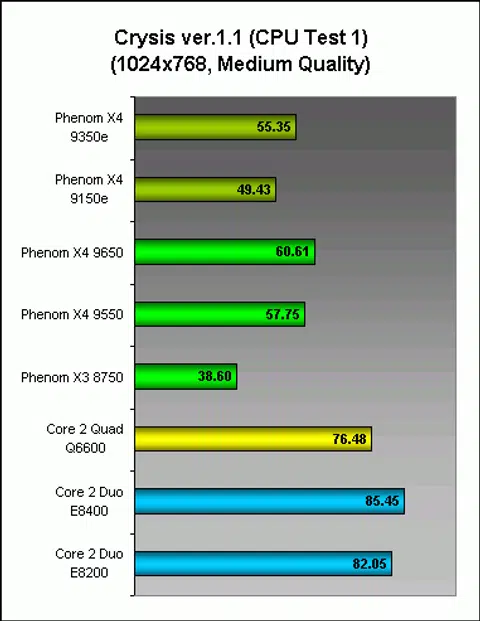
Results - World in Conflict & Crysis
Moving on to real-world 3D games testing with a couple of taxing games like World in Conflict and Crysis, we noted that the Phenom X4 9350e handled them semi-decently as it almost rivaled the Phenom X4 9550 in performance. The 9150e again took a big hit in performance. Of course, none of AMD's processors were any good when compared to Intel's offerings. The performance discrepancy is just too large of a delta to ignore when your graphics subsystem is similar but the underlying platform is different.
Power Consumption
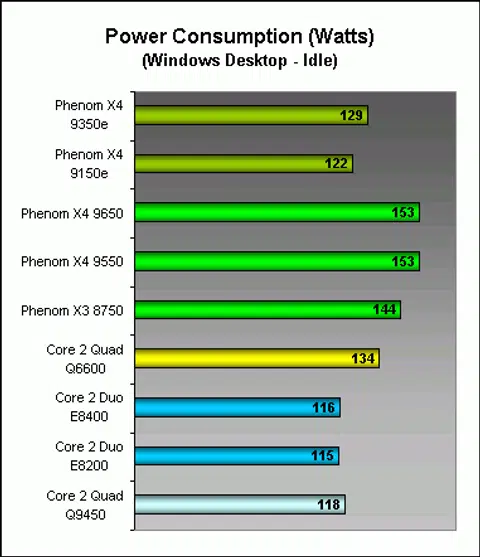
AMD has been trumpeting that their new entrants are the only 65W TDP processors in the market, so check out the total system power draw we noted in our testing with a power meter plugged at the power outlet. The results are interesting to say the least.
Idling in Windows Desktop
At idle mode, the Phenom X4 9350e and X4 9150e have both set new records in the power consumption for an AMD quad-core processor. However, this doesn't better Intel's Penryn processors as depicted in our inclusion of the Core 2 Quad Q9450 processor.
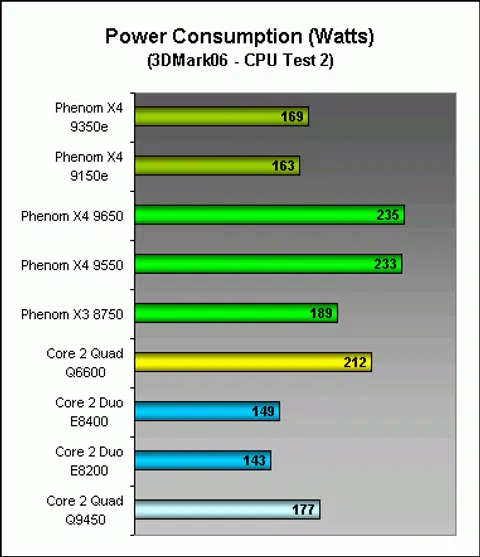
3DMark06 CPU Test 2
The power savings figures start to get interesting once we start to load the system. In this 3DMark CPU testing routine, the CPU is heavily taxed, but the GPU isn't involved much. AMD's newcomers fare well against their own kind, but that's very likely due to their operational clock speed difference alone. Among the similar price band of processors, the new energy efficient parts come out better than most other processors (sans the dual-core parts). But when you stop to pause at what tradeoff you get these good power consumption figures, it doesn't seem that good for AMD anymore. More so when you compare the Intel Q9450 processor drawing almost the same amount of power but delivers much more performance.
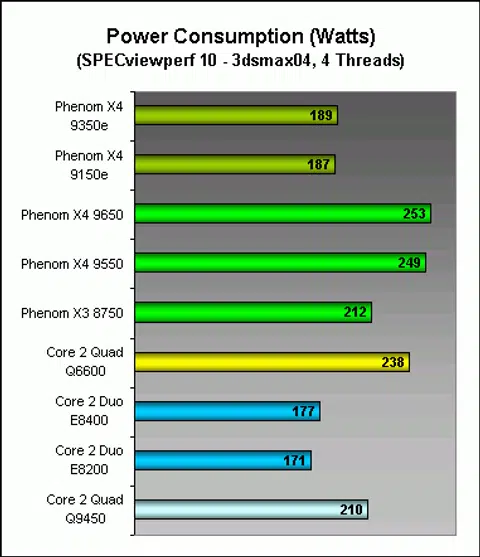
SPECviewperf 10 Full System Loading - Quad Run
Our final power consumption test had the systems running the highly intensive quad-threaded 3dsmax viewset in SPECviewperf 10, which maximized all the CPU cores and put the GPU into good use. Even in this scenario, not much has changed in the overall picture.
Performance per Watt Comparison
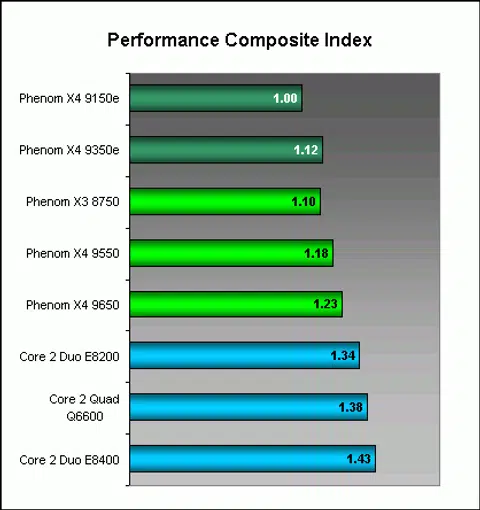
On this page, we aggregated the benchmark results from all our tests on the previous pages to form a composite index for all processors tested. This is only a general comparison and will hold true only if one doesn't have any strong priorities to sway one's decision based on a particular usage model. Of course different people will always have different needs, thus the general comparison would be the most effective for an overview of performance.
We used only one set of results from each of the benchmarks to avoid overweighing any one benchmark. This means if we had multiple benchmark configuration results to show earlier, we chose only the most appropriate configuration that best represents the benchmark's competence. The exception here is SPEC CPU2000 that we have omitted due to an incomplete set of results. Finally, we compared the performance of all the processors against the AMD Phenom X4 9150e processor (which held up the rear of most benchmarks) and aggregated the difference (mostly performance gain) with respect to this processor. While we would love to tabulate all the differences in a table, there are just too many benchmarks and performance figures properly fit within view and to be of meaningful value. Thus, we have axed that and shown you the final composite performance index graph directly. As observed in our individual benchmark results, there's no surprise from the outcome that the Intel Core 2 Duo processors came out tops, as much as over 40% faster (and at a similar price point).
Next, we take the overall aggregated performance results above and divide that by the maximum power consumed by each test system (from the SPECviewperf quad-thread load shown earlier) to get better understanding how the overall performance per watt efficiency pans out for the processors. We then plotted those values against the overall aggregated performance results to get the following graph:-
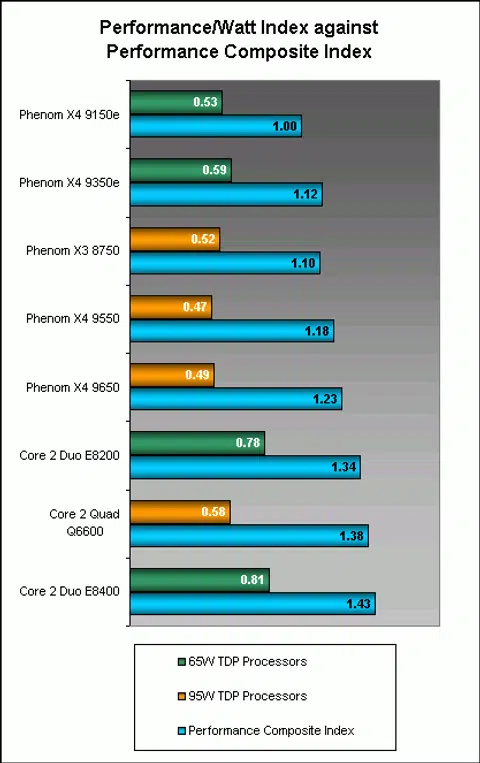
The higher the values, the better.
The new Phenom entrants have better performance-per-watt standings than the higher-end Phenom processors, but they pale against the figures obtained on the Intel contingent. Higher overall performance and better performance-per-watt go to the Core 2 Duo processors and if you step out to compare the Penryn processors that are in a higher priced bracket, they can obtain performance-per-watt figures similar to the Core 2 Duo series and have higher overall performance yet.
To conclude this part of our results findings, the processors compared here are all in the similar price bracket, and it's clear that Intel gives more performance and a higher performance-per-watt ratio.
'Energy Efficient' at the Expense of Performance
If we had to describe the AMD Phenom X4 9350e and 9150e processors in a just a few words, the title for our conclusion is more than apt. After all, if a processor has had a substantial revision, like we saw for the Core 2 in the past, then certainly we can expect better power consumption at the same performance or even more performance. However, these new Phenom entrants don't bring anything new to the table other than being really well qualified for the new TDP rating via lower frequencies. So correspondingly performance dropped from what we've already come to expect on the existing Phenom processors.
The AMD Phenom X4 9350e and 9150e processors have a very narrow proposition to offer and it's only apparent if you've workloads that can actually take good advantage of its quad-core nature. Otherwise, the four cores aren't going to perform much better than two cores as seen in our findings.
To the average consumer, we can only think of one scenario where the new Phenom entrants would be of potential value and that's when you consider AMD's balanced system slogan, exemplified by AMD's mainstream Cartwell platform. Such a platform would marry an AMD 780G motherboard with a low TDP quad-core processor like these new Phenoms and make for a powerful, yet compact little system to play your Blu-ray movies or equivalent HD video content, with decent gaming potential thrown in.
The cost of such a system will definitely be lower and more effective than anything from the Intel camp at the moment. This only means that you're more likely to find these 65W quad-core Phenoms from system integrators and OEMs, since vendors like Acer and HP would love to advertise PCs
using these processors as quad-core class (we all know that it's a race of cores, not GHz nowadays) when it's actually the integrated graphics subsystem on the 780G that is pulling the weight in terms of graphics and HD playback performance. One however should not underestimate the prospects for an energy efficient mainstream platform and we'll probably see more of these systems very soon in retail.
As we found in our real-world games testing, the minute you consider discrete graphics for better game performance, an AMD-based system would only hinder your overall graphics performance. So for the performance-concerned enthusiasts, you would do well to stick with an Intel processor.
Our articles may contain affiliate links. If you buy through these links, we may earn a small commission.