
CES 2010: New LG HDTVs - Full of Features and Razor Thin (Updated!)
Having claimed the thinnest HDTV title, LG went to outclass themselves with even slimmer ones. How's 10mm for you? Slim aside, the new breed of premium LG HDTVs are choke full of features like 480Hz TruMotion technology, THX certification, 3D, DLNA and wireless ready, NetCast for online content, and more.
The Great TV Transformation
The movie and TV industry are going through exciting times as of late with the former venturing into 3D movies while TVs are undergoing enhancements in the form of aesthetics, image quality and even widgets for added functionality. And following of 3D TVs taking off in a big way as the ecosystem builds up momentum this year, LG too has committed its interest in this area. Among 3D ready TVs, other notable features that are propagating in LG's mid to high-end models in the 2010 lineup are wireless ready and broadband capable TVs (through LG's NetCast entertainment access). We detail more notes through our photos and captions from LG's press conference this morning, direct from Las Vegas in the biggest and most important consumer electronics show on earth - CES 2010.

President and CTO for LG Electronics, Dr.Woo Hyun Paik is responsible for the technology innovation at LG. Most notably, he has a hand in the revolution of TV technology and standards over his many years in this field of development. Dr.Paik gave the press a quick overview of the key areas of improvements that we will see in TVs and other equipment in 2010 from LG.
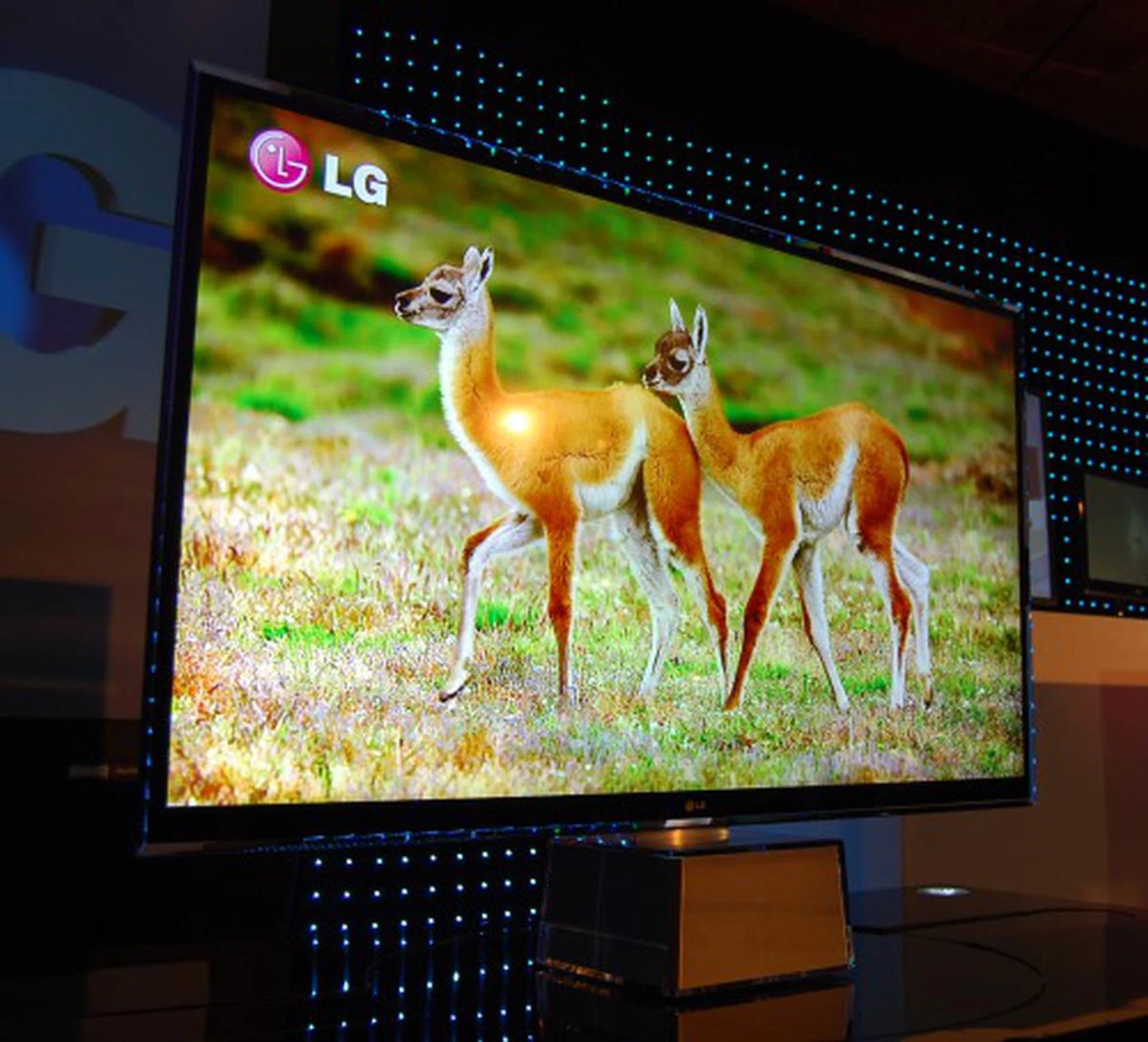
Among the most captivating and breathtaking of LG's announcements this morning is this prototype LED-backlit TV. What's so special? The entire panel is no thicker than 1cm!

Yes, you've read right, 1cm tops. It's so thin that it's almost surreal. And if you're wondering if all the processing, tuners and more are stored in the lumpy base, LG has told us that this won't be the case in the actual retail models which would sport a very normal base like any of their other current LCD TVs. Mind boggling! Keep a lookout for this critter in the second half of this year.
Closer to actual availability is 41 new LG TVs of the LED-backlit LCD HDTV variety and conventional CCFL-backlit LCD HDTV variety. Among them, the new Infinia series represents LG's latest crop of TVs with a slimmer chassis design, thinner bezels, improved technology and entertainment options over the others. The Infinia design is available in the LE9500, LE8500 and LE7500 series of the LED-backlit LCD HDTV segment, while the LD850, LD 650 and LD550 models of the CCFL-backlit LCD HDTV segment sport the Infinia design. LG's plasma TVs too received an update and the PK950 and PK750 models will carry the Infinia design.

The new LG Infinia design proposition. At 0.92-inches thick (about 23.3mm), that's slimmer than the recently launched LG SL90 series whose bezel is 29mm thick.
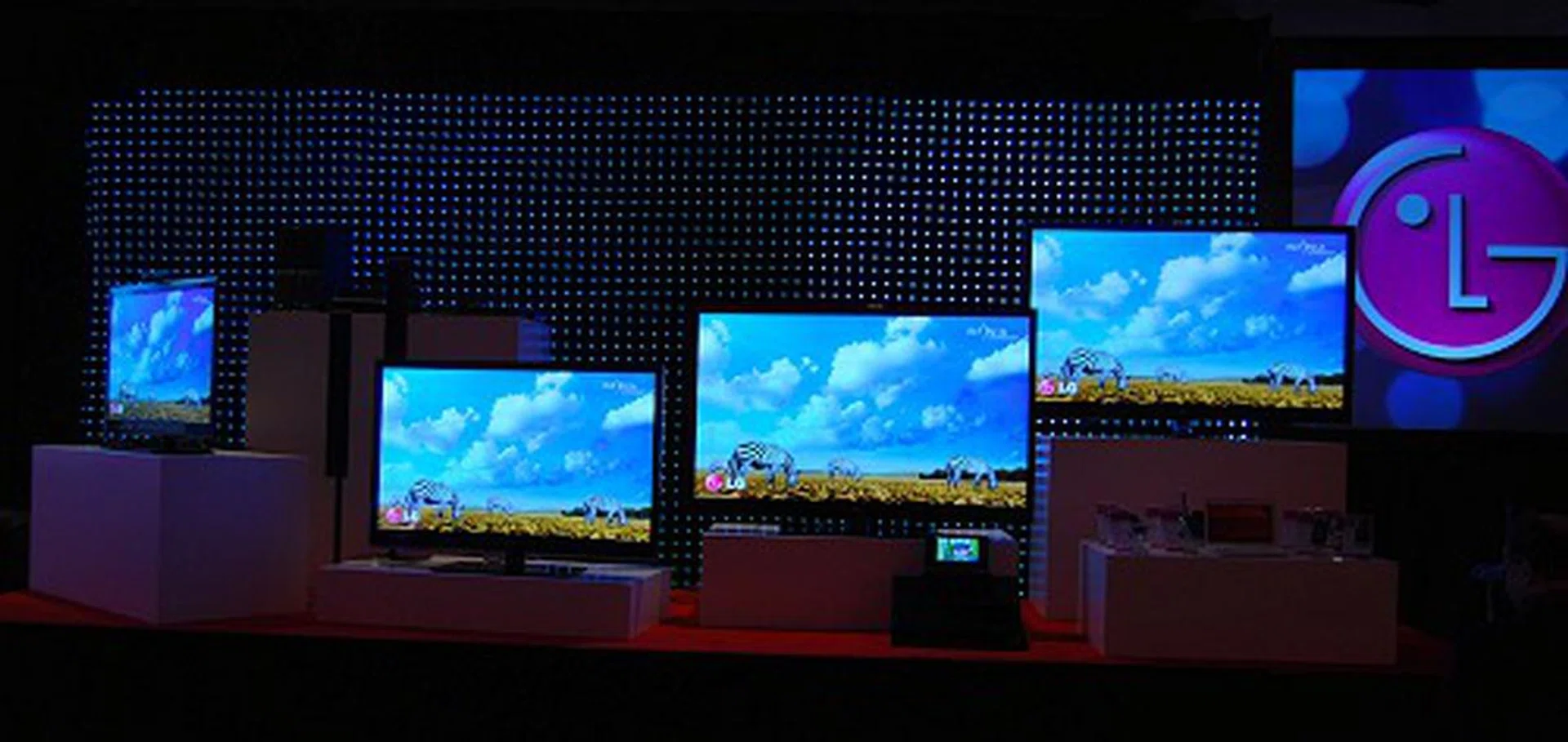
This is just a small sample of new TVs of the total 41 models that LG has in store for rollout at the moment in 2010.
New Features and Functions
With the new series of TVs, LG is introducing two new LED-backlit technologies. As coined by them, they are the Full LED Slim and LED Plus. The Full LED Slim is based on white LEDs and are is a design whereby the light source is maintained behind the LCD with a slim LED structure that supports local dimming up to 240 segments - all this while retaining the slimness conventionally seen on edge-LED lit designs. What's in it for you? Deeper black levels, and more uniform picture quality as typically expected of rear-LED lit designs with local dimming, but with a very slim chassis design. Both LE9500 and LE8500 models support the Full LED Slim technology. What's more, these two series are THX certified for their display. They include a THX Bright Room setting that optimizes contrast, gamma and other settings for watching movies under bright ambient lighting. This is in addition to the THX Cinema mode for dark room viewing of movies.

The LG LE9500 HDTV sporting the new Full LED Slim technology.
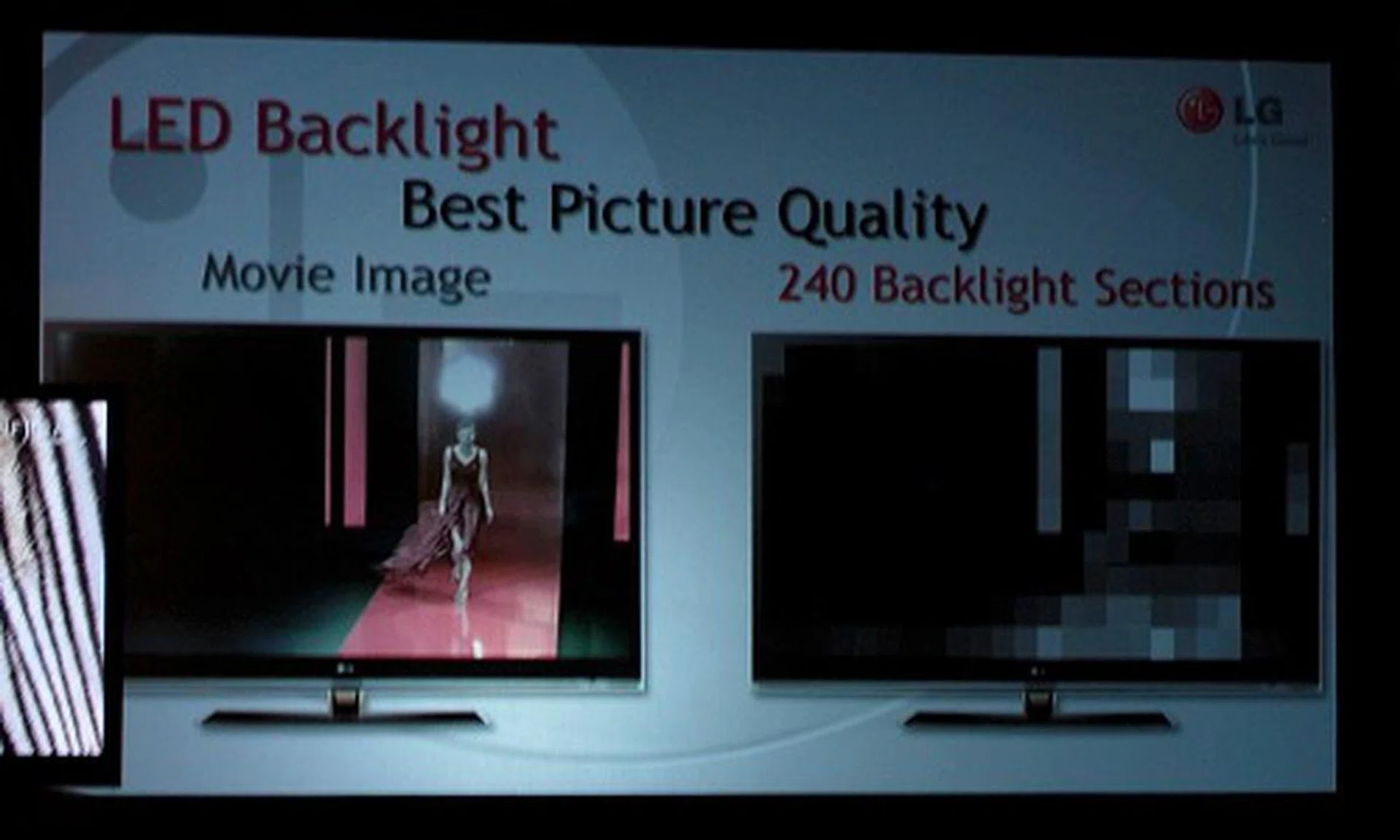
As mentioned, the Full LED Slim technology supports local dimming up to 240 segments for a 55-inch TV size.
The LED Plus technology used on the new LE7500 and LE5500 models are edge-LED lit designs but with basic local dimming of up to 16 segments, thereby improving picture quality and energy efficiency. Here's how the various new LED-backlit LCD HDTVs from LG matches up with one another:-
Features / Series | LE9500 | LE8500 | LE7500 | LE5500 | LE5400 |
Infinia design | Yes | Yes | Yes | - | - |
LED-backlit technology | Full LED Slim | Full LED Slim | LED Plus | LED Plus | LED |
TruMotion | 480Hz | 240Hz | 120Hz | 120Hz | 120Hz |
Intelligent Sensor | Yes | Yes | - | - | - |
Picture Wizard II | Yes | Yes | Yes | Yes | - |
THX Certification | Yes | Yes | - | - | - |
NetCast Entertainment Access - WiFi Ready | Yes | Yes | Yes | Yes | Yes |
Wireless HD Ready | Yes | Yes | Yes | Yes | Yes |
3D Ready TV | Yes | - | - | - | - |
Magic Wand remote | Yes | - | - | - | - |
Further focusing on the LED-backlit LED TVs, it's obvious that eventually when costs come down, CCFL based displays would slowly be discontinued in favor of the LED variants. One feature that was actually demoed in last year's CES is TruMotion 480Hz for ultra smooth video quality and eliminating any judders if at all they should occur. It's based on a combination of motion compensation as well as motion estimation and analysis. This will now be featured on the LE9500 series when it debuts soon.
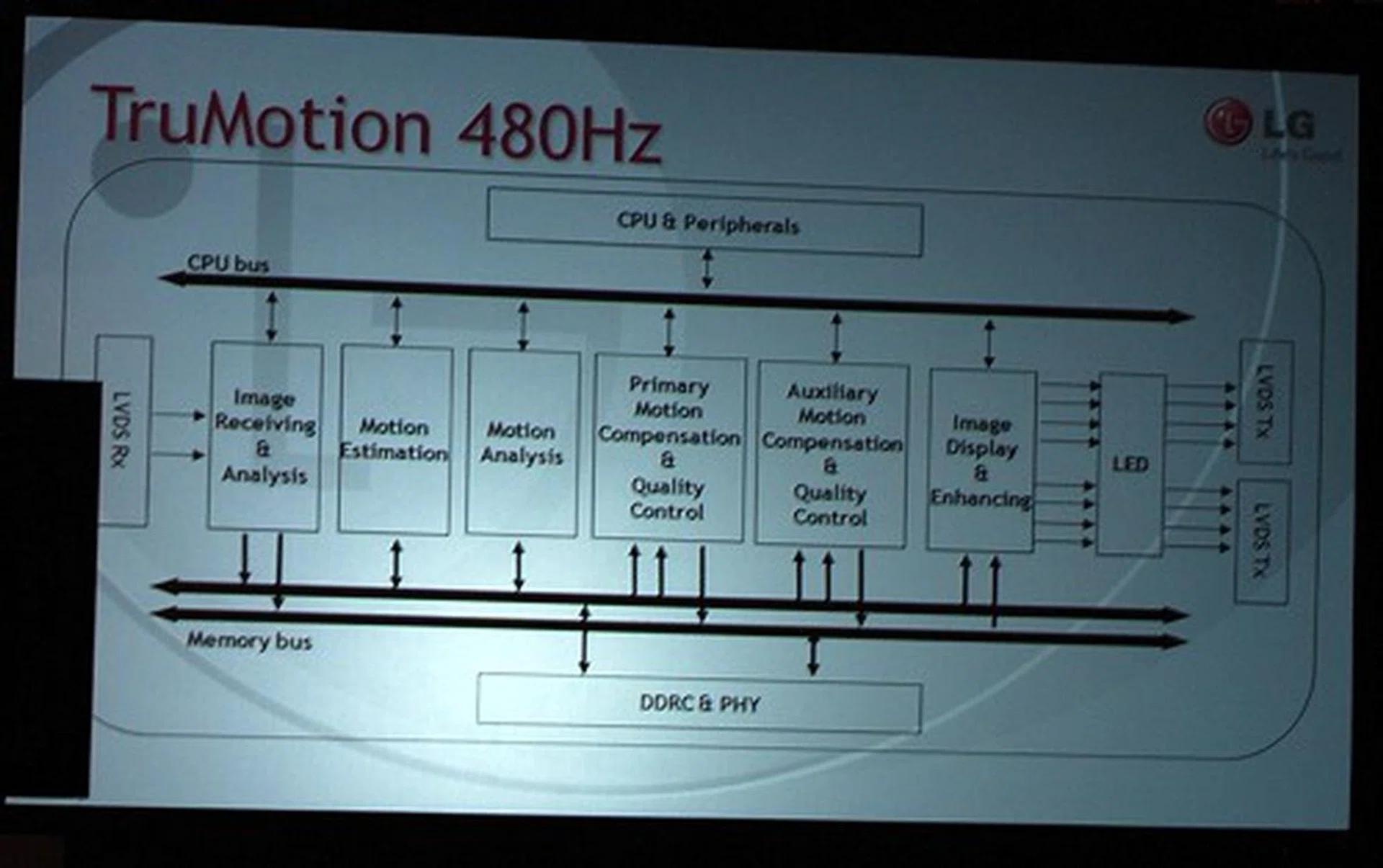
If you thought TruMotion 240Hz refresh was more than plenty, get ready for 480Hz!
Yet two more important features that are also the domain of the top-end LE9500 model is an immersive remote control called Magic Wand (somewhat reminiscent of the Lenovo A600 AIO PC's accelerometer equipped remote control) and the fact that this model will be the company's first 3D enabled TV outside of home base. The 3D-ready LE9500 series is expected to be available sometime mid of this year.
But fret not, the entire new refreshed range of LED-backlit LCD HDTVs would still have other new features such as being wireless ready (through an optional USB wireless broadband adaptor). And besides the entry-level LE5300 series, all other models will support LG's NetCast for extended entertainment and informational content. NetCast enabled TVs support streaming content from Netflix, YouTube and Napster. You can also buy or rent movie and TV content from VUDU and get informational updates via Yahoo Widgets. New to this list in 2010 is Skype functionality for video and voice calls via the internet. This function is enabled with a new optional camera add-on. As you can see, LG is making the TV as the central entertainment gateway to your home.
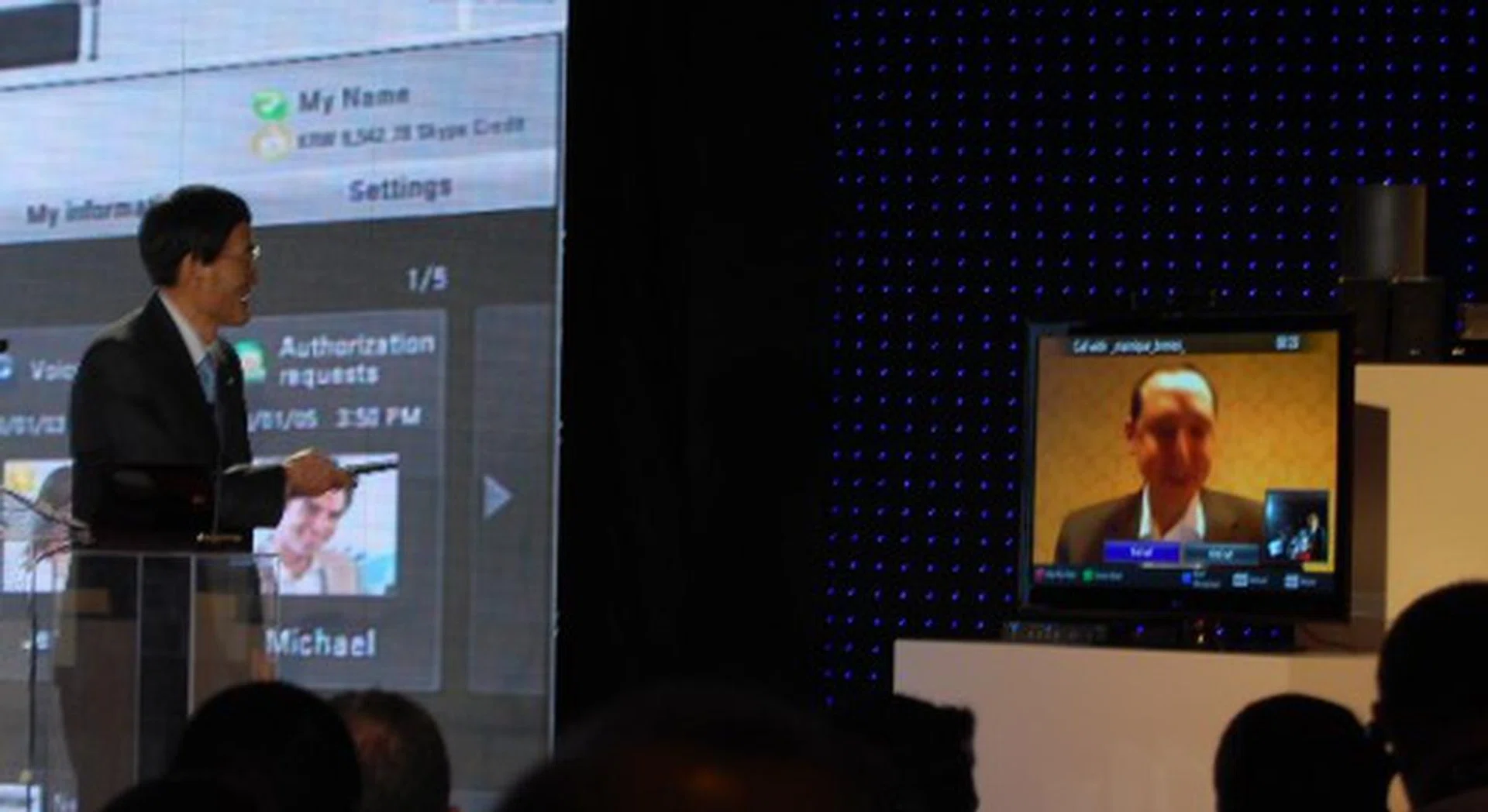
Dr.Paik having a video call with his colleague through the latest LG HDTV via the integrated Skype functionality. Looks like the number of couch potatoes is set to increase with the TV handling quite a fair bit of content and functions outsides of what's normally expected of a TV.

This is the optional Skype attachment that enabled the above scenario.
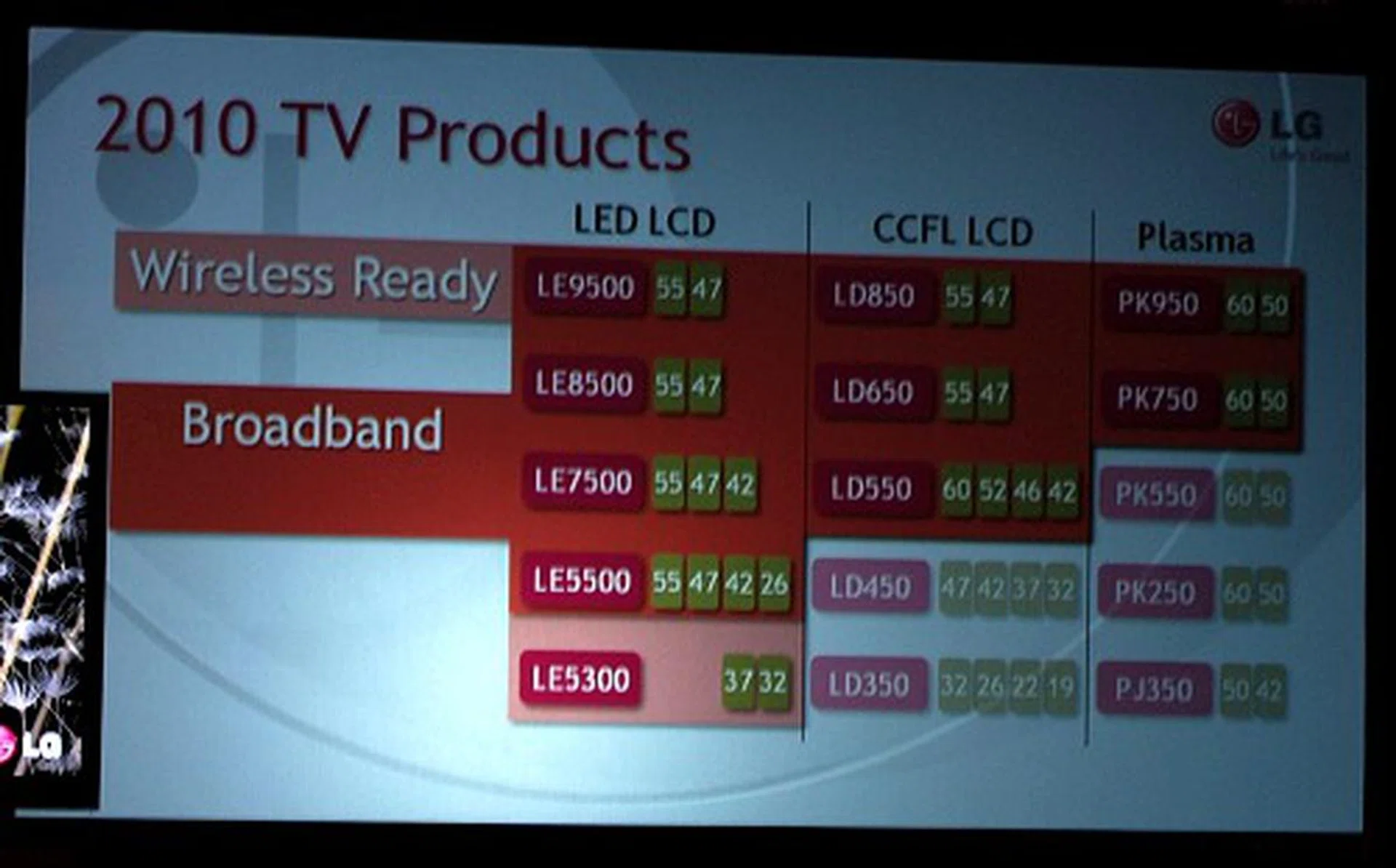
Here's how the wireless readiness and broadband functionality (through LG NetCast) is supported across the new range of TVs.
Furthering the TV's connectivity options, the full range of LED-backlit LCD HDTVs are DLNA compliant, promoting easy sharing of content from various PCs and other devices at home.
More TV Insights with the President & CTO of LG Electronics
Soon after the main LG press conference, we were privileged to have secured a quick chat session with the veteran Dr. Paik to gather more insights of where the TV industry is heading, LG's own focus and goals and his opinions. Here's a compilation of the key findings from our session with him:-

Dr. Paik eagerly exchanged views with us on LG's TV strategy as well as how the industry is evolving.
State of Availability for 3D Content Currently
- Korea already had a dedicated channel for 3D content
- ESPN in USA will be launching ESPN 3D, a sports channel broadcasting major sports events live in 3D.
- Children are already looking forward to 3D content when going for movies and they will be even more captivated to have that in their own home.
- By end of this year, Blu-ray players will be able to play 3D Blu-ray content now that the standard and storage medium exists.
- Current digital broadcast and transmissions will not have issues to accommodate 3D content when available as the data is in digital and doesn't necessarily use any more bandwidth.
- Furthermore, 3D production video recorders already exist and they just cost more; otherwise it isn't any more difficult to use. Actual production though might be more tricky / expensive since 3D is still a new element that needs time to settle down into a template to draw upon it.
Cost Penetration of 3D HDTVs
- LG is trying to keep the premium to a minimum for 3D TVs so that adoption will not be an issue.
- They will not bundle glasses as part of the TV package initially since some will not require the 3D function immediately. This suits LG since they want to keep TV costs more affordable. Additionally, it depends whether one is looking for cheaper passive glasses (about US$10) or the more eye pleasing active shutter glasses (around US$50).
- LG will work with third party suppliers for 3D glasses to ensure quality and design but without making it part of their own offering. This will give consumers more choice in fit and design, thus helping propel these items as a fashion statement of sort in future.
When will 3D HDTVs that Don't Require 3D Glasses become a Reality?
- Dr. Paik share that ideally we'll like to see things in 3D all the time.
- This is actually possible with current technology and has been demonstrated by various vendors time to time.
- The downside is loss of details, resolution and requires an ideal sweet spot to achieve the 3D effect.
- For LG, it's now important for it to be at the forefront to ensure it builds up in consumer's mind as a leading provider of 3D TVs using existing acceptable technology.
- Probably in 5 years, we can have true 3D TV without the need for glasses. There's always a tradeoff in resolution for either how wide u need the sweet spot to be or how effective the 3D content should be without glasses. So it really depends on the progress in this space.
- While 3D content is key to the acceptance of 3D going mainstream, the TV itself might be picking up in interest by the average consumer from next year. Eventually every new TV set would be 3D capable and it will be a natural buying process to opt for a TV with this technology.
What is the Status of OLED TVs and What can we expect of it?
- OLED TVs is a very important leap in TV technology. Currently LG has the largest commercially available screen size at 15 inches.
- They posses low power consumption, fast response time and better image quality than current LCD and Plasma panels.
- Their only downside now is the manufacturing issue, lifetime of the panel and high cost.
- But whether OLED takes off depends on how much LCD tech progresses. If LCD continues to progress further, and at lower costs, then OLED might have a hard time to take off. If LCD tech tapers off, then future refinements to OLED will bring its technology down to the masses.
- Plasma still has its niches:- it's better at low lighting condition,. cheaper in larger sizes, does not depend on a light source, achieves better viewing angles with high contrast and brightness. Plasma's growth is generally flat, which means there's a group who still know what they want. For LG, this space is actually growing.
- LCD is a better choice with when more ambient light is present but the image is already heavily processed and it requiers backlighting. LCD display can also have wide viewing angels but it might have to trade off for contrast/brightness ratings to achieve it usually.
- OLED has the best of both worlds, but will only be a valid choice when it's affordable.
- All three TV types are compatible for 3D. However plasma displays only work with active shutter glasses.
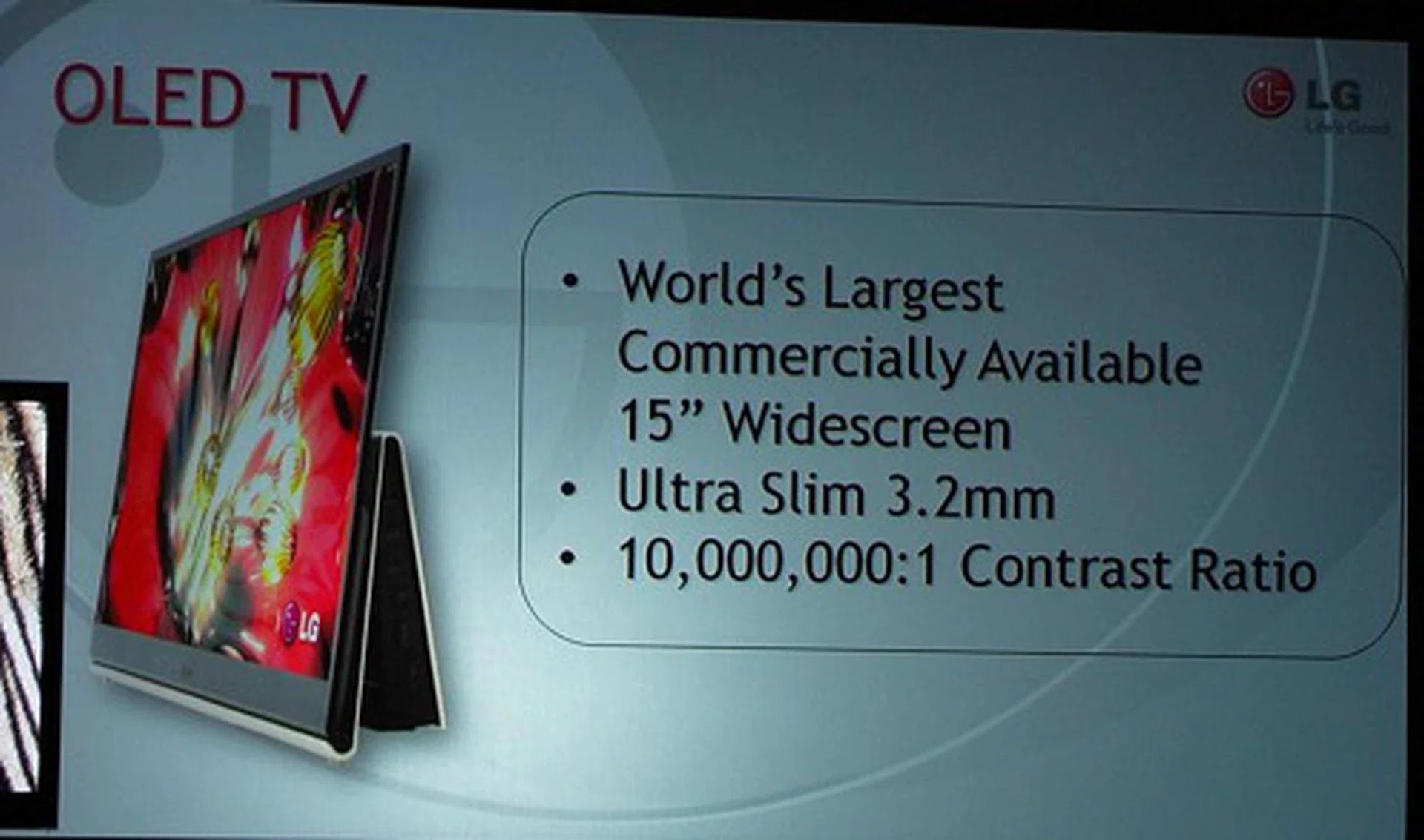
LG has now snatched the flag on the largest OLED TV screen commercially available. OLED is however only of critical importance to consumers when prices come down and sizes go up.
What are the Key Design Considerations Important for any TV Today?
- Top concerns are image quality, design of the TV and Bezel size.
- Now LG has actively supplying broadband connectivity for its new range of TVs by providing online movie content access via either an Ethernet port at the back or through wireless networking dongle support.
- To put all of these new areas to use effectively will require an easy to use interface for this to take off for light web surfing, emails and many other infotainment services that the 2010 series of LG TVs will support.
What about TVs capable of running a Windows OS for full PC Functionality?
- This was attempted previously but it was a failed project.
- Difficulties included long development time frame, expensive implementation due to cost of parts.
- It was also not speedy enough nor effectively used.
- Instead, they are approaching to equip TVs with certain computer-like functionality from highly integrated hardware, customized user interface and at a much lower premium.
- Thus the latest LG TVs are able to have entertainment services through NetCast, among other functions added currently over conventional TVs.
Our articles may contain affiliate links. If you buy through these links, we may earn a small commission.